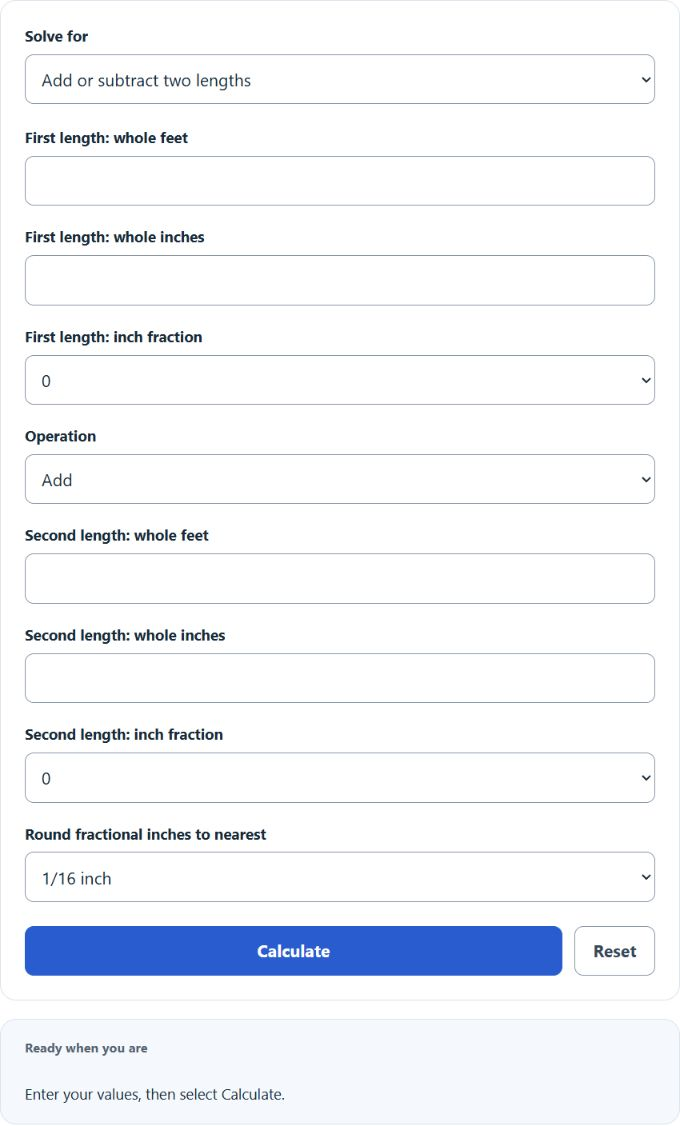
Calculate, add, subtract, and convert feet and inches with fractions, decimals, and metric units in seconds.
- All Unit Converters
- Remainder Calculator
- Feet to Inches Calculator (ft to in) – Convert Instantly
- mm to Inches Calculator + Conversion Chart & Formula
Feet and Inches Formula
Every mode first converts measurements into total inches and performs the selected arithmetic. For the fractional display, round the absolute total to whole ticks of 1/d inch, split those ticks into feet, whole inches and a reduced fraction, then apply the overall sign. Exact half-tick ties round away from zero; a rounded zero has no minus sign. Decimal and metric outputs use the unrounded total. The core conversions are:
Adding or subtracting two lengths:
Multiplying or dividing a single length by a number n:
Converting a decimal or metric length into total inches with a unit factor k (inches per unit):
- T = total length expressed in inches
- F = nonnegative whole feet for a mixed input, or whole feet in the rounded absolute result
- I = the whole number of inches (0 to 11)
- r = the fractional part of an inch, such as 0.5 for 1/2 inch
- T1, T2 = the first and second lengths converted to total inches
- n = the multiplier or divisor for scaling a length
- L = a length entered as a decimal or metric value
- k = inches per unit (for example 1 for inches, 12 for feet, 0.3937 for centimeters)
The "Add or subtract two lengths" mode converts both lengths to inches and combines them. The "Multiply or divide a length" mode scales one length by a number, which is useful for spacing or repeated cuts. The "Convert feet and inches" mode turns a feet and inches value into decimal feet, decimal inches, and metric units. The "Convert decimal or metric length" mode does the reverse, turning a single value into clean feet and inches rounded to your chosen fraction.
Inch Fraction and Unit Reference
The calculator rounds fractional inches to the nearest fraction you select. Use the table below to read the decimal value of each common sixteenth of an inch.
| Fraction | Decimal inch | Fraction | Decimal inch |
|---|---|---|---|
| 1/16 | 0.0625 | 9/16 | 0.5625 |
| 1/8 | 0.125 | 5/8 | 0.625 |
| 3/16 | 0.1875 | 11/16 | 0.6875 |
| 1/4 | 0.25 | 3/4 | 0.75 |
| 5/16 | 0.3125 | 13/16 | 0.8125 |
| 3/8 | 0.375 | 7/8 | 0.875 |
| 7/16 | 0.4375 | 15/16 | 0.9375 |
| 1/2 | 0.5 | 1 | 1.0 |
The table gives rounded decimal factors for reference. The calculator uses exact definitions: 1 ft = 12 in and 1 in = 25.4 mm. See NIST length definitions. For a metric input, divide millimeters by 25.4, centimeters by 2.54 or meters by 0.0254; do not round a conversion factor before calculating.
| Unit | Inches per unit (k) |
|---|---|
| Foot | 12 |
| Yard | 36 |
| Millimeter | 0.03937 |
| Centimeter | 0.3937 |
| Meter | 39.3701 |
Example Problems
Example 1: Adding two lengths. Add 5 ft 8 1/2 in and 2 ft 9 3/4 in. Convert each to inches: the first is (5 * 12) + 8 + 0.5 = 68.5 inches, and the second is (2 * 12) + 9 + 0.75 = 33.75 inches. The total is 68.5 + 33.75 = 102.25 inches. Convert back: floor(102.25 / 12) = 8 feet, and 102.25 - 96 = 6.25 inches. The answer is 8 ft 6 1/4 in.
Example 2: Converting a metric length. Convert 1.75 meters to feet and inches. Total inches = 1.75 / 0.0254 ≈ 68.8976378 inches. The remaining 8.8976378 inches rounds to 8 7/8 inches at the nearest 1/16 inch, giving about 5 ft 8 7/8 in. Keep the unrounded total for decimal and metric outputs.
Frequently Asked Questions
How many inches are in a foot? There are exactly 12 inches in 1 foot. That is why converting to total inches uses a factor of 12, and why the answer wraps back into feet whenever the inch total reaches 12.
How do you add feet and inches together? Convert each measurement to total inches, add the inch totals, then convert the sum back to feet and inches. Working in a single unit avoids mistakes when the inches add up to more than 12.
How do you turn a decimal foot into inches? Multiply the decimal part of the foot value by 12. For example, 0.75 feet equals 0.75 * 12 = 9 inches, so 3.75 feet is 3 ft 9 in.