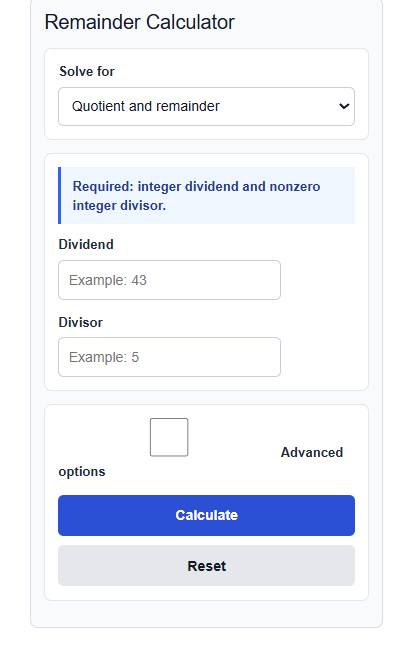
Calculate the remainder from a dividend and a divisor, and use the same division relationship to solve for the dividend, divisor, or remainder when one piece is missing.
Remainder Formula
Every whole-number division follows one relationship, called the division algorithm. Once you know any three of the four values, you can find the fourth.
a = b * q + r
Rearranged to solve directly for the remainder:
r = a - b * q
For standard (Euclidean) division the remainder is also constrained so it is never negative and never reaches the size of the divisor:
0 <= r < |b|
- a = dividend, the number being divided
- b = divisor, the number you divide by (cannot be zero)
- q = quotient, how many whole times the divisor fits into the dividend
- r = remainder, the amount left over after the whole quotient is removed
In the default "Quotient and remainder" mode you enter the dividend and divisor, and the calculator returns the integer quotient and remainder along with the exact fraction, mixed number, and decimal forms of the answer. The "Dividend" mode rebuilds the dividend from a divisor, quotient, and remainder using a = b * q + r. The "Divisor" mode solves b = (a - r) / q, which only returns a clean answer when those values produce a whole number. The "Remainder" mode applies r = a - b * q for a quotient you choose yourself. The advanced options let you pick how negative numbers are handled, since the quotient and remainder of a negative dividend depend on which convention you use.
Remainders for Small Divisors
The remainder of a division can only take a limited set of values: it always runs from 0 up to one less than the divisor. The table shows the possible remainders for common divisors and what a remainder of 0 tells you.
| Divisor | Possible remainders | Remainder of 0 means |
|---|---|---|
| 2 | 0, 1 | The number is even |
| 3 | 0, 1, 2 | Divisible by 3 |
| 5 | 0, 1, 2, 3, 4 | Ends in 0 or 5 |
| 10 | 0 through 9 | Ends in 0 |
The next table shows how the same division (43 divided by 5) appears in each output form the calculator reports.
| Output form | Result |
|---|---|
| Quotient and remainder | 8 remainder 3 |
| Exact fraction | 43/5 |
| Mixed number | 8 3/5 |
| Decimal | 8.6 |
Example Problems
Example 1: Find the remainder. Divide 43 by 5. The largest whole multiple of 5 that does not pass 43 is 5 * 8 = 40, so the quotient is 8. Subtract to get the remainder: 43 - 40 = 3. Written out, 43 = 5 * 8 + 3, so the remainder is 3.
Example 2: Find the dividend. A division has a divisor of 7, a quotient of 6, and a remainder of 4. Use a = b * q + r: a = 7 * 6 + 4 = 42 + 4 = 46. The dividend is 46, and you can check it because 46 divided by 7 is 6 remainder 4.
Frequently Asked Questions
What is a remainder? A remainder is the whole-number amount left over when one integer does not divide evenly into another. After you remove the largest whole number of divisors from the dividend, whatever is left and smaller than the divisor is the remainder. If the divisor fits perfectly, the remainder is 0 and the numbers divide evenly.
How is a remainder different from a decimal answer? They describe the same division in two ways. The remainder keeps the leftover as a whole number tied to the divisor, so 43 divided by 5 is 8 remainder 3. The decimal continues the division past the whole part, giving 8.6. The remainder form is used in long division and modular arithmetic, while the decimal form is used when you need a single numeric value.
Can the remainder be negative? Under standard Euclidean division the remainder is always 0 or positive and smaller than the size of the divisor. When the dividend is negative, the result depends on the convention you choose, which is why the advanced options offer truncated, floor, Euclidean, and least-absolute-remainder modes. These can report different signed remainders for the same numbers, so pick the one that matches the rule you are using.