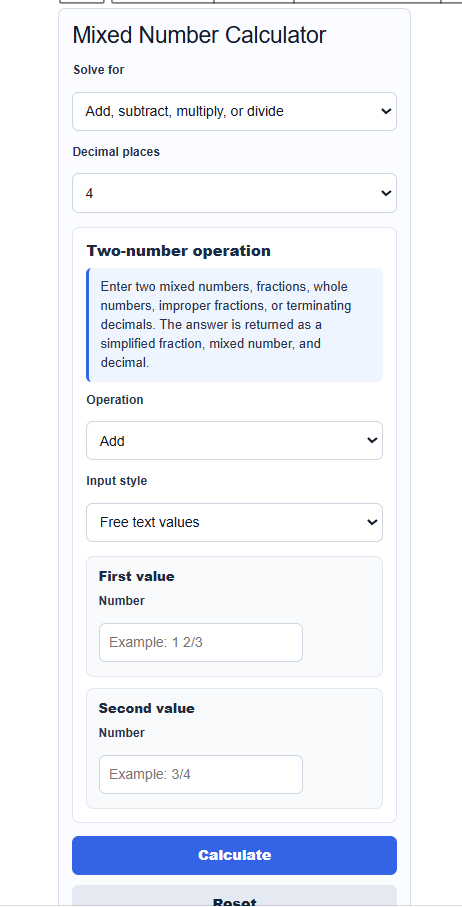
Add, subtract, multiply, divide, simplify, or convert mixed numbers with exact improper fractions, decimal results, common denominators, and clear steps.
Mixed Number Formula
Every operation starts by converting each mixed number into an improper fraction so the numerators and denominators can be worked with directly.
improper = (whole * denominator + numerator) / denominator
Once both values are improper fractions written as a/b and c/d, the four operations use these formulas.
a/b + c/d = (a*d + b*c) / (b*d)
a/b - c/d = (a*d - b*c) / (b*d)
a/b * c/d = (a*c) / (b*d)
a/b / c/d = (a*d) / (b*c)
The result is then reduced by dividing the numerator and denominator by their greatest common divisor, and written back as a mixed number when the numerator is larger than the denominator.
- whole: the whole-number part of a mixed number, such as the 2 in 2 3/4
- numerator: the top number of the fraction part
- denominator: the bottom number of the fraction part, which cannot be zero
- a, b: the numerator and denominator of the first value after converting to an improper fraction
- c, d: the numerator and denominator of the second value after converting to an improper fraction
The operation mode applies the add, subtract, multiply, or divide formula to two inputs. The convert mode applies the improper fraction formula in either direction, turning a mixed number into an improper fraction or an improper fraction back into a mixed number. The simplify mode reduces a single fraction to lowest terms using the greatest common divisor. The decimal mode reads the place value of a decimal to write it as a fraction, for example 0.75 as 75/100, then reduces it to 3/4.
Reducing Fractions to Lowest Terms
An answer is in lowest terms when the numerator and denominator share no common factor other than 1. The table shows common unreduced results and their reduced form.
| Fraction | Greatest common divisor | Lowest terms |
|---|---|---|
| 2/4 | 2 | 1/2 |
| 6/8 | 2 | 3/4 |
| 9/12 | 3 | 3/4 |
| 10/15 | 5 | 2/3 |
| 86/24 | 2 | 43/12 |
The next table lists common decimals and the fraction each one reduces to, which is what the decimal mode produces.
| Decimal | Fraction |
|---|---|
| 0.25 | 1/4 |
| 0.5 | 1/2 |
| 0.75 | 3/4 |
| 0.2 | 1/5 |
| 0.125 | 1/8 |
| 3.4166... | 3 5/12 |
Example Problems
Example 1: Add 1 2/3 and 3/4. Convert 1 2/3 to 5/3. Using a/b + c/d = (a*d + b*c) / (b*d) with 5/3 and 3/4 gives (5*4 + 3*3) / (3*4) = (20 + 9) / 12 = 29/12. Since 29 is larger than 12, write it as the mixed number 2 5/12.
Example 2: Divide 2 1/2 by 1/4. Convert 2 1/2 to 5/2. Using a/b / c/d = (a*d) / (b*c) with 5/2 and 1/4 gives (5*4) / (2*1) = 20/2 = 10. The answer is the whole number 10.
Frequently Asked Questions
What is a mixed number? A mixed number is a whole number written together with a proper fraction, such as 2 3/4. It represents the whole number plus the fraction, so 2 3/4 equals 2 plus 3/4. Any mixed number can be rewritten as an improper fraction, where the numerator is larger than the denominator, and the calculator moves between these two forms in convert mode.
Do I need a common denominator? You need a common denominator only for addition and subtraction, because you can only add or subtract fractions that describe parts of the same size. Multiplication and division do not require one. The formulas above handle the common denominator automatically by multiplying the two denominators together, which is why the result often needs reducing afterward.
How does the calculator handle negative mixed numbers? Enter the negative sign on the whole-number part, such as -2 5/8, and the whole value is treated as negative. The sign carries through each operation using the same formulas, and the final answer is shown with its correct sign and reduced to lowest terms.