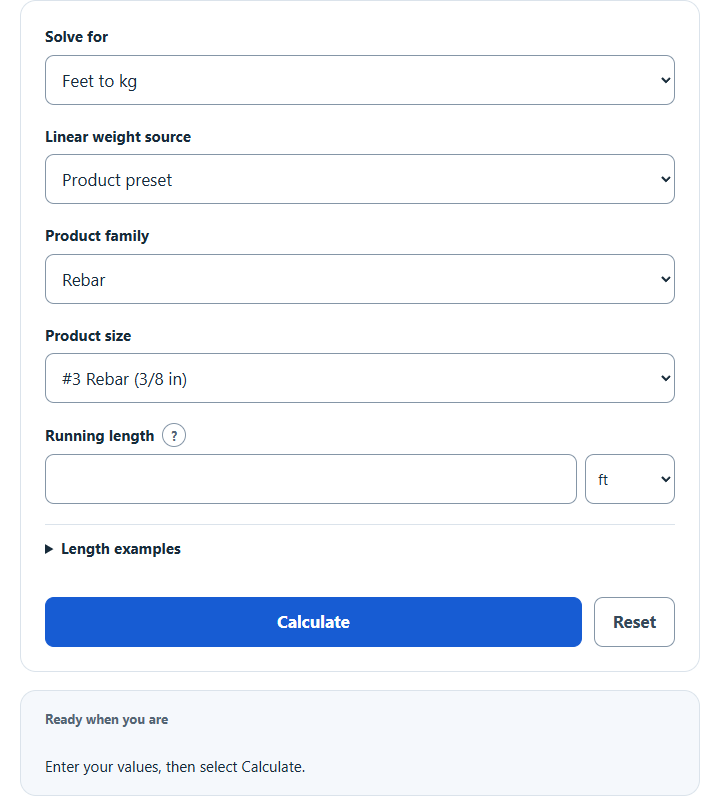
Convert feet to kg for rebar, steel pipe or wire rope by size, or kg to feet, using typical weight per foot or your own linear weight.
- All Unit Converters
- Cubic Feet to Pounds Calculator
- Feet Per Pound Calculator
- kg to Length Calculator
- Weight to Length Calculator
- Dimension to Weight Calculator
- Inch to Kg Calculator
Calculator Functions
| Function | What it does | What it requires |
|---|---|---|
| Feet to kg | Finds the mass in kilograms of a length of rebar, steel pipe, wire rope or any product with a known weight per foot | Requires a product preset and size, or a custom linear weight (kg/ft, lb/ft or kg/m), plus the running length (ft or m) |
| Kg to feet | Finds the length in feet that a mass of the same product makes up | Requires a product preset and size, or a custom linear weight, plus the mass (kg or lb) |
| Weight per foot from length and mass | Finds the linear mass of a piece from its measured length and mass | Requires the running length (ft or m), the mass (kg or lb) and the result unit (kg/ft, lb/ft or kg/m) |
| Square feet to kg | Finds the mass of a sheet, tile or fabric from its area | Requires the area (ft² or m²) and the mass per area (kg/m², lb/ft² or g/m²) |
Feet measure length and kilograms measure mass, so every function needs a weight per foot or per square foot to link the two. The presets are rebar sizes #3 to #11, Schedule 40 steel pipe from 1/2 in to 10 in, and 6×19 fiber core wire rope from 1/4 in to 1 in. Results also show pounds, meters, the linear mass in kg/ft, kg/m and lb/ft, and the feet per kilogram. Optional example lengths (1, 10, 20 and 100 ft) and masses (1, 10, 50 and 100 kg) fill the field in one step.
Feet To kg Formulas
| m | Mass (kg) |
| L | Running length (ft) |
| w | Linear mass (kg/ft) |
A preset stores the product’s weight in pounds per foot, and the calculator multiplies it by 0.45359237 to get kg/ft [4]. A length in meters is divided by 0.3048 first [4].
Feet to kg
The main formula as written. #4 rebar weighs 0.668 lb/ft [1], which is 0.303 kg/ft, so a 20 ft bar is 6.06 kg. The same length gives a different mass for every product, which is why 1 ft, 20 ft or 100 ft has no single answer in kilograms.
| Rebar size | lb per ft | kg per ft | kg per 20 ft | kg per 100 ft |
|---|---|---|---|---|
| #3 (3/8 in) | 0.376 | 0.171 | 3.41 | 17.1 |
| #4 (1/2 in) | 0.668 | 0.303 | 6.06 | 30.3 |
| #5 (5/8 in) | 1.043 | 0.473 | 9.46 | 47.3 |
| #6 (3/4 in) | 1.502 | 0.681 | 13.63 | 68.1 |
| #7 (7/8 in) | 2.044 | 0.927 | 18.54 | 92.7 |
| #8 (1 in) | 2.67 | 1.211 | 24.22 | 121.1 |
| #9 (1-1/8 in) | 3.4 | 1.542 | 30.84 | 154.2 |
| #10 (1-1/4 in) | 4.303 | 1.952 | 39.04 | 195.2 |
| #11 (1-3/8 in) | 5.313 | 2.410 | 48.20 | 241.0 |
Rebar figures are the nominal weights in ASTM A615 [1].
| Schedule 40 pipe | lb per ft | kg per ft | kg per 20 ft | kg per 100 ft |
|---|---|---|---|---|
| 1/2 in | 0.85 | 0.386 | 7.71 | 38.6 |
| 3/4 in | 1.13 | 0.513 | 10.25 | 51.3 |
| 1 in | 1.68 | 0.762 | 15.24 | 76.2 |
| 1-1/4 in | 2.27 | 1.030 | 20.59 | 103.0 |
| 1-1/2 in | 2.72 | 1.234 | 24.68 | 123.4 |
| 2 in | 3.66 | 1.660 | 33.20 | 166.0 |
| 2-1/2 in | 5.8 | 2.631 | 52.62 | 263.1 |
| 3 in | 7.58 | 3.438 | 68.76 | 343.8 |
| 4 in | 10.8 | 4.899 | 97.98 | 489.9 |
| 6 in | 18.99 | 8.614 | 172.27 | 861.4 |
| 8 in | 28.58 | 12.964 | 259.27 | 1296.4 |
| 10 in | 40.52 | 18.380 | 367.59 | 1838.0 |
Pipe figures are for dry, plain-end Schedule 40 steel pipe by nominal size [2].
| 6×19 wire rope | lb per ft | kg per ft | kg per 20 ft | kg per 100 ft |
|---|---|---|---|---|
| 1/4 in | 0.1 | 0.045 | 0.91 | 4.5 |
| 3/8 in | 0.23 | 0.104 | 2.09 | 10.4 |
| 1/2 in | 0.4 | 0.181 | 3.63 | 18.1 |
| 5/8 in | 0.63 | 0.286 | 5.72 | 28.6 |
| 3/4 in | 0.9 | 0.408 | 8.16 | 40.8 |
| 7/8 in | 1.23 | 0.558 | 11.16 | 55.8 |
| 1 in | 1.6 | 0.726 | 14.51 | 72.6 |
Wire rope figures are for 6×19 class rope with a fiber core [3].
Kg to feet
The main formula solved for length. 50 kg of #4 rebar is 50 ÷ 0.303 = 165.02 ft. A mass in pounds is converted to kilograms first.
Weight per foot from length and mass
Weighing a measured piece gives the linear mass for a product that is not in the presets. A 10 ft piece that weighs 5 kg is 0.5 kg/ft, which is 1.6404 kg/m. That figure can then go into Feet to kg as a custom linear weight.
Square feet to kg
A is the area and ρA the mass per area, both converted to metric: 1 ft² is 0.09290304 m² [4] and 1 g/m² (GSM) is 0.001 kg/m². 100 ft² of a sheet that weighs 2 lb/ft² is 200 lb, or 90.718 kg, and 100 ft² of 300 GSM fabric is 2.787 kg. Cubic feet are a volume and need a density instead: the Cubic Feet to Pounds Calculator handles that and also reports kilograms.
Height in Feet to kg
A height in feet and inches does not convert to a body weight in kilograms, because people of the same height weigh different amounts. The Ideal Weight Calculator gives height-based reference weights.
Limits of This Estimate
- Preset weights are nominal. Mill tolerances, coatings, threads, couplings, fittings and anything inside a pipe change the real mass, so a supplier’s figure for the exact product is better where it matters.
- The wire rope presets are for a fiber core. The same rope with a steel core is about 10% heavier, 0.44 lb/ft against 0.40 lb/ft at 1/2 in [3], and other constructions differ again.
- A material name or thickness alone is not a weight per square foot. Square feet to kg needs the supplier’s mass per area.
- The result is a material mass. It says nothing about how much load a bar, pipe or rope can carry.
Sources
- ASTM A615/A615M, Standard Specification for Deformed and Plain Carbon-Steel Bars for Concrete Reinforcement, Table 1: nominal weight per foot of bar sizes #3 to #11
- Botop Steel, Schedule 40 for Plain-End Pipe (data from ASME B36.10): plain-end weight per foot of Schedule 40 pipe from ASME B36.10
- Unirope, Class 6×19 IWRC and Fiber Core: weight per foot of 6×19 fiber core wire rope, and of the heavier steel core rope
- NIST, Guide for the Use of the International System of Units (SP 811), Appendix B.8: the pound as 0.4535924 kg, the foot as 0.3048 m and the square foot as 0.09290304 m²