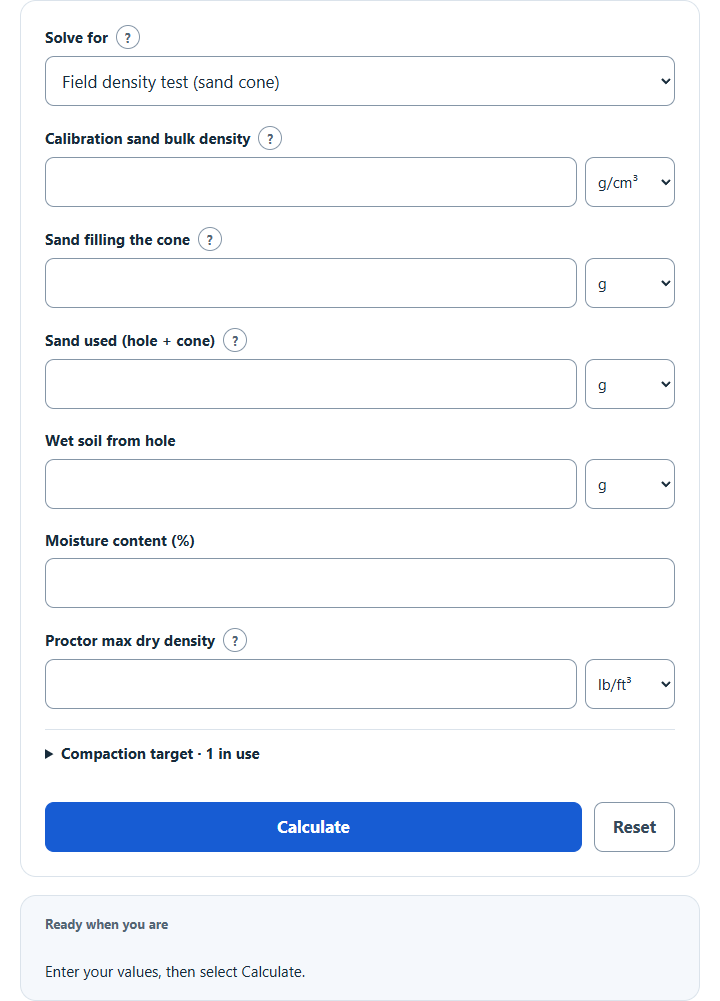
Calculate field density test results (dry density and percent compaction) from sand cone data, or convert wet density to dry density with moisture.
- All Construction Calculators
- Moisture Content Calculator
- Saturated Unit Weight Of Soil Calculator
- DCP to CBR Calculator
Field Density Test Formula
Variables:
- FDT is the Field Density Test (pcf)
- WD is the wet density (pcf)
- MC is the moisture content (pcf)
To calculate the Field Density Test, subtract the moisture content from the wet density.
How to Calculate Field Density Test?
The following steps outline how to calculate the Field Density Test.
- First, determine the wet density (pcf).
- Next, determine the moisture content (pcf).
- Next, gather the formula from above = FDT = WD – MC.
- Finally, calculate the Field Density Test.
- After inserting the variables and calculating the result, check your answer with the calculator above.
Example Problem :
Use the following variables as an example problem to test your knowledge.
wet density (pcf) = 1020
moisture content (pcf) = 102
FAQs
What is Wet Density in the context of soil testing?
Wet density of soil refers to the mass of soil per unit volume including the water content within the soil. It is measured in pounds per cubic foot (pcf) and is a crucial parameter in geotechnical engineering for determining soil compaction and strength.
Why is Moisture Content important in Field Density Tests?
Moisture content is significant because it affects the soil’s density and strength. Understanding the moisture content helps in assessing the compaction level of the soil in the field. It’s measured in pcf and is subtracted from wet density to calculate the Field Density Test result.
How does the Field Density Test contribute to construction projects?
The Field Density Test is essential in construction as it helps determine the soil’s compaction level. Proper soil compaction ensures stability and support for structures, preventing settlement and foundation issues. It’s a critical step in ensuring the safety and longevity of construction projects.
Can the Field Density Test formula be used for all types of soil?
While the basic principle of the Field Density Test, represented by the formula FDT = WD – MC, applies broadly, different soil types may require specific considerations or additional testing methods to accurately assess their compaction and moisture content characteristics.