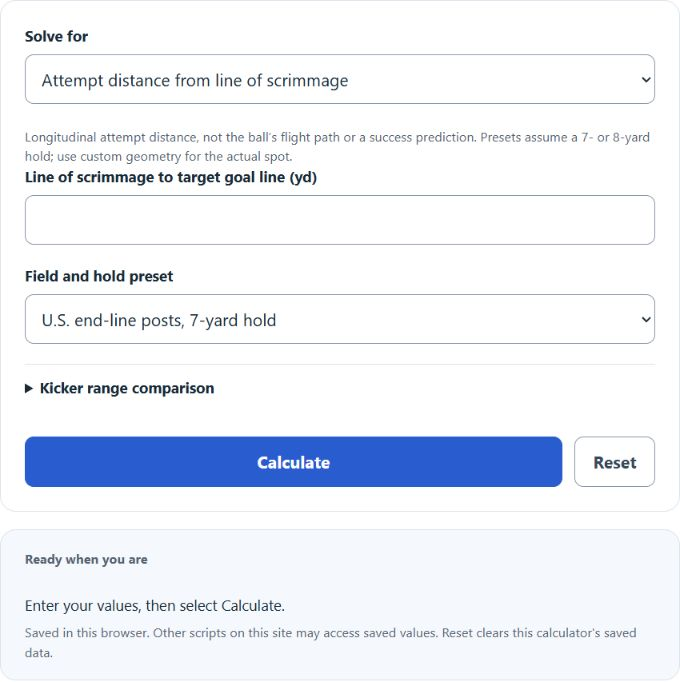
Enter the distance from the scrimmage line to the goal line (yds) into the Field Goal Distance Calculator. The calculator will evaluate and display the Field Goal Distance. 

Field Goal Distance Calculator

Standard calculation adds 17 yards for the end zone and snap.

Ball spot
Yards to goal
Needed spot
yards
yards
Field goal attempt
Show calculation ▾
Copy result

Field Goal Distance Formula

FG Distance = Yards to Goal Line + 10 + 7
  • FG Distance — total yards of the kick, holder spot to crossbar
  • Yards to Goal Line — distance from the line of scrimmage to the goal line
  • 10 — depth of the end zone (goal line to goal post)
  • 7 — distance from line of scrimmage back to the holder

If you know the ball spot on an opponent’s yard line, that number equals yards to the goal line. If the ball is on your own yard line, use 100 minus that yard line. To work backwards from a kicker’s range, subtract 17 from the range to get how close to the goal line the offense must reach.

Reference Tables

Field goal distance for common ball spots, assuming a 7-yard snap and 10-yard end zone:

Ball Spot Yards to Goal FG Distance
Opp. 2219 yds
Opp. 101027 yds
Opp. 202037 yds
Opp. 303047 yds
Opp. 333350 yds
Opp. 404057 yds
505067 yds

How to read the result:

Distance Difficulty
Under 20 ydsChip shot, near-automatic
20–39 ydsRoutine for NFL kickers (~95%)
40–49 ydsCommon long attempt (~80%)
50–59 ydsLong; success rate drops sharply (~65%)
60–66 ydsNear record range
67+ ydsBeyond NFL record (Tucker, 66 yds)

Example

Problem: The ball is on the opponent’s 28-yard line. How long is the field goal?

Solution: 28 + 10 + 7 = 45 yards.

Why add 17? The goal posts sit at the back of the 10-yard end zone, and the holder spots the ball 7 yards behind the line of scrimmage. Both add to the kick.

College and high school? The end zone and snap depth are the same, so the 17-yard rule applies. The only differences are hash mark width and goal post width, which affect angle, not distance.