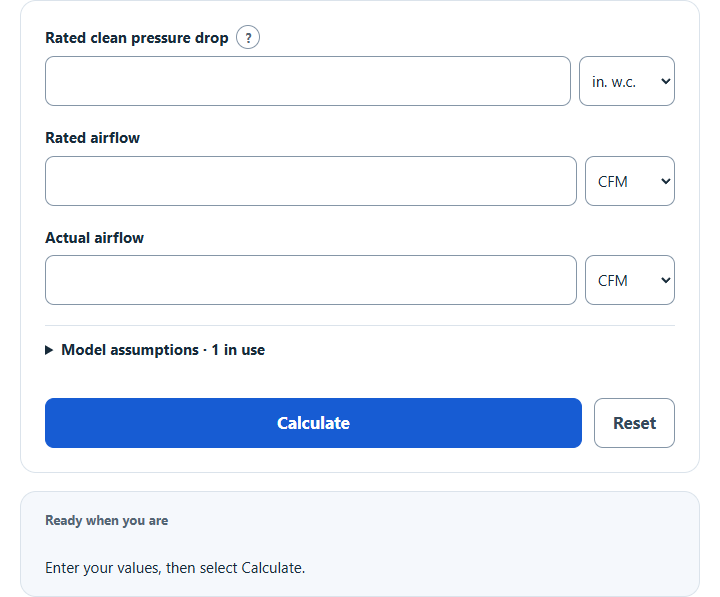
Calculate filter pressure drop at your actual airflow by scaling the rated clean pressure drop and airflow, with an optional dirty-filter multiplier.
Related Calculators
- Haaland Equation Calculator
- Air Friction Calculator
- Choked Mass Flow Rate Calculator
- Wet Bulb Calculator
- All Physics Calculators
Calculator Functions
| Function | What it does | What it requires |
|---|---|---|
| Pressure drop | Estimates the pressure drop of an air filter at an actual airflow from one rated point | Requires the rated clean pressure drop, the rated airflow and the actual airflow; the flow exponent and the loading multiplier are optional |
Pressure drop is entered in in. w.c., Pa or mm H₂O, and airflow in CFM, m³/h or L/s. The answer is in the unit of the rated pressure drop, with the value in pascals, the clean-filter figure, the airflow ratio and the resistance added by the loading multiplier listed under it.
Filter Pressure Drop Formulas
| ΔP | Estimated pressure drop at the actual airflow |
| ΔPr | Rated clean pressure drop from the filter label or data sheet |
| Q | Actual airflow |
| Qr | Rated airflow that goes with the rated pressure drop |
| n | Flow exponent, 2 unless changed [1] |
| M | Loading multiplier, 1 for a clean filter |
The default exponent of 2 follows the usual treatment of HVAC components, where static pressure drop is proportional to the square of the airflow. Some installations are fitted with a different, measured exponent [1], and the exponent field takes that value when the filter’s data supports one.
A filter rated 0.25 in. w.c. at 1,200 CFM and run at 900 CFM gives 0.25 × (900 ÷ 1,200)² = 0.1406 in. w.c. clean. A loading multiplier of 1.5 raises that to 0.2109 in. w.c., which is 52.54 Pa.
Both airflows are converted to m³/s before the ratio is taken, so the rated and actual airflow can be in different units. 1 in. w.c. is 249.08891 Pa, 1 mm H₂O is 9.80665 Pa and 1 CFM is 0.0004719474 m³/s [2].
Limits of This Estimate
- The estimate scales one rated point for the same filter, size and air conditions. When the manufacturer’s curve gives the pressure drop at the operating airflow, read that value from the curve.
- An exponent of 2 is an assumption, not a property of every filter [1].
- The loading multiplier is an assumed factor for a dirty filter and does not predict how fast dust builds up. These estimates are based on the best available data and estimations.
- Filters with the same MERV rating can have different pressure drops, so a rating alone cannot stand in for the rated point.
Sources
- Stephens, Novoselac and Siegel, The Effects of Filtration on Pressure Drop and Energy Consumption in Residential HVAC Systems (ASHRAE RP-1299), HVAC&R Research 16(3), 2010: pressure drop across HVAC components proportional to the square of airflow, with fitted exponents in some installations
- NIST, Guide to the SI (Special Publication 811), Appendix B.8: inch of water, millimeter of water and cubic foot per minute in SI units