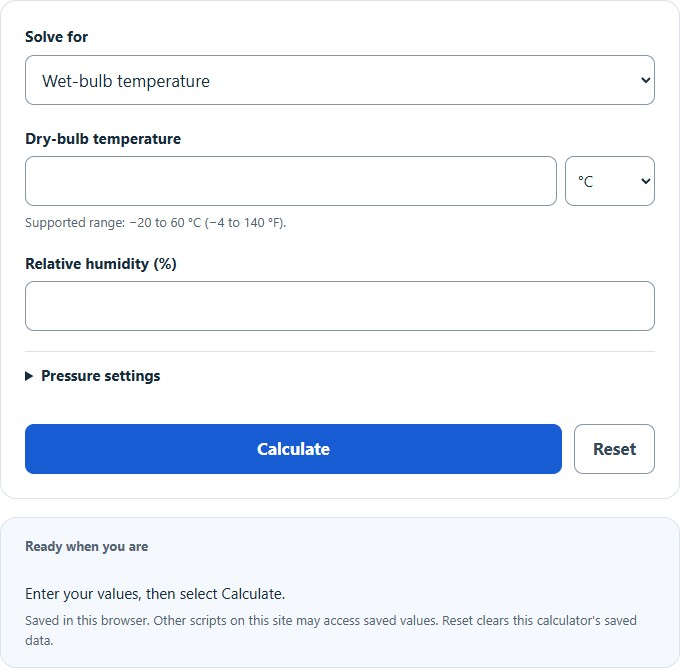
Estimate wet-bulb temperature from dry-bulb temperature, relative humidity, and station pressure, or solve relative humidity from dry- and wet-bulb readings. This approximate model assumes an aspirated liquid-water wick; subzero results refer to supercooled liquid, not an ice-covered wick. Standard sea-level pressure is the default; pressure settings allow an elevation estimate or measured station pressure.
- All Physics Calculators
- Air Density Calculator
- Dew Point Calculator
- Snow Day Chance
- Psychrometric Constant Calculator
Wet Bulb Formula
This calculator uses the Buck liquid-water saturation equation and an approximate ventilated psychrometer relation. Temperatures are in °C and pressures in kPa.
eₛ(T) = 0.61121 × exp[(18.678 − T / 234.5) × T / (257.14 + T)]
e = (RH / 100) × eₛ(Td)
e = eₛ(Tw) − 0.000662 × P × (Td − Tw)
Solve the last equation numerically for Tw, or compute RH = 100 × e / eₛ(Td). The coefficient assumes an aspirated Assmann-type psychrometer at approximately 5 m/s airflow. At 30 °C dry bulb, 50% RH and 101.325 kPa, Tw ≈ 22.07 °C.
- Tw is the estimated liquid-water wet-bulb temperature (°C); P is station pressure (kPa), and e is vapor pressure (kPa)
- Td is dry-bulb temperature (°C); eₛ(T) is liquid-water saturation pressure at temperature T
- RH is relative humidity over liquid water (%)
What is Wet-Bulb Temperature?
Wet-bulb temperature describes evaporative cooling of a wetted thermometer under specified ventilation. An aspirated psychrometer compares dry- and wet-bulb readings. This liquid-water model does not represent an ice-covered wick.
Wet-bulb temperature helps describe evaporative conditions, but this calculator is not a heat-safety or medical assessment.
The human body relies on evaporative cooling through sweat evaporation to maintain a stable internal temperature. When the air becomes saturated with moisture, the evaporation process slows, and the body's ability to cool itself becomes compromised.
Consequently, high wet-bulb temperatures indicate reduced evaporative cooling efficiency and increased risk of heat-related illnesses.
How to calculate wet bulb temperature
- First, determine the current temperature
Measure the current temperature using a thermometer.
- Next, determine the current relative humidity
This humidity is measured as a percentage.
- Finally, calculate the wet bulb
Using the current temperature and the humidity, calculate the wet-bulb temperature.
FAQ
What factors affect wet-bulb temperature readings?
Wet-bulb readings depend on dry-bulb temperature, relative humidity, station pressure, wick condition, ventilation, radiation and sensor accuracy. This model assumes an aspirated liquid-water wick. Use actual local station pressure, not a weather report pressure corrected to sea level. Closing pressure settings does not deactivate a selected elevation or custom pressure.
How is wet-bulb temperature relevant to heat stress and human health?
High wet-bulb temperature indicates reduced evaporative cooling potential. Health risk also depends on activity, exposure, radiation, clothing and individual factors. This estimate is not WBGT and must not be used alone for heat-exposure decisions.
Can wet-bulb temperature be used to predict weather conditions?
Wet-bulb temperature can inform meteorological analysis together with other observations. It cannot independently predict rain or thunderstorms. The calculator supports dry and wet bulbs from −20 to 60 °C, with wet bulb no warmer than dry bulb; subzero humidity is referenced to liquid water.