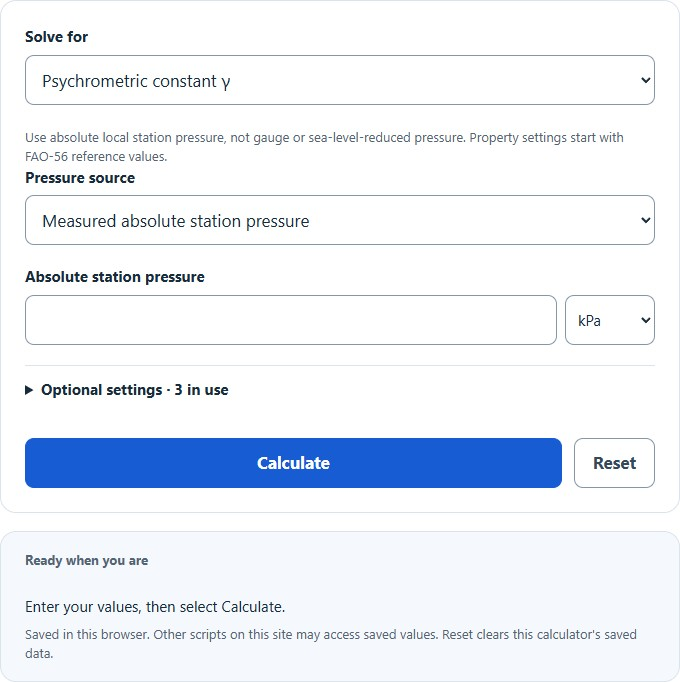
Use this psychrometric constant calculator to calculate the psychrometric constant from atmospheric pressure or elevation, or solve for pressure, elevation, specific heat, latent heat of vaporization, or molecular-weight ratio.
Psychrometric Constant Formula
The psychrometric constant is calculated from atmospheric pressure, the specific heat of air, the latent heat of vaporization of water, and the molecular-weight ratio of water vapor to dry air:
γ = (cₚ × P) / (ε × λ)
Variables:
- γ is the psychrometric constant in kPa/°C
- cₚ is the specific heat of air at constant pressure in MJ/(kg·°C)
- P is absolute local station pressure in kPa, not gauge pressure or sea-level-reduced pressure
- ε is the molecular-weight ratio of water vapor to dry air, commonly 0.622
- λ is the latent heat of vaporization, commonly 2.45 MJ/kg near 20°C
Using cₚ = 1.013 × 10⁻³ MJ/(kg·°C), ε = 0.622, and λ = 2.45 MJ/kg gives the commonly used rounded shortcut:
γ ≈ 0.000665 × P
At standard sea-level pressure of 101.325 kPa, the psychrometric constant is approximately 0.0674 kPa/°C.
Pressure From Elevation Formula
When local pressure is unavailable, this calculator estimates average atmospheric pressure from elevation with the FAO standard-atmosphere relationship:
P = 101.3 × [(293 - 0.0065z) / 293]5.26
In this equation, P is absolute local station pressure in kPa and z is elevation above sea level in meters. This simplified atmosphere is referenced to about20°C. FAO’s published tables cover0–4,000m; the calculator’s broader −1,000 to20,000m computational bounds are not validated atmospheric limits. Outside the tabulated interval, treat the result as extrapolation. Actual pressure changes with weather, so measured station pressure is preferable for a precise current value.
What Is the Psychrometric Constant?
The psychrometric constant links a temperature difference to a vapor-pressure difference in calculations involving evaporation and moist air. It appears in psychrometric equations that use dry- and wet-bulb temperatures and in evapotranspiration methods such as the FAO Penman-Monteith equation.
Despite its name, the value is not identical everywhere. Atmospheric pressure decreases with elevation, and the psychrometric constant decreases almost proportionally with it. The specific heat of air and latent heat of vaporization can also vary slightly with air composition and temperature, although standard engineering and agricultural calculations commonly use fixed reference values.
How to Calculate the Psychrometric Constant
- Determine absolute local station pressure in kPa, excluding gauge or sea-level-reduced pressure. If it is unknown, estimate it from elevation with the stated model limitations.
- Determine the specific heat of air at constant pressure. A common standard value is 1.013 kJ/(kg·K), which equals 0.001013 MJ/(kg·K).
- Determine the latent heat of vaporization. The FAO reference value near 20°C is 2.45 MJ/kg.
- Use 0.622 for the molecular-weight ratio unless your application specifies another gas composition.
- Multiply specific heat by pressure, then divide by the molecular-weight ratio multiplied by latent heat.
Typical Psychrometric Constant by Elevation
The values below use the FAO standard-atmosphere pressure equation and the rounded relationship γ = 0.000665P. Local weather can make the actual pressure and constant slightly different.
| Elevation | Estimated pressure | Psychrometric constant |
|---|---|---|
| 0 m (0 ft) | 101.3 kPa | 0.0674 kPa/°C |
| 500 m (1,640 ft) | 95.5 kPa | 0.0635 kPa/°C |
| 1,000 m (3,281 ft) | 90.0 kPa | 0.0599 kPa/°C |
| 1,500 m (4,921 ft) | 84.8 kPa | 0.0564 kPa/°C |
| 1,800 m (5,906 ft) | 81.8 kPa | 0.0544 kPa/°C |
| 2,000 m (6,562 ft) | 79.8 kPa | 0.0531 kPa/°C |
| 3,000 m (9,843 ft) | 70.5 kPa | 0.0469 kPa/°C |
| 5,000 m (16,404 ft) | 54.6 kPa | 0.0363 kPa/°C |
Example Problems
Example 1: Calculate the psychrometric constant at sea level.
Suppose P = 101.325 kPa, cₚ = 0.001013 MJ/(kg·°C), ε = 0.622, and λ = 2.45 MJ/kg. Insert the values into the formula:
γ = (0.001013 × 101.325) / (0.622 × 2.45) = 0.06735 kPa/°C
Example 2: Calculate the psychrometric constant at an elevation of 1,800 meters.
The standard-atmosphere equation gives an average pressure of approximately 81.8 kPa at 1,800 m. Using the rounded relationship, γ = 0.000665 × 81.8 = 0.0544 kPa/°C.
Example 3: Find atmospheric pressure from a known psychrometric constant.
Suppose γ = 0.0600 kPa/°C and the standard values are used for cₚ, ε, and λ. Rearrange the formula to P = (γ × ε × λ) / cₚ. The result is approximately 90.3 kPa, which corresponds to a standard-atmosphere elevation of roughly 980 meters.
Frequently Asked Questions
What is the standard psychrometric constant at sea level?
Using standard sea-level pressure and the commonly adopted FAO constants, the value is about 0.067 kPa/°C, or about 67 Pa/K. The exact result changes slightly with the pressure and property values used.
Why does the psychrometric constant decrease with altitude?
The formula is directly proportional to atmospheric pressure. Pressure falls as elevation increases, so the psychrometric constant also falls when the other terms remain unchanged.
Is the psychrometric constant truly constant?
It is commonly treated as constant for a location because an average local pressure and standard air properties are used. It is not a universal constant: pressure varies with altitude and weather, while specific heat and latent heat vary slightly with humidity and temperature.
What units should I use?
A consistent SI set is pressure in kPa, specific heat in MJ/(kg·°C), latent heat in MJ/kg, and a dimensionless molecular-weight ratio. The result is then in kPa/°C. The calculator converts the supported pressure, heat, elevation, and psychrometric-constant units internally.
What is the difference between this constant and a psychrometer instrument coefficient?
The thermodynamic psychrometric constant calculated here is γ = cₚP/(ελ). A wet- and dry-bulb instrument may instead use an empirical psychrometer coefficient that depends on ventilation and instrument design. The two values can be close for a well-ventilated psychrometer, but they are not automatically interchangeable.
Should I enter measured pressure or elevation?
Use measured local station pressure when accuracy matters. Elevation provides a convenient standard-atmosphere estimate, but daily weather systems can move actual pressure above or below that estimate.