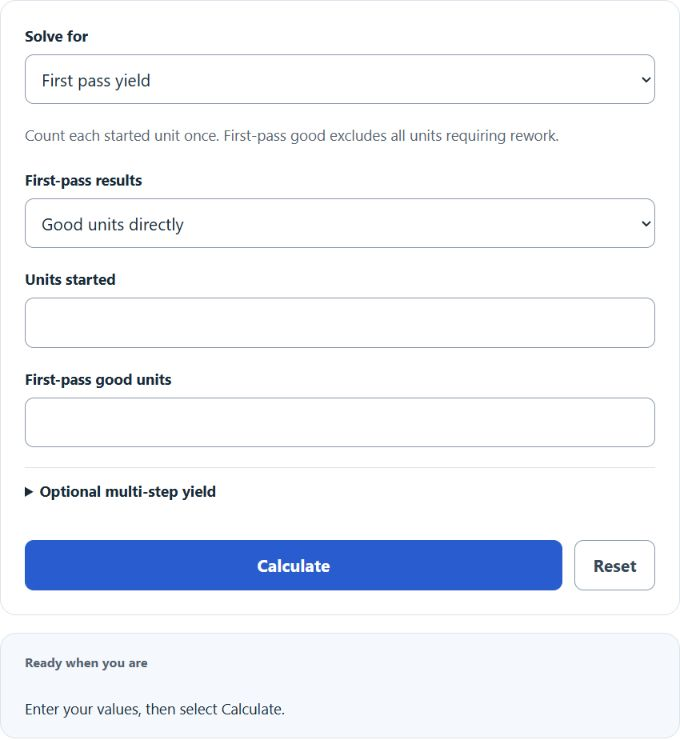
Calculate first pass yield (FPY) as first-pass good units divided by units started, or from scrap and rework counts, with optional rolled throughput yield.
- All Statistics Calculators
- Product Yield Calculator
- Production Efficiency Calculator
- Casting Yield Calculator
Calculator Functions
| Function | What it does | What it requires |
|---|---|---|
| First pass yield | Finds the percentage of started units that pass on the first attempt with no rework | Requires the units started and either the first-pass good units or the units scrapped and the units requiring rework; reworked units later recovered are optional |
| Expected first-pass good units | Applies a target yield to a planned number of starts | Requires the units started and the target first pass yield in percent |
| Starts implied by a good-unit target | Finds how many units have to be started to end up with a wanted number of first-pass good units | Requires the first-pass good units wanted and the target first pass yield in percent |
Every function also accepts a list of 2 to 5 step yields, separated by commas or new lines, and multiplies them into a rolled throughput yield. Each result lists the first-pass loss in units, the loss rate and the losses per million starts.
First Pass Yield Formulas
| FPY | First pass yield (%) |
| G | Units that pass on the first attempt without rework |
| S | Units started in the same batch or period |
First pass yield is the share of units that go through a process and meet the quality requirements without being scrapped, rerun, retested, returned or sent for repair. It is worked out as the units entering the process minus the defective units, divided by the units entering [1]. A unit that fails and is later repaired still counts against the yield.
First pass yield
With good units entered directly, the main formula is used as it stands: 95 good units from 120 started is 95 ÷ 120 × 100 = 79.167%. With the scrap and rework breakdown selected, the good units are found first by taking both kinds of loss away from the starts. A batch of 200 with 10 scrapped and 30 needing rework has 160 first-pass good units and a yield of 80%.
The breakdown adds two more figures. The potential final yield assumes every reworked unit is saved, (200 − 10) ÷ 200 = 95%. If the number actually recovered is entered, such as 24, the final yield is (160 + 24) ÷ 200 = 92%. Neither changes the first pass yield.
Expected first-pass good units
Starting 500 units at a 92% yield is expected to give 500 × 0.92 = 460 good units. The answer can be a fraction: 75 starts at 91% gives 68.25, which is also shown rounded down to 68 whole units.
Starts implied by a good-unit target
To finish with 100 first-pass good units at a 93% yield, 100 ÷ 0.93 = 107.5269 units have to be started, shown rounded up as 108. The target yield has to be above zero.
Rolled throughput yield
… × Yn × 100
Each Y is one step’s first pass yield written as a fraction. Four steps at 98%, 95%, 97% and 96% give 0.98 × 0.95 × 0.97 × 0.96 = 86.695%, so about 13.3% of units need attention somewhere along the line. The step list is kept apart from the main calculation and does not change its answer.
Limits of This Estimate
- Good units and starts have to come from the same batch or period, with each unit counted once. The yield is only as reliable as the inspection that decides what passes.
- Expected good units and implied starts are planning figures. A target yield does not guarantee the outcome of a real run.
- Rolled throughput yield treats the steps as a chain in which a unit has to pass every one. It is the usual way of combining step yields and is not part of the definition cited for a single process. These estimates are based on the best available data and estimations.
Sources
- American Society for Quality, Quality Glossary, First pass yield (FPY): definition of first pass yield and how it is calculated