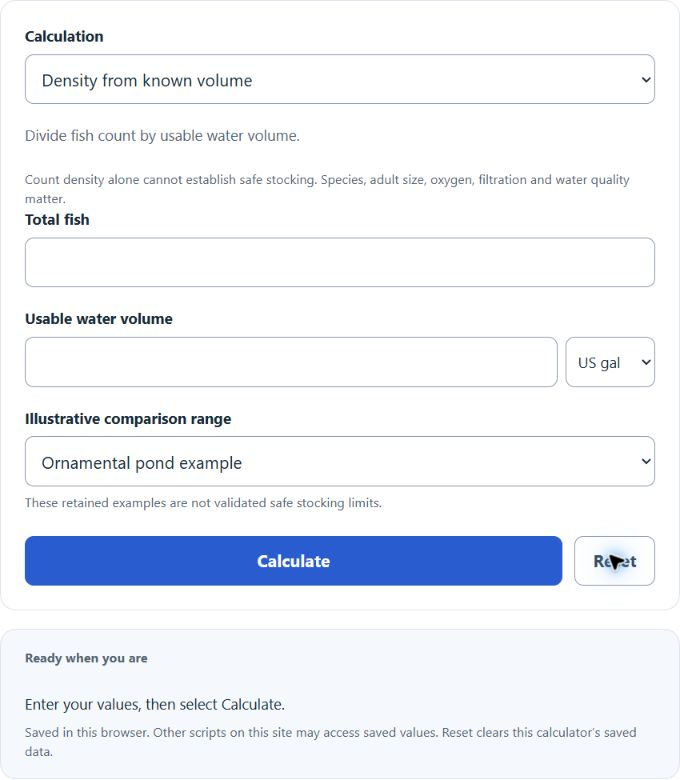
Calculate fish count density from usable water volume or dimensions, or convert a selected illustrative density range to a count. Gallons mean US liquid gallons. These calculations do not establish safe stocking.
- All Biology Calculators
- All Density Calculators
- Aquarium Stock Calculator
- Viscosity to Density Calculator
- Fish Yield Calculator
Fish Density Formula
The calculator uses one core formula and a second formula for the stocking capacity mode.
When you enter dimensions instead of a known volume, the calculator first computes:
- Density: fish per gallon (also shown per liter, per m³, and per acre-foot)
- Total Fish: count of fish in the system
- Water Volume: usable water in the tank or pond
- Length, Width, Depth: tank or pond dimensions in the same unit
- Target Density: fish per US gallon from a selected illustrative range
The Density from known volume mode divides count by usable volume. Density from dimensions uses length × width × average water depth as a volume estimate. Count at an illustrative density multiplies volume by the low and high example density bounds, rounding each count down. It does not impose a minimum of one fish.
Illustrative Density Ranges and Unit References
The retained example ranges below are used only for numerical comparison. They have not been validated as safe limits for a species or system. Use species-specific guidance and measured water quality for actual stocking decisions.
| System type | Fish per gallon | Fish per acre-foot |
|---|---|---|
| Ornamental/backyard pond | 0.001 to 0.010 | 325 to 3,260 |
| Catfish pond, low to semi-intensive | 0.0015 to 0.006 | 490 to 1,955 |
| Aquarium, small community fish | 0.05 to 0.20 | 16,290 to 65,170 |
| Intensive tank/RAS | 0.05 to 0.30 | 16,290 to 97,755 |
| From | To gallons, multiply by |
|---|---|
| Liters | 0.2642 |
| Cubic meters | 264.17 |
| Acre-feet | 325,851 |
| Cubic feet (L×W×D in ft) | 7.4805 |
Worked Examples
Example 1: Backyard pond. A rectangular pond is 20 ft × 10 ft with an average water depth of 4 ft and 80 fish. Estimated volume is 5,984.416 US gallons and density is 0.013368 fish/US gallon. This is above the illustrative ornamental-pond range; the comparison alone does not prove overstocking or prescribe a filtration upgrade.
Example 2: A 75-US-gallon aquarium. Applying the illustrative 0.05–0.20 fish/US gallon range gives floor(3.75) to floor(15), or 3–15 fish. This is an arithmetic example, not a stocking recommendation.
FAQ
Does fish size matter? Yes. Fish count omits adult size, biomass, species, life stage, behavior, feeding and system capacity. Oxygen demand and waste cannot be inferred from count density alone; use appropriate species and system guidance.
Should I use total volume or net water volume? Use net water volume. Subtract space taken by gravel, rocks, and large decor in aquariums, and use average depth (not maximum depth) for ponds with sloped sides.
Does an above-range result mean the system is overstocked? The result compares numbers with an illustrative range. It does not certify a safe load. Dissolved oxygen, ammonia, nitrite, filtration, adult size and species requirements need separate assessment.
Which mode should I use? Use known volume when usable water volume is known. Use dimensions for a rectangular footprint and average depth, allowing for displacement. Use the count mode to explore an illustrative range without treating it as a safe stocking limit.