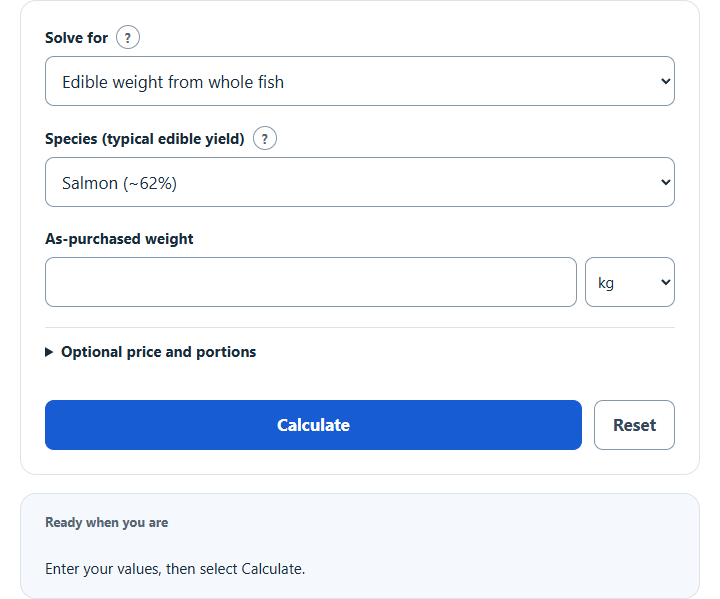
Calculate fish yield: estimate edible fillet weight from whole fish using typical species yields, find how much whole fish to buy, or measure your yield %.
Related Calculators
- Dressing Percentage Calculator
- Cow Live Weight Vs Meat Weight Calculator
- Deer Meat Yield Calculator
- Moisture Loss Calculator
- All Food and Cooking Calculators
Fish Yield Formula
Variables:
- FY is the Fish Yield (%)
- EPW is the edible product weight (g)
- APW is the as-purchased weight (g)
To calculate Fish Yield, convert the edible product and as-purchased weights to the same unit, divide edible weight by purchase weight, then multiply by 100. Use the same batch and exclude added water or ingredients. Zero edible output gives 0% measured yield when purchase weight is positive; a positive target cannot be obtained at zero yield.
How to Calculate Fish Yield?
The following steps outline how to calculate the Fish Yield.
- First, determine the edible product weight (g).
- Next, determine the as-purchased weight (g).
- Next, gather the formula from above = FY = EPW / APW *100.
- Finally, calculate the Fish Yield.
- After inserting the variables and calculating the result, check your answer with the calculator above.
Example Problem :
Use the following variables as an example problem to test your knowledge.
edible product weight (g) = 750
as purchased weight (g) = 1000; yield = 750 / 1000 × 100 = 75%
Frequently Asked Questions (FAQ)
What is the significance of calculating Fish Yield?
Fish Yield calculation is crucial for determining the efficiency of fish processing, helping businesses and consumers understand the amount of edible fish product obtained from a given weight of purchased fish. This can aid in cost estimation, nutritional planning, and waste reduction.
How can the Fish Yield formula help in daily cooking or commercial kitchens?
In daily cooking or commercial kitchens, the Fish Yield formula can assist in accurately planning meal portions, managing inventory, and minimizing waste by estimating the actual amount of fish that is consumable from a given purchase, while recognizing that expected yield is not guaranteed. Optional price uses one unchanged currency with an explicit mass basis; changing that basis converts the price rate. Portion equivalents and full portions are shown separately. The ±5 percentage-point sensitivity table is an illustrative scenario at the same purchase weight, not a predicted recovery range.
Can the Fish Yield formula be applied to other types of meat or seafood?
While the formula is specifically designed for fish, the concept of yield calculation can be adapted to other types of meat or seafood by adjusting the parameters to fit the characteristics of the product, such as fat content, bone structure, and processing method.
Is there a way to improve the Fish Yield?
Improving Fish Yield can involve several strategies, including selecting high-yield species, optimizing processing techniques to reduce waste, and properly storing and handling the fish to maintain its quality. Training and technology can also play significant roles in maximizing yield.