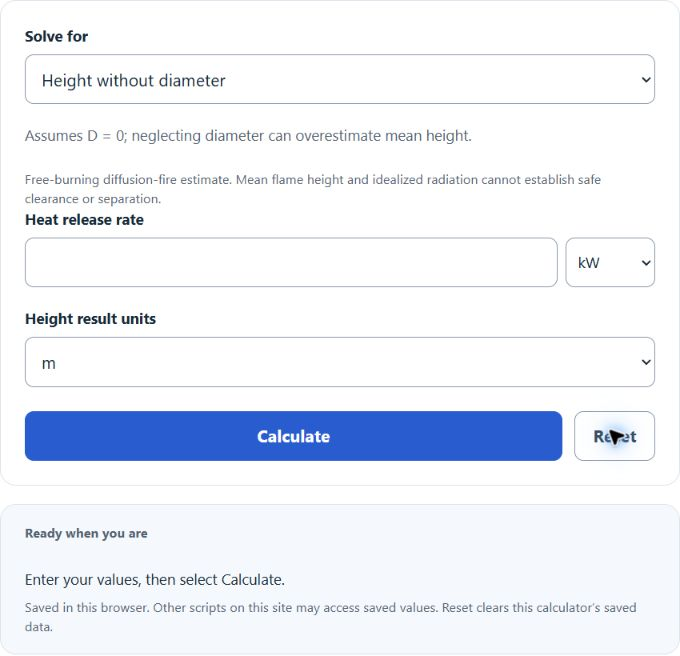
Estimate mean flame height from heat release rate and source diameter, or explore idealized radiant flux and ceiling-height comparisons. These estimates do not establish fire-safe clearances.
Flame Height Formula
The following correlation is commonly used to estimate mean visible flame height for free-burning turbulent diffusion flames:
Variables:
- L_f is the mean visible flame height above the fuel surface (meters)
- Q is the heat release rate (kW)
- D is the effective fire/source diameter (meters)
To calculate flame height, the Heskestad correlation relates flame height to heat release rate raised to the power of 2/5, with an additional term that accounts for the fire/source diameter.
What is Flame Height?
Flame height is the distance from the base of a fire to the top of the visible flame. It is an important parameter in fire safety and engineering as it relates to the potential for fire spread, heat release, and the effects on surrounding structures and environments.
How to Calculate Flame Height?
The following steps outline how to calculate the flame height:
- First, determine the heat release rate (Q) of the fire in kilowatts (kW).
- Next, if you know the effective fire/source diameter (D), use the correlation L_f = 0.235 * Q^{2/5} – 1.02 * D to calculate the mean visible flame height. Omitting the diameter correction gives the approximation L_f ≈ 0.235 * Q^{2/5} (D = 0). A nonpositive prediction is outside the usable physical-height range. Mean height is not a maximum, and these estimates do not establish safe separation or ceiling clearance.
- Finally, enter the heat release rate (and diameter, if available) into the calculator to get the flame height.
Example Problem:
Use the following variables as an example problem to test your knowledge.
Heat release rate (Q) = 500 kW