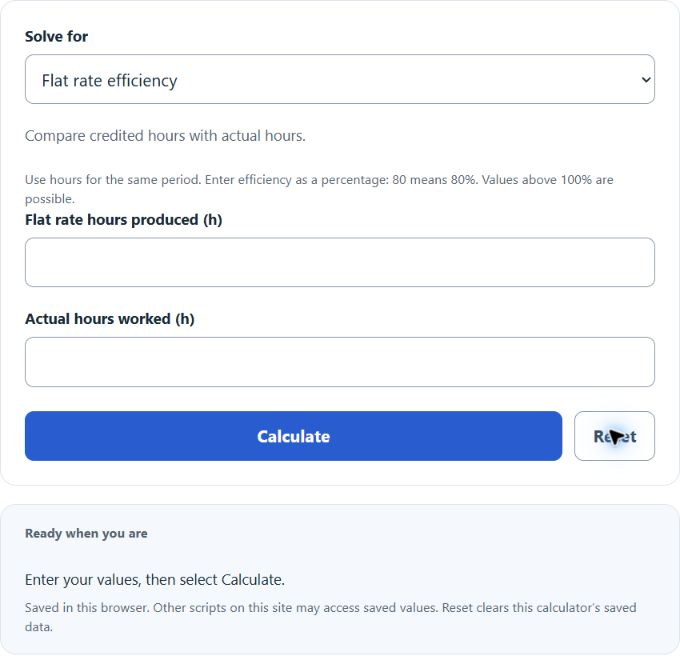
Calculate flat-rate efficiency, flat-rate hours produced, or actual hours worked when you enter any two values in this production formula.
- All Automotive Calculators
- All Efficiency Calculators
- Production Efficiency Calculator
- Time Efficiency Calculator
- Process Cycle Efficiency Calculator
Flat-Rate Efficiency Formula
The following formula is used to calculate the Flat-Rate Efficiency.
- Where Efr is the Flat-Rate Efficiency ratio (multiply by 100 for a percentage)
- FR is the flat-rate hours produced
- Ah is the actual hours worked
To calculate the flat-rate efficiency, divide the flat-rate hours by the actual hours worked.
How to Calculate Flat-Rate Efficiency?
The following two example problems outline how to calculate the Flat-Rate Efficiency.
Example Problem #1:
- First, determine the flat-rate hours produced. In this example, the flat-rate hours produced is given as 8.
- Next, determine the actual hours worked. For this problem, the actual hours worked is given as 10.
- Finally, calculate the Flat-Rate Efficiency using the equation above:
Efr = FR / AH
Inserting the values from above and solving the equation:
Efr = 8 / 10 = .8, equivalent to 80%
FAQ
What is Flat-Rate Efficiency?
Flat-Rate Efficiency is a metric used to measure the productivity and efficiency of work, especially in environments where tasks are billed at a flat rate. It is calculated by dividing the flat-rate hours produced by the actual hours worked. A higher value indicates greater efficiency.
Why is measuring Flat-Rate Efficiency important?
Measuring Flat-Rate Efficiency is crucial for businesses and workers to understand their productivity levels. It helps identify areas where efficiency can be improved, can inform compensation discussions but does not by itself establish fair compensation, and can be used to benchmark performance over time or against industry standards.
Can Flat-Rate Efficiency be applied to all types of work?
While Flat-Rate Efficiency is particularly relevant to industries where tasks or services are billed at a flat rate, such as automotive repair or certain types of contracting work, its principles can be adapted to measure efficiency in various other sectors. However, its direct application may not be suitable for all types of work, especially those that do not have easily quantifiable output or where work complexity varies significantly.