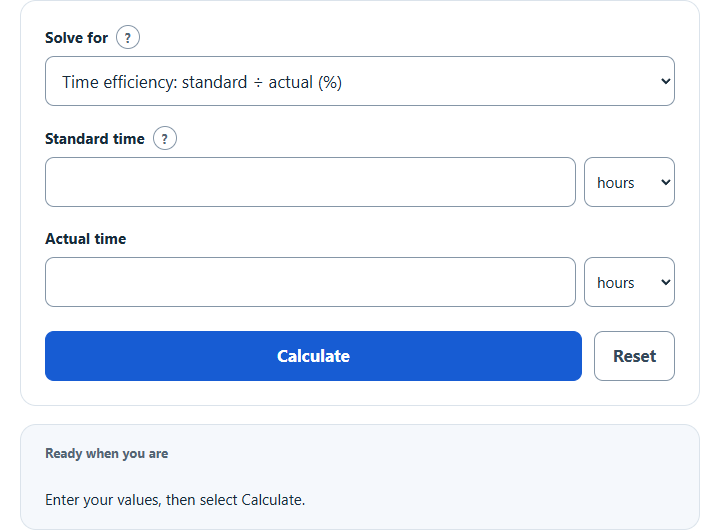
Calculate time efficiency from standard and actual time, or measure productive time as a percentage of available time, with minutes, hours, and days.
- Every Day Life And Education Calculators
- All Efficiency Calculators
- Production Efficiency Calculator
- Garment Industry Efficiency Calculator
Time Efficiency Formula
The performance basis compares standard time with actual time for the same work scope. A ratio above 100% is valid: the work took less actual time than its standard. The ratio alone does not measure quality, safety, or overall productivity.
- Where Etime is the Time Efficiency (%)
- SL is the standard time allowed for the defined work, converted to the same unit as AT.
- AT is the actual time spent on that same work; it must be greater than zero.
Performance efficiency (%) = 100 × standard time ÷ actual time. To solve for standard time, use actual time × efficiency ÷ 100. To solve for actual time, use 100 × standard time ÷ efficiency, provided the inputs identify a positive actual duration.
The utilization basis measures productive time as a share of available time for one defined period. Utilization (%) = 100 × productive time ÷ available time; productive time = available time × utilization ÷ 100; available time = 100 × productive time ÷ utilization when a positive available duration is uniquely determined. Available time must be positive and should exclude the breaks declared outside that period’s net working time. Productive time is part of that same available time, so it cannot exceed available time and utilization runs from 0% through 100%.
Choose the performance or utilization result you need, then enter the two known quantities. Time fields support minutes, hours, and days; the calculator converts compatible units, using 1 hour = 60 minutes and 1 day = 24 hours. A day here is an elapsed 24-hour duration, not an assumed work shift.
A zero standard time or productive time with a positive denominator gives a valid 0% ratio. In the corresponding numerator inverse, 0% with a positive actual or available time gives zero standard or productive time. In a denominator inverse, zero numerator at 0% is nonunique because every positive denominator fits; positive numerator at 0% is impossible; zero numerator at a positive percentage would give a zero denominator and is outside the positive-denominator model. These cases do not justify inventing a positive duration.
Calculate updates results manually. When browser storage is available, the last successful input snapshot is saved and validated and recomputed on return. Editing values retains a marked previous result until Calculate is selected again. Reset clears this calculator’s saved state, blanks its numeric fields, and restores the documented initial mode and units.
How to Calculate Time Efficiency?
The following two examples use the performance basis with standard and actual time in hours.
Example Problem #1:
- First, determine the standard labor hours (hrs). In this example, the standard labor hours (hrs) is given as 25.
- Next, determine the actual amount of time worked (hrs). For this problem, the actual amount of time worked (hrs) is given as 76.
- Finally, calculate the Time Efficiency using the equation above:
Etime = SL / AT * 100
Inserting the values from above and solving the equation:
Etime = 25 / 76 * 100 ≈ 32.89%. The calculator displays 32.894737% before further rounding for this example.
Example Problem #2:
Using the same process as above, first define the variables required by the formula. In this case, these values are:
standard labor hours (hrs) = 23
actual amount of time worked (hrs) = 100
Entering these values yields:
Etime = 23 / 100 * 100 = 23 (%)