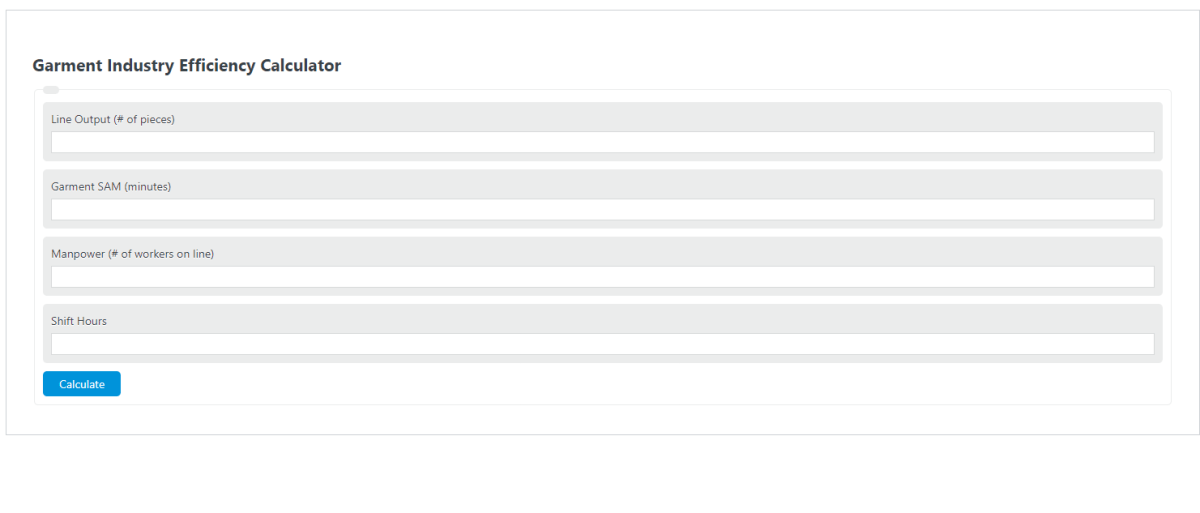
Calculate garment line efficiency, output, SAM, manpower, or shift hours from any four production values with time units in seconds, minutes, or hours.
- All Efficiency Calculators
- Condenser Efficiency Calculator
- Mean Time To Failure (MTTF) Calculator
- All Business Calculators
- Fabric Weight Calculator
- Production Efficiency Calculator
Garment Industry Efficiency Formula
Garment industry efficiency, often called line efficiency, measures how much standard production time a line earns compared with the labor time made available during the shift. It is useful because it evaluates output in relation to SAM rather than piece count alone, which makes comparisons more meaningful when garment complexity changes.
In this equation, the numerator represents the standard minutes earned by actual production, while the denominator represents the labor minutes available on the line.
| Variable | Meaning | Typical Unit |
|---|---|---|
| LE | Garment line efficiency | Percent (%) |
| O | Accepted line output for the measured period | Pieces |
| GSAM | Standard allowed minutes required for one garment | Minutes per piece |
| M | Total manpower assigned to the line during the period | Workers |
| H | Shift length for the same period | Hours |
How the Formula Works
The calculation is easiest to understand when broken into two parts:
The factor of 60 converts shift hours into minutes so both sides of the ratio use the same time unit. After that, the ratio is multiplied by 100 to express efficiency as a percentage.
How to Calculate Garment Line Efficiency
- Measure actual output for the same shift or time window you want to evaluate.
- Use the correct garment SAM for that style or operation set.
- Count total manpower assigned to the line during the period.
- Enter shift hours for that same period.
- Apply the formula to convert earned standard minutes into a line efficiency percentage.
This metric is most reliable when all inputs refer to the same production period. Mixing output from one shift with manpower or hours from another will distort the result.
Input Quality Checklist
| Input | Best Practice |
|---|---|
| Output | Use good or accepted pieces for the period being analyzed. |
| GSAM | Use the approved standard for the exact garment style and method. |
| Manpower | Use the actual number of workers assigned to the line, not a planned headcount. |
| Shift Hours | Stay consistent with your reporting method so comparisons across days or lines remain meaningful. |
Rearranged Equations for Missing Inputs
If you know any three values, the same relationship can be rearranged to solve for the fourth. These forms are useful for target setting, manpower planning, and production balancing. In the equations below, enter LE as a percentage value, such as 41.67 rather than 0.4167.
Example
Suppose a line produces 50 pieces, the garment SAM is 20 minutes, manpower is 5 workers, and the shift length is 8 hours.
That result means the line earned 1,000 standard minutes of production from 2,400 available labor minutes during the shift.
How to Interpret Garment Efficiency
- Higher efficiency means a larger share of available labor time is being converted into standard output.
- Lower efficiency can point to downtime, imbalance, waiting, training gaps, quality losses, rework, style changeovers, or inaccurate standards.
- Efficiency is a line metric, not the same as operator efficiency, machine utilization, or defect rate.
- Comparisons are strongest when lines are producing similar styles under similar measurement rules.
Common Mistakes
- Mixing minutes and hours. GSAM is in minutes per piece, while shift time is entered in hours.
- Using planned manpower instead of actual workers present on the line.
- Counting defective, unapproved, or reworked pieces the same way as accepted output without a consistent rule.
- Applying an outdated or inaccurate SAM after a method, machine, or style change.
- Comparing two lines only by percentage without considering product complexity, training status, or startup losses.
Frequently Asked Questions
- What does SAM mean in garment production?
- SAM is the standard allowed minutes required to produce one garment under the defined method and standard conditions.
- Why is efficiency better than raw piece count alone?
- Piece count ignores garment difficulty. Efficiency uses standard minutes, so a line making more complex garments can be evaluated more fairly.
- Can garment efficiency exceed 100%?
- Yes. That happens when the line earns more standard minutes than the baseline available minutes entered into the calculation. If this occurs often, review the SAM, output count, manpower, and time inputs for consistency.
- Should I use scheduled hours or effective hours?
- Either approach can work, but you should use one method consistently across all reports so your trend analysis and line-to-line comparisons stay valid.