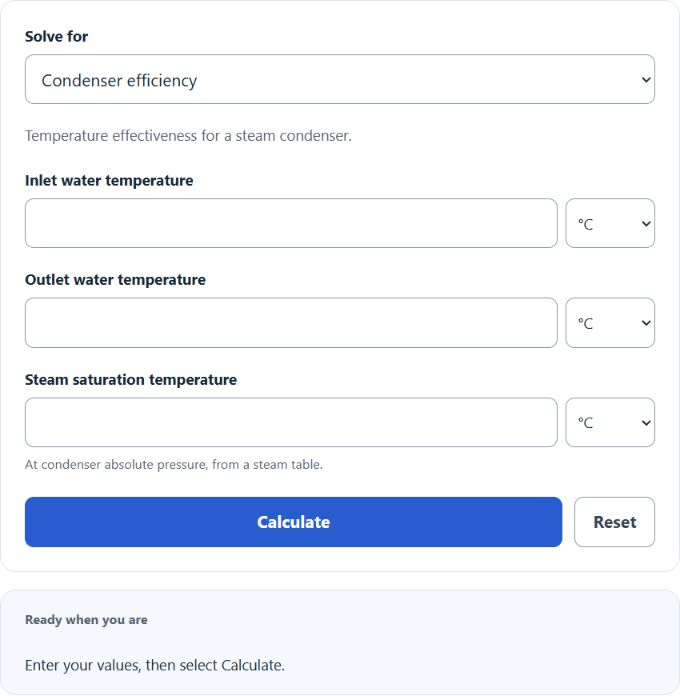
Select condenser efficiency, inlet water temperature, outlet water temperature, or steam saturation temperature and enter the three known values.
- All Construction Calculators
- Reciprocating Compressor Volumetric Efficiency Calculator
- Thermal Efficiency Calculator
- COP (Coefficient of Performance Calculator)
Condenser Efficiency Formula
The condenser efficiency calculation compares the actual cooling water temperature rise to the maximum possible rise based on the steam saturation temperature at the condenser absolute pressure.
- CE = condenser efficiency, as a percentage
- T_in = inlet water temperature, in °C
- T_out = outlet water temperature, in °C
- T_v = steam saturation temperature at condenser absolute pressure, in °C
Select the unknown quantity. The calculator uses the corresponding rearrangement and supports Celsius, Fahrenheit, or kelvin temperatures. Inlet temperature is not uniquely determined at 100% efficiency, and saturation temperature is not uniquely determined at 0% with no water temperature rise.
Condenser Efficiency Result Ranges
These bands only describe the calculated temperature ratio; they are not universal acceptable-performance limits. Compare performance with design data under comparable water flow, operating load, fouling, air leakage and measurement conditions.
| Condenser Efficiency | General Meaning | What to Check |
|---|---|---|
| Below 50% | Less than half the available temperature rise | Design ratio, cooling water flow, load, fouling, air leakage and sensor accuracy |
| 50% to 70% | 50% to 70% of the available temperature rise | Compare with design data and recent operating history |
| 70% to 85% | 70% to 85% of the available temperature rise | Monitor trend over time |
| Above 85% | Outlet water approaches steam saturation temperature | Verify temperatures, pressure conversion, and sensor accuracy |
Temperature Inputs and Checks
| Input | Expected Relationship | Why It Matters |
|---|---|---|
| Inlet water temperature | Usually the lowest of the three temperatures | It is the starting temperature of the cooling water. |
| Outlet water temperature | Should normally be higher than inlet water temperature | The water gains heat as steam condenses. |
| Steam saturation temperature | Should be higher than inlet water temperature for a valid denominator | If it equals inlet temperature, condenser efficiency cannot be calculated. |
| Efficiency | Usually between 0% and 100% | Values outside this range usually mean one or more inputs should be checked. |
Example Problems
Example 1: Calculate condenser efficiency
You have an inlet water temperature of 25°C, an outlet water temperature of 35°C, and a steam saturation temperature of 45°C.
The condenser efficiency is 50%.
Example 2: Calculate steam saturation temperature
You have an inlet water temperature of 28°C, an outlet water temperature of 38°C, and a condenser efficiency of 62.5%.
The steam saturation temperature at condenser absolute pressure is 44°C.
FAQ
What does condenser efficiency mean?
Condenser efficiency shows how much of the available temperature difference is actually used to heat the cooling water. A higher percentage means the outlet water temperature is closer to the steam saturation temperature, by definition. A higher ratio alone does not establish better overall plant performance.
Why is steam saturation temperature used instead of vacuum pressure directly?
The formula uses the saturation temperature corresponding to the condenser absolute pressure. Vacuum pressure itself is not a temperature, so it must be converted to the equivalent saturation temperature before using this calculation.
Can condenser efficiency be greater than 100%?
In normal use, condenser efficiency should not be greater than 100%. A result above 100% usually means the outlet water temperature is higher than the steam saturation temperature, the pressure-to-temperature conversion is wrong, or one of the temperature readings is inaccurate.