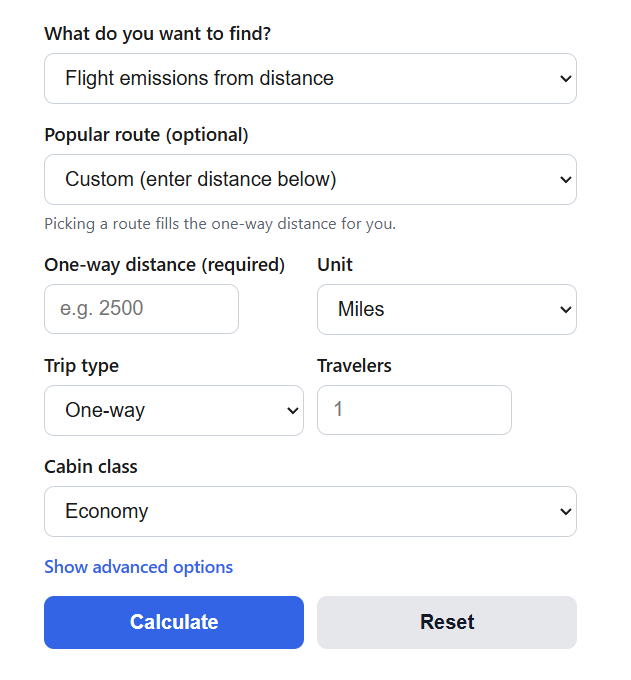
Calculate the carbon footprint of any flight from distance or flight time, including cabin class, round trips, and non-CO2 effects, or find how far you can fly on a set CO2 budget.
- All Everyday Life & Education Calculators
- Carbon Footprint of Driving Calculator
- Carbon Offset Cost Calculator
Flight Carbon Footprint Formula
The calculator multiplies the distance you fly by an emission factor that matches the type of flight and your cabin class:
E = D * EF * T * P
Variables:
- E is the flight carbon footprint in kg of CO2e (carbon dioxide equivalent)
- D is the one-way flight distance in kilometers
- EF is the emission factor in kg CO2e per passenger-kilometer, set by flight type (domestic, short-haul, or long-haul) and cabin class
- T is the trip multiplier, 1 for one-way and 2 for a round trip
- P is the number of travelers
If you know the flight time but not the distance, the calculator first estimates the distance from typical gate-to-gate airline speeds:
D = 880 * t - 400
where t is the flight time in hours. The fixed 400 km deduction accounts for taxi, climb, and descent, which is why short flights average a much lower speed than long ones.
In budget mode the formula is rearranged to show how far you can fly within a fixed emissions allowance B:
Dmax = B / EF
The emission factors come from the UK government (DEFRA/DESNZ) 2025 conversion factors, the standard public dataset for distance-based flight emissions. The calculator picks the flight type automatically from the distance, and you can override it in the advanced options. Three toggles adjust the factor itself: non-CO2 effects (on by default) include the warming from contrails and nitrogen oxides at cruise altitude, roughly 1.7 times the CO2-only figure; well-to-tank adds about 21 percent for producing and transporting the jet fuel; and the 8 percent routing uplift compensates for the fact that real flights do not follow the straight great-circle line between airports.
Emission Factors by Flight Type and Cabin Class
These are the per-passenger factors the calculator uses, in kg CO2e per passenger-kilometer, including non-CO2 effects. The last column shows the CO2-only economy value used when you switch non-CO2 effects off. DEFRA publishes cabin class splits only for the classes an aircraft type typically carries, so domestic business and short-haul premium seats are mapped from the nearest published ratio.
| Flight type | Economy | Premium economy | Business | First | Economy, CO2 only |
|---|---|---|---|---|---|
| Domestic / regional (under 500 km) | 0.229 | 0.229 | 0.344 | 0.344 | 0.136 |
| Short-haul (500 to 3,700 km) | 0.126 | 0.126 | 0.189 | 0.189 | 0.074 |
| Long-haul (over 3,700 km) | 0.117 | 0.187 | 0.339 | 0.468 | 0.069 |
Two patterns in this table explain most flight footprints. Per kilometer, short hops are the dirtiest way to fly because takeoff and climb burn a large share of the fuel. And cabin class matters as much as distance: a long-haul business seat carries about 2.9 times the emissions of economy, and first class about 4 times, because larger seats take up more of the aircraft floor per person.
Different flight calculators can return numbers that differ by a factor of 3 for the same ticket. This comparison shows why, so you can tell whether a gap comes from the method rather than an error:
| Calculator | Basis | Non-CO2 effects | Also includes |
|---|---|---|---|
| This calculator | DEFRA 2025 distance and class factors | Optional, about 1.7x, on by default | Optional fuel production and 8% routing uplift, flight-time and carbon budget modes |
| ICAO ICEC | Fuel burn per route and aircraft | Not included | 50 to 125 km routing correction, passenger and freight split |
| myclimate | Fuel burn curve per aircraft | Multiplier of 2 on cruise emissions | Fuel production, share of aircraft manufacture, 95 km detour |
| atmosfair | Aircraft-specific fuel model | Multiplier of about 3 on cruise above 9 km | Aircraft type, seat class, load factor |
| Airline and booking-site estimates | Per-flight fuel models | Usually not included | Usually the lowest numbers you will see for a route |
Flight Carbon Footprint Example Problems
Example 1: A one-way New York to London flight in economy. The great-circle distance is about 5,570 km, which is over 3,700 km, so the long-haul economy factor of 0.117 applies. E = 5,570 * 0.117 * 1 * 1 = 651.7, so about 652 kg CO2e. That equals roughly 3,830 km of driving in an average car and about 33 percent of a 2-tonne personal annual climate budget.
Example 2: A couple flies a 1,500 km short-haul round trip in business class. The short-haul business factor is 0.189. Per traveler, E = 1,500 * 0.189 * 2 = 567 kg CO2e. For both travelers the trip totals 567 * 2 = 1,134 kg CO2e, more than a tonne for a fairly short trip, driven mostly by the class choice.
Flight Carbon Footprint Frequently Asked Questions
Why is this result higher than the number my airline or booking site shows?
Airline and booking-site estimates almost always count only the CO2 from burning the fuel, assigned to your seat. This calculator includes non-CO2 effects by default, which raises the figure by about 70 percent, and can also add fuel production emissions. Turn off both toggles in the advanced options and the results will land close to a typical airline estimate. Neither number is wrong; they answer different questions, and the higher one is the better measure of total climate impact.
What are non-CO2 effects and should I include them?
Jet engines at cruise altitude also produce contrails, cirrus clouds, and nitrogen oxides, which trap heat in ways ground-level emissions do not. Research summarized by the UK government and the IPCC attributes the majority of aviation’s total warming to these non-CO2 effects, which is why DEFRA applies a multiplier of roughly 1.7 to the CO2 figure. Include them when you want your flight’s full climate impact, and state which basis you used when comparing numbers, since many published figures are CO2 only.
What actually reduces a flight footprint the most?
In order of impact: fly less often and combine trips, since no other change removes a whole flight’s emissions; fly economy, because a long-haul business seat emits about 2.9 times economy for the same route; choose nonstop routings, since connections add distance plus an extra fuel-heavy takeoff and climb; and replace flights under about 500 km with rail where possible, which typically cuts that leg’s emissions by 80 to 90 percent. Offsets can compensate for what remains, but they reduce the footprint of the flight itself by nothing, so treat them as a last step rather than a substitute.