Calculate the cost to offset your carbon emissions from the tonnes of CO2 and the price per tonne, with project presets plus budget and break-even modes.
- All Everyday Life & Education Calculators
- Recycling Energy Savings Calculator
- Flight Carbon Footprint Calculator
- Carbon Footprint of Driving Calculator
Carbon Offset Cost Formula
The cost to offset your emissions is the number of tonnes you produce multiplied by the price of one carbon credit:
Cost = T * P
With a broker fee and a multi-year commitment, the total becomes:
Total = T * P * Y * (1 + F/100)
In budget mode the tool rearranges the same relationship to tell you how many tonnes a fixed amount of money buys:
T = B / P
In break-even mode it works out the price per tonne hidden inside a quoted total:
P = C / T
If you estimate emissions from activities instead of entering tonnes, the tool sums each activity and converts kilograms to tonnes:
T = (Fly*0.25 + Car*0.40 + Elec*0.39 + Gas*5.3) / 1000
Variables:
- Cost is the money needed to offset your emissions once
- Total is the cost after any fee and multi-year commitment
- T is the emissions to offset, in tonnes of CO2 equivalent (CO2e)
- P is the offset price, in dollars per tonne
- Y is the number of years you are offsetting, which repeats the annual cost
- F is the broker or retirement fee, as a percent added on top of the credit price
- B is your budget, in dollars
- C is a total price you were quoted, in dollars
- Fly, Car, Elec, and Gas are yearly flight passenger-miles, car miles, electricity kWh, and natural gas therms
- 0.25, 0.40, 0.39, and 5.3 are the kilograms of CO2e released per unit of each activity
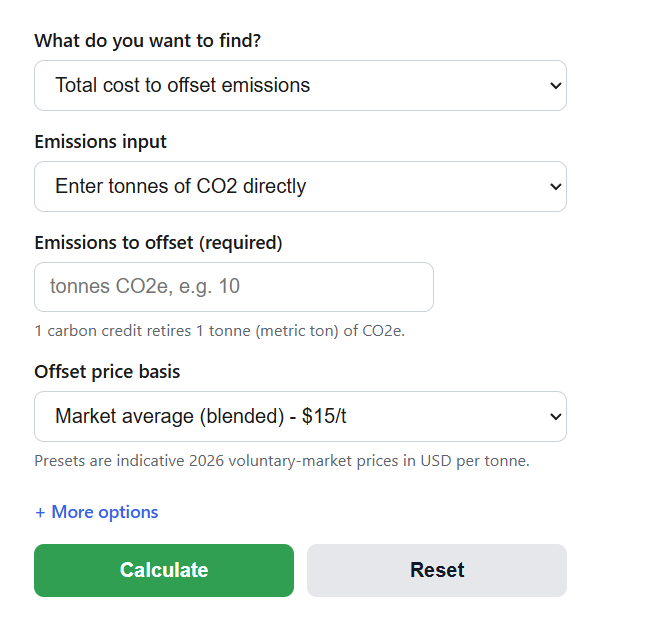
Pick what you want to find at the top. In cost mode you enter your emissions and a price and get the total to offset them. In budget mode you enter a dollar amount and see how many tonnes it covers. In break-even mode you enter a quoted total and the tonnes it covers and get the real price per tonne, which is the fastest way to check whether an offer is fairly priced. The price basis menu fills in a typical 2026 price for each project type, or you can switch to Custom and type a quote of your own. One carbon credit always retires one tonne, so the credit count equals your tonnes. The activity estimator and the price-per-tonne comparison table in the results are two things the plain cost calculators on competing pages leave out.
Offset Price and Quality by Project Type
The single biggest driver of your cost is which type of project issues the credit. Cheaper credits usually avoid future emissions, while pricier ones physically remove carbon and lock it away for longer. The permanence column is the piece most competing calculators omit, and it explains why two credits that both claim one tonne can differ in price by 100 times.
| Project type | Typical 2026 price ($/tonne) | What it does / permanence |
|---|---|---|
| REDD+ forest protection | 5 to 8 | Avoids deforestation; permanence at risk from fire and logging |
| Renewable energy | 2 to 15 | Avoids fossil generation; additionality often questioned |
| Improved forest management | 10 to 20 | Grows existing forest stock; decades of permanence |
| Reforestation / tree planting | 15 to 30 | Removes carbon into new trees; permanence tied to forest survival |
| Blue carbon / soil | 20 to 40 | Stores carbon in wetlands or soil; medium permanence |
| Biochar | 120 to 200 | Locks carbon in charcoal; centuries of permanence |
| Enhanced rock weathering | 150 to 250 | Mineralizes CO2 in rock dust; very long permanence |
| Direct air capture | 400 to 1,000+ | Captures and stores CO2 underground; permanent |
Prices below about 5 dollars a tonne are usually a warning sign rather than a bargain, because they tend to come from projects with weak additionality or outdated baselines.
Cost to Offset Common Activities
These are rough single-activity footprints and what they cost to offset at the 15 dollar market-average price. Use them to sanity check the tonnes the calculator returns.
| Activity | Approx. emissions | Offset cost at $15/t |
|---|---|---|
| Round-trip transatlantic flight (economy) | 1.6 t | $24 |
| 12,000 miles of driving a year | 4.8 t | $72 |
| Average US household electricity (year) | 4.2 t | $63 |
| Whole US personal footprint (year) | 16 t | $240 |
Example Problems
Example 1: Offset a fixed amount of emissions.
You want to offset 10 tonnes of CO2e. At the 15 dollar market-average price the cost is Cost = 10 * 15 = 150 dollars. The same 10 tonnes bought as reforestation credits at 22 dollars would cost 220 dollars, and as direct air capture at 600 dollars would cost 6,000 dollars. The tonnage is identical; only the project quality changes the price.
Example 2: Estimate from activities, then offset.
Over a year you fly 10,000 passenger-miles, drive 12,000 miles, use 10,000 kWh of electricity, and burn 400 therms of gas. The tonnes are T = (10000*0.25 + 12000*0.40 + 10000*0.39 + 400*5.3) / 1000 = 13.32 tonnes. Offsetting that with reforestation credits at 22 dollars a tonne costs 13.32 * 22 = 293.04 dollars.
Frequently Asked Questions
How much does it cost to offset one tonne of CO2?
In 2026 a single tonne runs from about 5 dollars for cheap forest-protection and renewable-energy credits to 400 dollars or more for direct air capture. Nature-based removals such as reforestation sit in the middle at roughly 15 to 30 dollars. The price you should use depends on how much permanence and verification quality you want, which is why the calculator lets you pick a project type or enter your own quote.
How many carbon credits do I need to buy?
One credit retires one tonne of CO2e, so the number of credits equals your emissions in tonnes. If you produce 8 tonnes a year, you buy 8 credits. Enter your tonnes directly, or use the activity estimator to build them up from flights, driving, electricity, and gas, and the calculator reports the credit count alongside the cost.
Why are some offsets so much cheaper than others?
Price tracks how real and how lasting the climate benefit is. Avoidance credits, which pay a project not to emit, are cheap but hard to verify and can reverse if a protected forest later burns. Removal credits physically pull carbon out of the air and store it, and engineered removals like biochar or direct air capture keep it locked away for centuries, so they cost far more. A very low price is often a signal of weak additionality rather than a good deal.