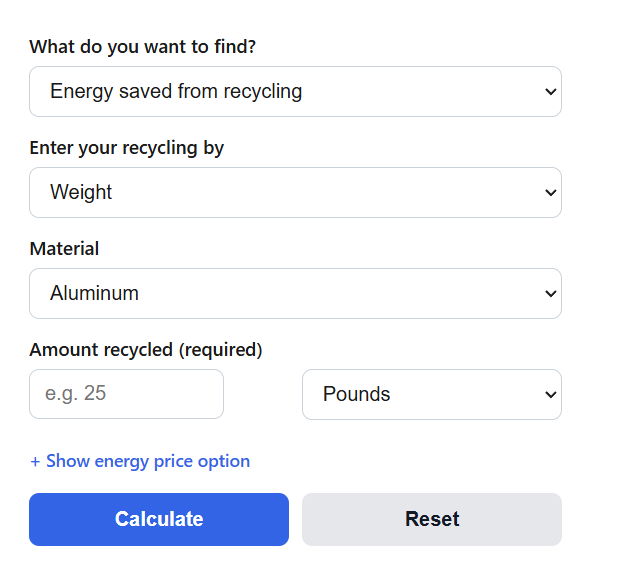
Calculate the energy saved by recycling aluminum, plastic, paper, glass, and steel in kWh, by weight or item count, with everyday energy equivalents.
- All Everyday Life & Education Calculators
- Recycling Energy Savings Calculator
- Carbon Offset Cost Calculator
- Flight Carbon Footprint Calculator
- Carbon Footprint of Driving Calculator
Recycling Energy Savings Formula
The energy saved by recycling is the amount of material you recycle multiplied by the energy that material saves per ton compared with making it new from raw ore, pulp, or petroleum:
E = S * W
To work backward and find how much you must recycle to reach an energy goal, divide the goal by the per-ton saving:
W = E / S
When you enter a count of items instead of a weight, the weight is the count times the typical weight of one item, and that weight is then used in the formula above:
W = n * w
Variables:
- E is the energy saved, in kilowatt-hours (kWh)
- S is the energy saved per ton for that material, in kWh per ton
- W is the weight recycled, in tons
- n is the number of items you recycle
- w is the typical weight of one item, in tons
Set “What do you want to find?” to energy saved to enter an amount and read the kWh saved, or to the amount mode to enter a kWh goal and read the weight you would have to recycle. Enter your recycling by weight when you know the pounds or kilograms, or by item count when you only know how many cans or bottles you have. The optional energy price field multiplies the kWh saved by your electricity rate to show the dollar value of that energy.
Energy Saved by Material
Different materials save very different amounts of energy because some are far more expensive to make from raw materials than others. Aluminum saves the most because smelting new aluminum from bauxite is extremely energy intensive, while new glass is cheap to melt, so recycled glass saves comparatively little. The figures below are commonly cited energy-saved-per-ton values used across recycling programs.
| Material | Energy saved per ton (kWh) | Approx. savings vs new | Powers an average home for |
|---|---|---|---|
| Aluminum | 14,000 | 95% | 483 days |
| Plastic (PET) | 5,774 | ~90% | 199 days |
| Paper (mixed) | 4,100 | ~40% | 141 days |
| Steel / tin cans | 642 | 60-74% | 22 days |
| Newspaper | 601 | ~40% | 21 days |
| Glass | 42 | 25-30% | 1.4 days |
The next table shows the energy saved by recycling a single common item, using typical item weights, so you can picture the impact of one can or bottle. The last column converts that energy into hours of runtime for a 10 watt LED bulb.
| Item | Typical weight | Energy saved | 10 W LED bulb runtime |
|---|---|---|---|
| Aluminum can | 15 g | 0.23 kWh | 23 hours |
| Plastic bottle (PET) | 10 g | 0.064 kWh | 6.4 hours |
| Glass bottle | 300 g | 0.014 kWh | 1.4 hours |
Example Problems
Example 1: energy saved by weight. You recycle 100 pounds of aluminum. First convert to tons: 100 divided by 2,000 equals 0.05 tons. Multiply by the aluminum rate: 0.05 times 14,000 equals 700 kWh saved. That is roughly enough electricity to power an average US home for about 24 days.
Example 2: recycling needed for a goal. You want your recycling to save 500 kWh, and you only recycle glass. Divide the goal by the glass rate: 500 divided by 42 equals about 11.9 tons, or roughly 23,810 pounds. Because glass saves so little energy per ton, reaching the same 500 kWh with aluminum would take only about 71 pounds.
FAQ
How much energy does recycling one aluminum can save?
Recycling a single aluminum can saves about 0.23 kWh, which is enough to run a 10 watt LED bulb for roughly a full day or a laptop for several hours. Aluminum stands out because making new aluminum from bauxite ore uses about 95 percent more energy than remelting a used can. This is why aluminum returns the largest energy savings of any common household material.
Why does glass save so little energy compared with aluminum?
New glass is made mainly from sand, soda ash, and limestone, which are cheap to melt, so recycled glass only trims energy use by about 25 to 30 percent. Recycling glass still cuts mining, landfill, and raw material use, but the energy saved per ton is small next to metals and plastics. If your goal is maximum energy savings, focus on aluminum and plastic first.
Is the energy saved the same as the carbon saved?
No. This calculator reports energy in kilowatt-hours, not greenhouse gas emissions. The two are related, because most energy still comes from fuels that release carbon, but the exact carbon savings depend on the energy mix used in production and would need emission factors to estimate. Use the kWh figure here as an energy measure, and treat any carbon estimate as a separate calculation.