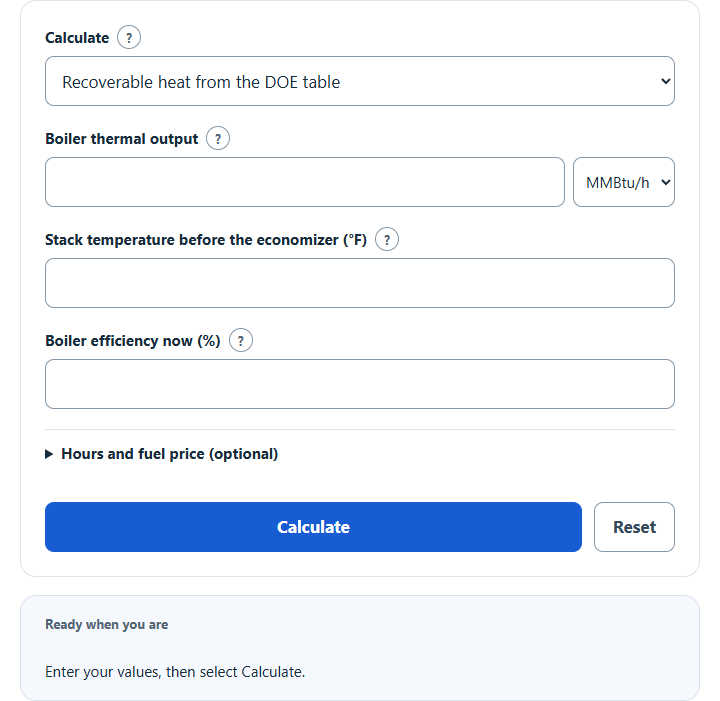
Estimate the heat a boiler economizer can recover from flue gas, the fuel and money it saves in a year, and the efficiency gain from a cooler stack.
- All Construction Calculators
- Heat Recovery Calculator
- Boiler Efficiency Calculator
- Boiler Steam To Fuel Ratio Calculator
- Boiler Blowdown Rate Calculator
Calculator Functions
The calculator estimates how much heat a feedwater economizer can take back from a boiler's flue gas, and what that is worth in fuel each year. Select a function to open it in the calculator.
| Function | Use it when | You enter |
|---|---|---|
| Recoverable heat from the DOE table | You have a natural gas boiler and know its output and stack temperature | Boiler output, stack temperature and efficiency |
| Savings from a lower stack temperature | You know how far the stack temperature will drop | Fuel input, stack temperatures before and after, efficiency and fuel |
The optional settings add operating hours, 8,400 a year unless you change them, and a fuel price for the yearly saving in dollars.
Flue Gas Heat Recovery Formulas
| F | Fuel saved per year, MMBtu |
| R | Recovered heat taken from the flue gas, MMBtu/h, from the DOE table below |
| h | Operating hours per year |
| η | Boiler efficiency: the fraction of fuel energy the boiler turns into steam; dividing by it converts heat saved into fuel saved |
Boiler flue gases often leave the stack more than 100°F to 150°F hotter than the steam the boiler makes. An economizer passes that gas over the incoming feedwater, so less fuel is needed to raise steam; it can often cut fuel use by 5% to 10% [1].
Recoverable heat table
| Initial stack temperature | 25 MMBtu/h boiler | 50 MMBtu/h | 100 MMBtu/h | 200 MMBtu/h |
|---|---|---|---|---|
| 400°F | 1.3 | 2.6 | 5.3 | 10.6 |
| 500°F | 2.3 | 4.6 | 9.2 | 18.4 |
| 600°F | 3.3 | 6.5 | 13.0 | 26.1 |
Between the listed values the calculator interpolates in a straight line. Outside the 25 to 200 MMBtu/h range it scales the nearest column in proportion to output; across the table, recoverable heat is close to proportional to boiler output.
Rule of thumb for stack temperature
Here Δη is the efficiency gain in percentage points and ΔT the drop in stack temperature in °F. Boiler efficiency generally rises by 1% for every 40°F the flue gas temperature falls [1]. For the same steam output, fuel use then falls by the gain divided by the new efficiency: going from 80% to 85% saves 5 ÷ 85 = 5.9% of the fuel.
Worked example
An 80% efficient natural gas boiler makes 45,000 lb/h of 150 psig steam from 117°F feedwater, a thermal output of 45,000 × (1,195.5 − 84.97) Btu/lb = 50 MMBtu/h. Its stack temperature is 500°F, so the table gives 4.6 MMBtu/h of recoverable heat. Over 8,400 hours a year at $8.00 per MMBtu of fuel, the saving is 4.6 × 8.00 × 8,400 ÷ 0.80 = $386,400 a year [1].
Limits of This Estimate
- Flue gas should not be cooled below about 250°F for natural gas, 300°F for coal and low-sulfur fuel oils, or 350°F for high-sulfur fuel oils, to keep it from condensing and corroding the stack [1]. The table assumes cooling to 250°F, so it applies to natural gas.
- Measure the stack temperature after the boiler has been tuned, with excess air close to optimum and all heat transfer surfaces clean [1].
- Economizers suit boilers that lack enough heat transfer surface. Boilers over 100 boiler horsepower, running above 75 psig and loaded heavily all year, are the strongest candidates [1].
- The 1% per 40°F figure is a general rule. The actual gain depends on the fuel, the excess air and the boiler.
Sources
- U.S. Department of Energy, Advanced Manufacturing Office, Steam Tip Sheet #3: Use Feedwater Economizers for Waste Heat Recovery (DOE/GO-102012-3412, January 2012): the 1% per 40°F rule, the recoverable heat table, the worked example, the lowest flue gas temperatures by fuel and which boilers suit an economizer