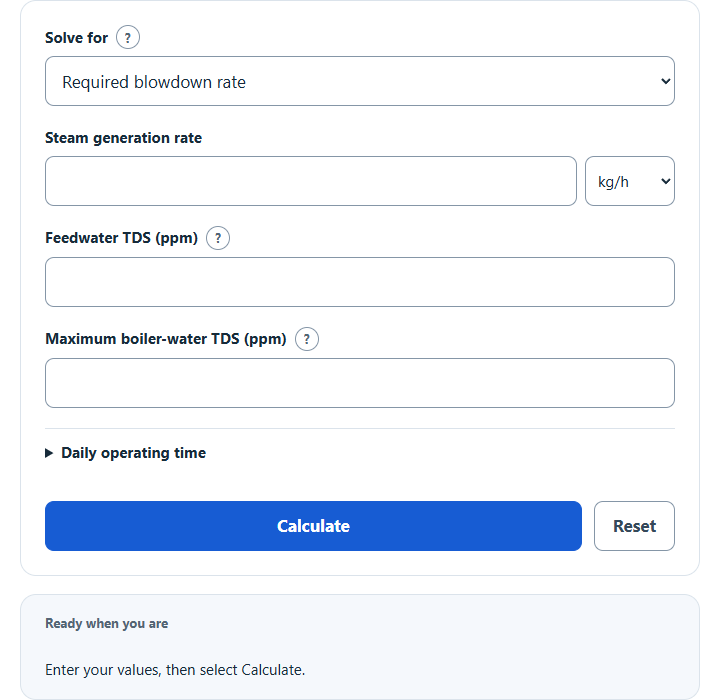
Calculate boiler blowdown rate from steam output, feedwater TDS and boiler-water TDS limit, or solve for the supported steam rate or maximum feedwater TDS.
- All Construction Calculators
- Cooling Tower Cycles of Concentration Calculator
- Steam Velocity Calculator
Boiler Blowdown Rate Formula
The following formula is used to calculate the Boiler Blowdown Rate.
Variables:
- BBR is the Boiler Blowdown Rate (kg/h)
- SC is the steam consumption (kg/h)
- TDSW is the total dissolved solids in the water (ppm)
- TDSM is the maximum allowable dissolved solids (ppm)
To calculate the boiler blowdown rate, multiply the steam generation rate by the feedwater TDS, then divide by the maximum boiler-water TDS minus the feedwater TDS. The maximum must exceed the feedwater TDS. Select a solve mode, enter the required values and units, then select Calculate. In Daily operating time, blank hours means 24 hours; this setting affects daily discharge only. Use the boiler manufacturer’s water-quality limits.
How to Calculate Boiler Blowdown Rate?
The following steps outline how to calculate the Boiler Blowdown Rate.
- First, determine the steam consumption (kg/h).
- Next, determine the total dissolved solids in the water (ppm).
- Next, determine the maximum allowable dissolved solids (ppm).
- Next, gather the formula from above: BBR = SC * TDSW / (TDSM-TDSW).
- Finally, calculate the Boiler Blowdown Rate.
- After inserting the variables and calculating the result, check your answer with the calculator above.
Example Problem:
Use the following variables as an example problem to test your knowledge.
steam consumption (kg/h) = 50
total dissolved solids in the water (ppm) = 20
maximum allowable dissolved solids (ppm) = 30
BBR = 50 × 20 / (30 − 20) = 100 kg/h