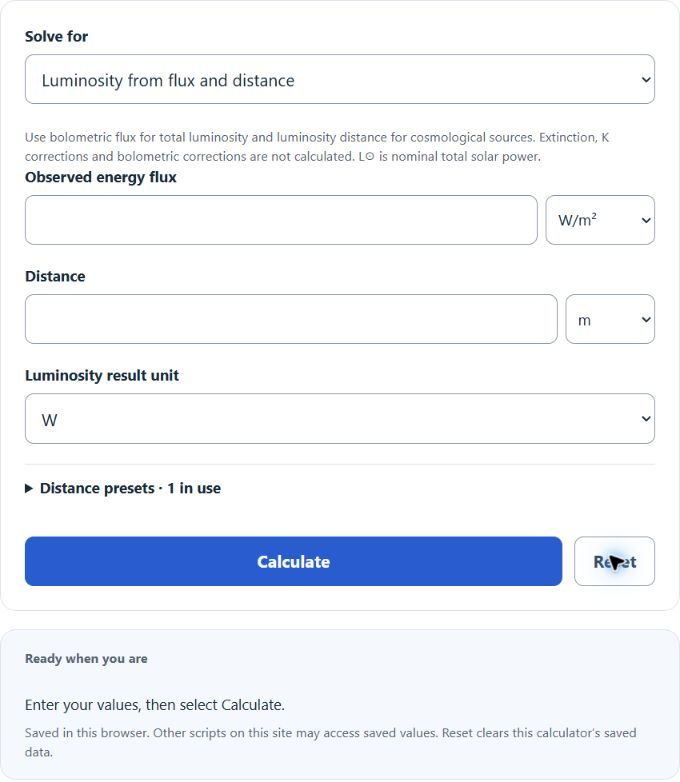
Convert flux to luminosity with L = 4πd²F: enter a star’s observed flux and distance to get luminosity in watts or solar units, or solve for flux.
Related Calculators
- Star luminosity from radius and temperature
- Light Intensity Calculator
- Radiation Distance Calculator
- Transmission Coefficient Calculator
- Energy Calculator
- All Physics Calculators
Calculator Functions
| Function | What it does | What it requires |
|---|---|---|
| Luminosity from flux and distance | Finds the luminosity of a source from its observed flux | Requires observed energy flux and distance |
| Flux from luminosity and distance | Finds the flux received at a distance | Requires luminosity and distance |
| Distance from luminosity and flux | Finds the distance to a source of known luminosity | Requires luminosity and observed energy flux |
| Absolute magnitude from luminosity | Converts a luminosity to an absolute magnitude | Requires luminosity and a reference magnitude |
| Luminosity from absolute magnitude | Converts an absolute magnitude to a luminosity | Requires absolute magnitude and a reference magnitude |
Flux is entered in W/m², W/cm² or erg/(s·cm²), luminosity in W, erg/s or L☉, and distance in m, cm, km, AU, ly, pc, kpc or Mpc. Distance presets fill in 1 AU, 1 ly, 1 pc, 10 pc, 1 kpc or 1 Mpc. The magnitude functions offer a bolometric reference, a V-band reference or a custom one, and a custom or V-band reference also needs the matching reference power in watts.
Flux to Luminosity Formulas
| L | Luminosity (W) |
| d | Distance to the source (m) |
| F | Observed energy flux (W/m²) |
Luminosity from flux and distance
The flux is treated as spread evenly over a sphere of radius d. The Sun is the standard check: sunlight arrives at 1,361 W/m² at 1 AU, which gives 4π × (1.495978707 × 10¹¹)² × 1,361 = 3.8275 × 10²⁶ W. The International Astronomical Union rounds this to a nominal solar luminosity of 3.828 × 10²⁶ W [1], and that is the value of 1 L☉ here. One AU is 149,597,870,700 m and one parsec is 648,000 ÷ π AU [2].
Flux from luminosity and distance
A star of 1 L☉ seen from 10 pc delivers 3.828 × 10²⁶ ÷ (4π × (3.0857 × 10¹⁷)²) = 3.199 × 10⁻¹⁰ W/m².
Distance from luminosity and flux
A source of 3.828 × 10²⁶ W observed at 1,361 W/m² is 1.0001 AU away. Both the luminosity and the flux must be greater than zero.
Absolute magnitude from luminosity
log₁₀(L ÷ Lref) [2]
The bolometric reference is the Sun: Lref = 3.828 × 10²⁶ W at Mref = 4.74 [2]. A star of 100 L☉ has M = 4.74 − 2.5 × 2 = −0.26. The V-band reference changes Mref to 4.83 and uses the entered band power as Lref.
Luminosity from absolute magnitude
10^(0.4 × (Mref − M))
An absolute bolometric magnitude of 0 gives 3.828 × 10²⁶ × 10^(0.4 × 4.74) = 3.0128 × 10²⁸ W, which is the zero point the IAU set for the bolometric scale [2].
Limits of This Estimate
- The formula assumes the source shines equally in all directions. For a beamed source the result is the luminosity it would need if it did.
- A flux measured in one band gives the luminosity in that band, not the total. Total luminosity needs the bolometric flux. A flux density per hertz or per unit wavelength is not an energy flux and cannot be entered directly.
- Dimming by dust and corrections for redshift are not applied. For a distant galaxy, the distance in the formula is the luminosity distance.
- The V-band solar magnitude of 4.83 is a rounded convention that varies slightly between calibrations, and the calculator does not convert V-band power to total luminosity. These estimates are based on the best available data and estimations.
Sources
- International Astronomical Union, 2015 Resolution B3 on Recommended Nominal Conversion Constants for Selected Solar and Planetary Properties: nominal solar luminosity and its link to solar irradiance at 1 AU
- International Astronomical Union, 2015 Resolution B2 on Recommended Zero Points for the Absolute and Apparent Bolometric Magnitude Scales: bolometric magnitude formula, zero point, solar value and the parsec