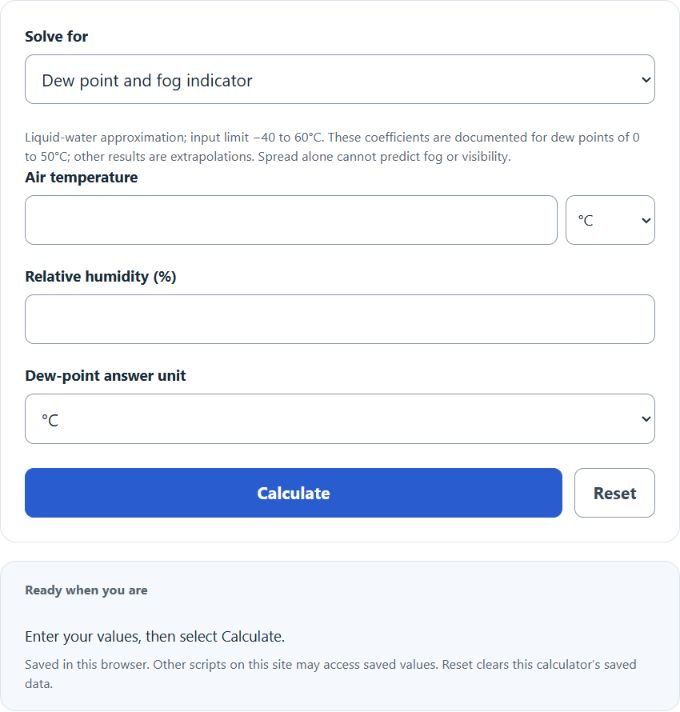
Calculate dew point, relative humidity, and fog risk from air temperature plus humidity or dew point in Celsius, Fahrenheit, or Kelvin.
Related Calculators
- Evaporative Cooling Calculator
- Lapse Rate Calculator
- Air Weight Calculator
- Initial Temperature Calculator
- All Physics Calculators
Fog Equation (Magnus-Tetens Approximation)
The dew point is calculated using the Magnus-Tetens approximation, an empirical estimate of dew point over liquid water:
where:
- DP = dew point temperature (°C)
- α = (a · T / (b + T)) + ln(RH / 100)
- a = 17.27, b = 237.7°C (liquid-water coefficients documented for dew points from 0°C to 50°C)
- This calculator estimates liquid-water dew point; it does not calculate frost point over ice
- The calculator limits air and dew-point temperatures to −40°C through 60°C. This is a computational guard, not a validated accuracy range; results outside the documented 0°C to 50°C dew-point range are labeled extrapolations
Fog Formation Thresholds (T - DP Spread)
The temperature-to-dew-point spread indicates how much cooling would bring air to saturation under fixed conditions. The following bands are descriptive calculator cues, not fog probabilities or visibility predictions. Wind, moisture, cooling and local conditions also matter:
| T - DP Spread | Calculator cue | Interpretation limit |
|---|---|---|
| Less than 2°C (3.6°F) | Near saturation | Small spread; fog is not guaranteed |
| 2 to less than 5°C (3.6 to less than 9°F) | Some cooling needed | Further cooling or moisture may bring saturation |
| 5°C or more (9°F or more) | Larger spread | More cooling or moisture is needed under this simple model |
Types of Fog
| Type | Formation Mechanism | Required Conditions |
|---|---|---|
| Radiation | Surface radiates heat overnight; overlying air cools to dew point | Clear skies, calm winds (under 5 knots), high RH |
| Advection | Warm moist air mass moves over a cooler surface | Wind required; common along coastlines and over cold ocean currents |
| Upslope | Moist air rises over terrain and cools adiabatically to dew point | Sustained onshore or upslope flow, moist air mass |
| Steam (Evaporation) | Cold air flows over warm water; evaporation saturates the cold surface layer | Cold air above a warmer water surface; local moisture and mixing affect formation |
| Frontal (Precipitation) | Rain falls into dry air below, evaporates, and raises dew point to air temperature | Warm front with precipitation descending into a dry layer |
What is Dew Point?
Dew point is the temperature to which air must cool at constant pressure and moisture content for condensation to begin. It is an absolute measure of atmospheric water vapor content: unlike relative humidity, dew point does not change when air temperature changes unless moisture is physically added to or removed from the air mass.
Practical dew point reference values: below 10°C (50°F) feels comfortable and dry; 15-20°C (59-68°F) is noticeably humid; above 21°C (70°F) is oppressive. For fog prediction, the critical value is not the absolute dew point but the gap between current air temperature and dew point. A small spread with light winds and clear skies can favor radiation fog, but it does not guarantee fog by sunrise.
Example Calculation
Scenario: Evening observation shows T = 15°C, RH = 80%. Will fog form overnight?
- Calculate α: (17.27 × 15) / (237.7 + 15) + ln(0.80) = 1.025 + (-0.223) = 0.802
- Calculate DP: (237.7 × 0.802) / (17.27 - 0.802) = 190.6 / 16.47 = 11.6°C
- T - DP spread = 15 - 11.6 = 3.4°C
- Interpretation: About 3.4°C of cooling would bring this air to saturation if pressure and moisture remain unchanged. Fog formation and visibility cannot be determined from these two measurements alone.