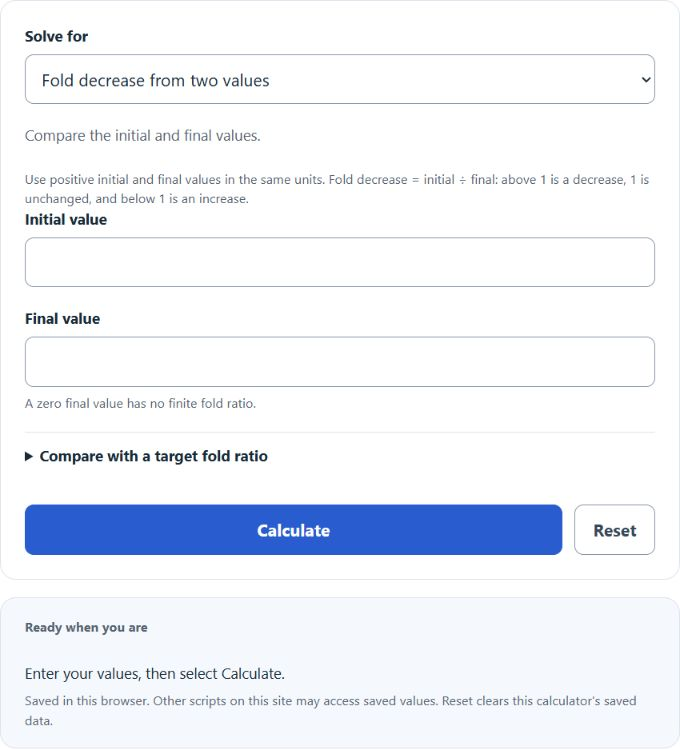
Calculate fold decrease, initial value, or final value and compare percent decrease, remaining fraction, log2 fold change, and a target fold reduction.
Fold Decrease Formula
The following formula is used to calculate the fold decrease:
Variables:
- FD is the fold decrease
- IV is the initial value
- FV is the final value
To calculate the fold decrease, divide the initial value by the final value.
What is Fold Decrease?
Here, fold decrease means initial value divided by final value, using positive values in the same units. A change from 1000 to 100 is a 10-fold decrease: 10% remains and the percent decrease is 90%. A ratio of 1 means no change; a ratio below 1 describes an increase. A zero final value has no finite fold ratio. The calculator also solves either value from the other value and a fold ratio.
How to Calculate Fold Decrease?
The following steps outline how to calculate the fold decrease:
- First, determine the initial value (IV).
- Next, determine the final value (FV).
- Use the formula FD = IV / FV to calculate the fold decrease (FD).
- Finally, enter the initial and final values into the calculator above to verify the fold decrease.
Example Problem:
Use the following variables as an example problem to test your knowledge.
Initial Value (IV) = 200 units
Final Value (FV) = 50 units