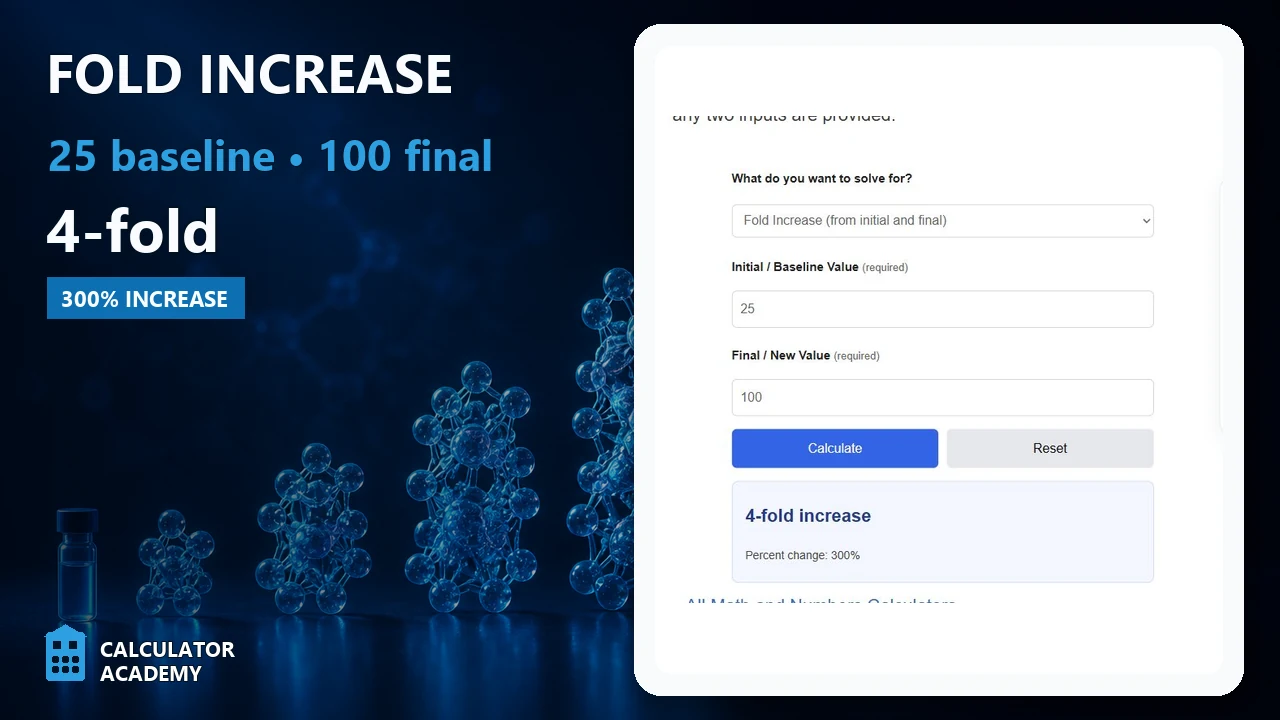
Calculate fold increase from a baseline and new value, or find the missing baseline or new value when any two inputs are provided.
- All Math and Numbers Calculators
- Scale Factor Dilation Calculator
- Percentage Difference Calculator
- Scaling Down Calculator
Fold Increase Formula
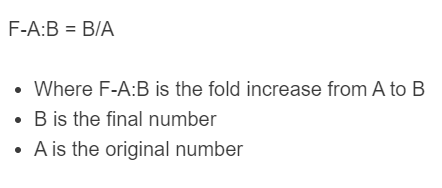
The fold increase between two values is calculated as the ratio of the new value to the baseline value:
Fold Increase = New Value / Baseline Value
If a protein concentration rises from 5 ng/mL to 15 ng/mL, the fold increase is 15 / 5 = 3. This means the concentration tripled, or there was a 3-fold increase.
To convert a fold increase to a percent change: Percent Change = (Fold Increase – 1) x 100. A 3-fold increase equals a 200% increase, not 300%. This distinction trips up many researchers and students.
Fold Increase to Percent Change Reference Table
| Fold Value | Percent Change | Meaning | Log2 Fold Change |
|---|---|---|---|
| 0.25 | -75% | Quarter of original | -2.00 |
| 0.5 | -50% | Half of original | -1.00 |
| 1.0 | 0% | No change | 0.00 |
| 1.5 | +50% | 50% more than original | 0.58 |
| 2.0 | +100% | Double the original | 1.00 |
| 3.0 | +200% | Triple the original | 1.58 |
| 4.0 | +300% | Quadruple the original | 2.00 |
| 5.0 | +400% | 5x the original | 2.32 |
| 10.0 | +900% | 10x the original | 3.32 |
| 20.0 | +1,900% | 20x the original | 4.32 |
| 100.0 | +9,900% | 100x the original | 6.64 |
Fold Increase vs. Fold Change
Fold change is the broader term. It covers both increases (fold > 1) and decreases (fold < 1). A fold change of 0.5 represents a 2-fold decrease, meaning the new value is half the original. A fold change of 2 represents a 2-fold increase, meaning the new value is double the original.
In practice, “fold increase” should only be used when the new value exceeds the baseline. When reporting decreases, use “fold decrease” or state the fold change value directly (e.g., “a fold change of 0.25” rather than “a negative fold increase”).
The “N-Fold Increase” Ambiguity Problem
A long-standing source of confusion in scientific literature: does a “3-fold increase” mean the value tripled (new = 3x original) or increased by 3 times (new = 4x original)?
The accepted convention in most scientific fields is that an N-fold increase means the new value is N times the original. So a 3-fold increase from 10 yields 30. A 1-fold “increase” means no change at all, since the value is 1 times the original. Researchers have published commentary arguing the phrase should be avoided entirely due to how often it is misused. When precision matters, stating the ratio directly (e.g., “the value increased to 3x baseline”) removes all ambiguity.
Log2 Fold Change
In genomics and bioinformatics, fold changes are typically expressed on a log2 scale. The log2 fold change equals log2(New Value / Baseline Value). This transformation is standard in RNA-Seq and microarray analysis because it centers data symmetrically around zero: a 2-fold increase becomes +1, while a 2-fold decrease becomes -1.
Practical interpretation: a log2 fold change of 1.5 means the expression increased by a factor of 2^1.5 = 2.83. A log2 fold change of -2 means the expression dropped to 1/4 of the original (2^-2 = 0.25). Most differential expression analyses flag genes with an absolute log2 fold change above 1 (corresponding to a 2-fold change in either direction) as biologically significant.
Where Fold Increase Is Used
Gene Expression Analysis: Comparing mRNA or protein levels between treated and untreated cells. A drug that causes a 5-fold increase in a tumor suppressor gene’s expression may indicate therapeutic potential.
Microbiology and Serial Dilution: Bacterial colony counts after incubation are compared to initial inoculum. If a culture grows from 10^3 to 10^6 CFU/mL, that is a 1,000-fold increase, often expressed as a 3-log increase.
Pharmacology and Dose Response: IC50 shifts between drug-sensitive and drug-resistant cell lines are reported as fold changes. A 10-fold increase in IC50 suggests significant resistance development.
Finance and Investment: An investment growing from $10,000 to $50,000 represents a 5-fold increase. At 7% annual returns, the Rule of 72 predicts a 2-fold increase roughly every 10.3 years.
Epidemiology: Disease incidence reported as fold increases over baseline rates. A 4-fold increase in antibody titer between acute and convalescent serum samples is a standard criterion for confirming recent infection.
How to Calculate a Fold Increase
1. Record the baseline value. Example: initial bacterial count = 500 CFU/mL.
2. Record the new value after the change. Example: count after 24 hours = 4,000 CFU/mL.
3. Divide the new value by the baseline: 4,000 / 500 = 8.
4. The fold increase is 8, meaning the bacterial population grew to 8 times its original size, a 700% increase.
FAQ
What does a 2-fold increase mean?
A 2-fold increase means the final value is 2 times the original. Starting from 50, a 2-fold increase yields 100. This equals a 100% increase.
What is the difference between fold increase and percent increase?
Fold increase is a multiplicative ratio (new/original). Percent increase is ((new – original) / original) x 100. They are related by the formula: Fold = (Percent / 100) + 1. A 150% increase is a 2.5-fold increase.
Can fold increase be less than 1?
A fold value below 1 indicates a decrease, not an increase. A fold change of 0.5 is a 2-fold decrease (the value halved). The term “fold increase” should only apply when the ratio exceeds 1.
What is a 4-fold increase in antibody titer?
A 4-fold rise in antibody titer (e.g., from 1:32 to 1:128) between paired serum samples is a widely used diagnostic threshold for confirming seroconversion or recent infection in clinical immunology.
How do I convert fold increase to log2 fold change?
Take the base-2 logarithm of the fold value. A 4-fold increase has a log2 fold change of 2 (since 2^2 = 4). A 1.5-fold increase has a log2 fold change of approximately 0.58.