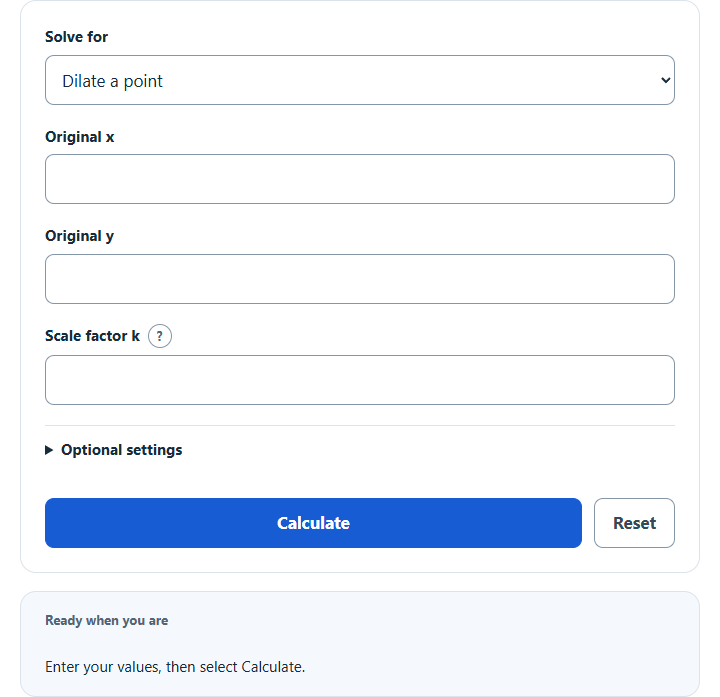
Find a dilation’s image point from coordinates and a scale factor, find the scale factor of a dilation, or scale a segment length, about any center.
- All Math and Numbers Calculators
- Scale Calculator
- Magnification Calculator
- Field of View Calculator
- Dimensional Analysis Calculator
Calculator Functions
| Function | What it does | What it requires |
|---|---|---|
| Dilate a point | Finds the image of a point after a dilation | Requires the original x and y and the scale factor k, with the center of dilation as an option |
| Find scale factor | Finds the scale factor that carries a point to its image | Requires the original point and the image point, with the center of dilation as an option |
| Dilate a segment length | Finds the image length of a segment, or the original length from the image length | Requires one segment length and the scale factor k |
A blank center means the origin (0, 0). Values can be typed as fractions such as 1/2 or 2/3, and the scale factor can be negative. The segment function also shows the area scale, k².
Scale Factor Dilation Formulas
| P | Original point (x, y) |
| P′ | Image point (x′, y′) |
| C | Center of dilation (cx, cy) |
| k | Scale factor |
A dilation moves each point along the line through the center and multiplies its distance from the center by the scale factor [1]. In coordinates, x′ = cx + k × (x − cx) and y′ = cy + k × (y − cy). With the center at the origin this is simply (k × x, k × y). A factor above 1 enlarges the figure, a factor between 0 and 1 shrinks it, and a factor of 1 leaves it the same size. A negative factor puts the image on the opposite side of the center.
Dilate a point
Dilating (−3, 4) by a scale factor of −4 about the origin gives (−4 × −3, −4 × 4) = (12, −16). Dilating (−4, 7) by 1/2 about the center (2, 5) gives x′ = 2 + 0.5 × (−4 − 2) = −1 and y′ = 5 + 0.5 × (7 − 5) = 6, so the image is (−1, 6). To dilate a polygon, dilate each vertex in turn.
Find scale factor
The y coordinates must give the same ratio. If (−2, 6) maps to (−1, 3) about the origin, k = −1 ÷ −2 = 0.5, and 3 ÷ 6 agrees. The calculator divides using the coordinate that lies farther from the center and then checks the other one. If the two ratios differ, the points are not a dilation about that center and the result says so. An original point that sits on the center cannot give a scale factor.
Dilate a segment length
A dilated segment is longer or shorter in the ratio of the scale factor [1]. A segment of 8 units dilated by 3/2 becomes 12 units. Going backward, an image of 21 units made with a scale factor of 3/4 came from a segment of 21 ÷ 0.75 = 28 units. A perimeter scales the same way as a length.
Area scales by k², because both dimensions are multiplied by k. A trapezoid with an area of 40 cm² dilated by a scale factor of 4 has an image area of 40 × 16 = 640 cm². A square of 9 square units dilated by 3 becomes 81 square units. For a solid, surface area also scales by k² and volume by |k|³.
Limits of This Estimate
- The calculator works on one point or one length at a time and does not draw the figure on a graph.
- A scale factor found from one pair of points assumes the chosen center is correct. A different center gives a different factor for the same two points.
- A scale factor of 0 collapses every point onto the center, so an original length cannot be recovered from the image.
Sources
- Common Core State Standards for Mathematics, Glossary and standard HSG-SRT.A.1: definition of a dilation by a center and scale factor, and the segment-length ratio