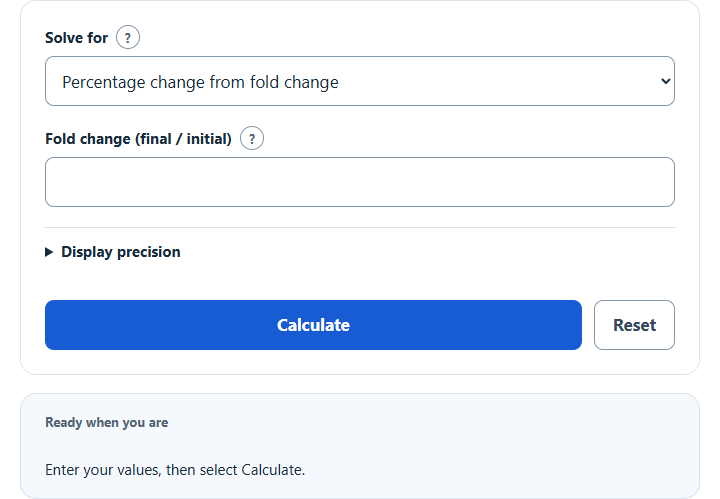
Convert a fold change to a percentage change, turn a percent change back into fold change, or find the fold increase or decrease between two values.
Calculator Functions
| Function | What it does | What it requires |
|---|---|---|
| Percentage change from fold change | Converts a fold change into the percentage increase or decrease it represents | Requires the fold change, which is the final value divided by the initial value: 1 for unchanged, 2 for doubled, 0.5 for halved |
| Fold change from percentage change | Converts a percentage change back into a fold change | Requires a signed percentage of −100 or more: positive for an increase, negative for a decrease |
| Fold and percentage change from two values | Finds the fold change, the percentage change and the absolute change between two measurements | Requires a positive initial value and a final value of zero or more, in the same unit |
Every result lists the fold change, the percentage change, the final value as a percent of the initial value, the direction of the change and the log₂ fold change. An optional setting shows 0 to 4 decimal places.
Fold to Percentage Formulas
| F | Fold change: the final value divided by the initial value |
| % | Percentage change from the initial value. A negative result is a decrease |
Percentage change from fold change
The main formula applies directly. A fold change of 1.5 is (1.5 − 1) × 100 = 50%, a 3-fold change is 200%, and a fold change of 0.5 is −50%. The final value as a percent of the initial value is a different figure, F × 100: a 3-fold change leaves the final value at 300% of the original, which is a 200% increase.
| Fold change | Percentage change | Final as % of initial |
|---|---|---|
| 0.25 | −75% | 25% |
| 0.5 | −50% | 50% |
| 0.75 | −25% | 75% |
| 1 | 0% | 100% |
| 1.25 | 25% | 125% |
| 1.5 | 50% | 150% |
| 2 | 100% | 200% |
| 3 | 200% | 300% |
| 4 | 300% | 400% |
| 5 | 400% | 500% |
| 6 | 500% | 600% |
| 10 | 900% | 1,000% |
| 20 | 1,900% | 2,000% |
| 100 | 9,900% | 10,000% |
Fold change from percentage change
This is the main formula rearranged. A 100% increase is 1 + 100 ÷ 100 = a 2-fold change, and a 50% decrease is 1 − 0.5 = 0.5-fold. A change below −100% is rejected, because a quantity that cannot be negative cannot fall by more than all of itself.
Fold and percentage change from two values
The percentage change is (final − initial) ÷ initial × 100, which equals (F − 1) × 100. A value that goes from 20 to 50 has a fold change of 50 ÷ 20 = 2.5, a percentage change of 150% and an absolute change of 30 units. An initial value of zero has no fold change.
log₂ fold change
% = (2^log₂FC − 1) × 100
A doubling has a log₂ fold change of 1 and a halving has −1, so increases and decreases of the same size sit the same distance from zero. A fold change of 1.5 has a log₂ fold change of 0.58, and a log₂ fold change of 2 is a 4-fold change, or 300%. A fold change of zero has no finite log₂ value.
Limits of This Estimate
- Fold change here always means final ÷ initial. A phrase such as “a 3-fold increase” is sometimes used loosely for a value that rose by three times the original, which would be a 4-fold change. Checking the two underlying values with the third function removes the doubt.
- The calculator covers quantities that cannot be negative, so the fold change is zero or more and the percentage change is −100% or more.
- A fold change describes the size of a change only. It does not show whether the change is statistically, biologically or financially significant.