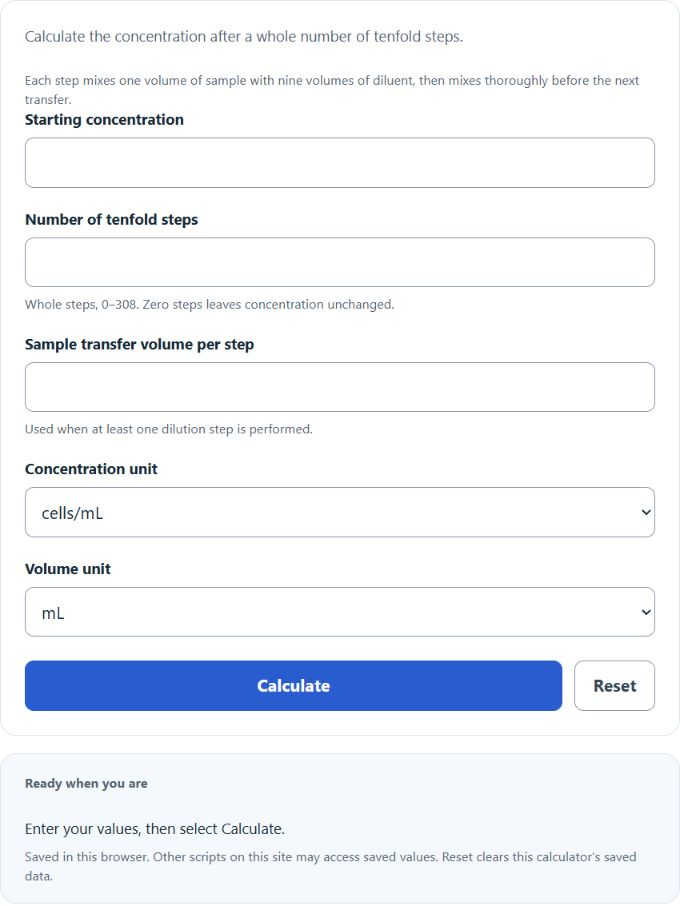
Enter the starting concentration, a whole number of tenfold dilution steps, and the sample transfer volume to calculate the final concentration and diluent required.
10-Fold Dilution Formula
The following formula is used to calculate the final concentration after a 10-fold dilution.
Variables:
- C2 is the final concentration after dilution
- C1 is the initial concentration before dilution
- D is the cumulative dilution factor: 10 for one step or 10ⁿ for n whole tenfold steps
To calculate the final concentration after a 10-fold dilution, divide the initial concentration by the dilution factor.
What is a 10-Fold Dilution?
A 10-fold dilution is a process in which a substance is diluted to one-tenth of its original concentration. This is typically done by taking one part of the substance and adding nine parts of a diluent, such as water or another solvent. The result is a solution that is 10 times less concentrated than the original. This process can be repeated multiple times to achieve even lower concentrations.
How to Calculate 10-Fold Dilution?
The following steps outline how to calculate a 10-Fold Dilution.
- First, determine the initial concentration before dilution (C1).
- Next, determine the dilution factor (D). In this case, the dilution factor is 10 for a 10-fold dilution.
- Next, use the formula C2 = C1 / D to calculate the final concentration after dilution (C2).
- Finally, calculate the 10-Fold Dilution by inserting the values of C1 and D into the formula and solving for C2.
- After calculating the result, check your answer for accuracy.
Example Problem:
Use the following variables as an example problem to test your knowledge:
Initial concentration before dilution (C1) = 50
Dilution factor (D) = 10
The final concentration is 50 ÷ 10 = 5 in the same concentration unit. For a 1 mL transfer, add 9 mL of diluent to prepare 10 mL. Three repeated steps give D = 1,000. Zero steps gives D = 1 and leaves the starting concentration unchanged. Thorough mixing, analyte-free diluent and no analyte loss or gain are assumed.