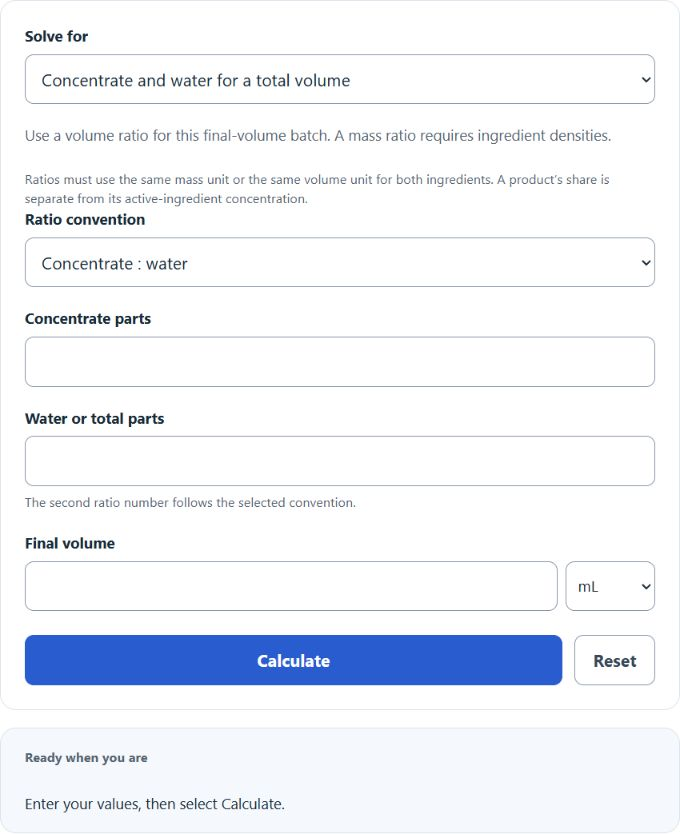
Calculate ingredient amounts, dilution ratios, or stock volume. Choose the solve task and ratio convention explicitly; compare ingredient amounts on the same mass or volume basis.
Related Calculators
- Percentage Strength Calculator
- Percent Volume Calculator
- Molarity Calculator
- g/mL To mol/L Calculator
- All Chemistry Calculators
Liquid Dilution Ratio Formula
The liquid dilution ratio compares the amount of water to the amount of substance in a mixture. It answers a simple question: how many parts of water are used for each 1 part of substance?
A result of 12.5 means the mixture has a 12.5:1 water-to-substance ratio. In general, a larger ratio means more water relative to the substance, while a smaller ratio means a stronger mixture.
Variable Definitions
- LDR = liquid dilution ratio
- PW = total parts water
- PS = total parts substance
The word parts is flexible. A part can be liters, milliliters, gallons, ounces, or another consistent unit. What matters is that the quantities are measured on a compatible basis so the ratio reflects the intended mix.
How to Calculate the Liquid Dilution Ratio
- Measure the total amount of water.
- Measure the total amount of substance.
- Divide water by substance.
- Express the result as water:substance.
If water is 50 parts and substance is 4 parts, the ratio is:
This is read as 12.5:1, meaning 12.5 parts water for every 1 part substance.
Rearranged Forms
If you know the target dilution ratio and one ingredient amount, you can solve for the other quantity directly.
| Purpose | Formula |
|---|---|
| Find water needed | PW = LDR × PS |
| Find substance allowed | PS = (PW) / (LDR) |
| Find total mixture parts | TM = PW + PS |
Example Applications
Known amounts: If a mixture uses 60 parts water and 3 parts substance, the ratio is:
The mixture is 20:1.
Known target ratio: If you want an 8:1 ratio and you already have 5 parts substance, the water required is:
You would mix 40 parts water with 5 parts substance.
How to Interpret the Result
| Ratio | Meaning | Relative substance share |
|---|---|---|
| 1:1 | Equal parts water and substance | 50% |
| 4:1 | 4 parts water for every 1 part substance | 20% |
| 10:1 | 10 parts water for every 1 part substance | About 9.09% |
| 20:1 | 20 parts water for every 1 part substance | About 4.76% |
As the first number in the ratio increases, the mixture becomes more diluted because more water is being used per unit of substance.
Useful Mixing Relationships
When the ratio stays the same, the mixture can be scaled up or down without changing its strength. For example, 10:1, 20:2, and 50:5 all represent the same dilution.
If you want to estimate the substance share of the total mixture, first compute total parts and then divide the substance by the total:
For a 10:1 mix, there are 11 total parts, so the substance makes up 1 out of 11 parts of the batch.
Common Mistakes
- Reversing the order of the ratio: the article expresses ratios as water:substance. The calculator labels both orders and provides a separate concentrate:total convention.
- Using inconsistent measurements: make sure the amounts represent comparable parts of the mixture.
- Confusing ratio with total parts: a 10:1 mix contains 11 total parts, not 10.
- Assuming larger numbers mean stronger concentration: for water:substance ratios, larger values usually mean a weaker mixture.
When This Calculator Is Helpful
- Preparing cleaning solutions
- Mixing concentrates with water
- Scaling recipes or formulas
- Checking whether a batch matches a target dilution
- Converting a desired ratio into actual ingredient amounts
Use the calculator whenever you need a quick, consistent way to determine the correct water-to-substance proportion and express the mixture clearly as a dilution ratio.