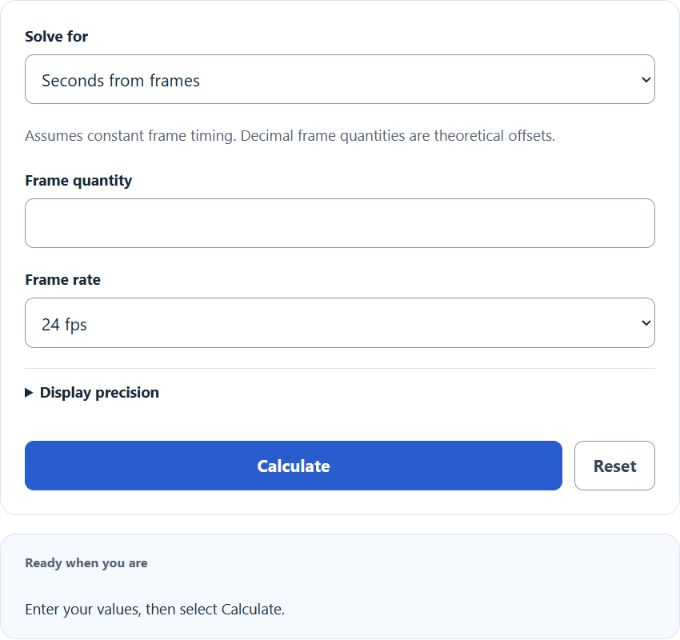
Calculate frames, frame rate, or duration from any two values, converting between frames per second and seconds, minutes, or hours as needed.
| Frames to Seconds | Seconds to Frames |
|---|---|
| 100 frames = 3.333 seconds | 1 second = 30 frames |
| 240 frames = 8 seconds | 2 seconds = 60 frames |
| 300 frames = 10 seconds | 5 seconds = 150 frames |
| 500 frames = 16.667 seconds | 10 seconds = 300 frames |
| 900 frames = 30 seconds | 15 seconds = 450 frames |
| 1,000 frames = 33.333 seconds | 20 seconds = 600 frames |
| 1,500 frames = 50 seconds | 30 seconds = 900 frames |
| 1,800 frames = 60 seconds | 45 seconds = 1,350 frames |
| 2,000 frames = 66.667 seconds | 60 seconds (1 min) = 1,800 frames |
| 3,000 frames = 100 seconds | 90 seconds = 2,700 frames |
| 3,600 frames = 120 seconds | 120 seconds (2 min) = 3,600 frames |
| 4,500 frames = 150 seconds | 180 seconds (3 min) = 5,400 frames |
| 5,000 frames = 166.667 seconds | 300 seconds (5 min) = 9,000 frames |
| 7,200 frames = 240 seconds | 600 seconds (10 min) = 18,000 frames |
| 9,000 frames = 300 seconds | 900 seconds (15 min) = 27,000 frames |
| 10,000 frames = 333.333 seconds | 1,200 seconds (20 min) = 36,000 frames |
| 10,800 frames = 360 seconds | 1,800 seconds (30 min) = 54,000 frames |
| 18,000 frames = 600 seconds | 2,700 seconds (45 min) = 81,000 frames |
| 21,600 frames = 720 seconds | 3,600 seconds (1 hr) = 108,000 frames |
| 54,000 frames = 1,800 seconds | 7,200 seconds (2 hr) = 216,000 frames |
| Formulas: seconds = frames ÷ FPS and frames = seconds × FPS (here, FPS = 30). | |
| Frames to Seconds | Seconds to Frames |
|---|---|
| 24 frames = 1 second | 1 second = 24 frames |
| 48 frames = 2 seconds | 10 seconds = 240 frames |
| 72 frames = 3 seconds | 60 seconds (1 min) = 1,440 frames |
| 240 frames = 10 seconds | 300 seconds (5 min) = 7,200 frames |
| 1,000 frames = 41.667 seconds | 3,600 seconds (1 hr) = 86,400 frames |
| Formulas: seconds = frames ÷ FPS and frames = seconds × FPS (here, FPS = 24). | |
Frames to Seconds Formula
A video is a sequence of still images called frames, and the frame rate tells you how many of those frames play each second. To find how long a set of frames lasts, divide the frame count by the frame rate:
S = F / R
To go the other way and find how many frames fit into a length of time, multiply the duration in seconds by the frame rate:
F = S * R
If you know the frame count and the duration but not the frame rate, divide the frames by the seconds:
R = F / S
Variables:
- S is the duration in seconds
- F is the total number of frames
- R is the frame rate in frames per second (fps)
Pick what you want to solve for at the top of the calculator. In the default mode you enter a frame count and a frame rate and the tool returns the duration in seconds. Switch the selector to find the number of frames from a duration, or to find the frame rate from a frame count and a duration. The frame rate menu holds the presets used most in film and video, including 23.976, 24, 25, 29.97, 30, 50, and 60 fps, and a Custom option lets you type any rate such as 12 fps for hand-drawn animation.
Results include seconds, minutes, hours and an elapsed clock rounded to milliseconds. Expand the calculation details for the nearest whole-frame count and a nominal non-drop-frame count label using rounded nominal FPS. This count label differs from elapsed time at fractional rates and is not a drop-frame conversion. Display precision changes formatting only. Fractional presets use exact 1000/1001 rates; custom FPS is literal. Frames-from-duration results retain theoretical fractions and list whole-frame rounding alternatives.
Common Frame Rates and Their Uses
Different formats settled on different frame rates. This table lists the rates you will meet most often, where each one is used, and how long a single frame lasts at that rate.
| Frame rate (fps) | Typical use | Seconds per frame |
|---|---|---|
| 24 | Cinema and most films | 0.0417 |
| 25 | PAL television (Europe) | 0.0400 |
| 29.97 | NTSC video (North America) | 0.0334 |
| 30 | Online and general video | 0.0333 |
| 60 | High motion, sports, gaming | 0.0167 |
The next table shows how long common frame counts last at three popular rates, so you can sanity check a result at a glance.
| Frames | 24 fps | 30 fps | 60 fps |
|---|---|---|---|
| 1 | 0.042 s | 0.033 s | 0.017 s |
| 24 | 1.000 s | 0.800 s | 0.400 s |
| 30 | 1.250 s | 1.000 s | 0.500 s |
| 60 | 2.500 s | 2.000 s | 1.000 s |
| 240 | 10.000 s | 8.000 s | 4.000 s |
| 1,000 | 41.667 s | 33.333 s | 16.667 s |
Example Problems
Example 1: Find a duration in seconds from a frame count.
A clip is 240 frames long and was shot at 24 fps. Divide the frames by the frame rate: S = 240 / 24 = 10 seconds.
Example 2: Find the number of frames in a duration.
You want to know how many frames make up a 5-second title card at 30 fps. Multiply the seconds by the frame rate: F = 5 * 30 = 150 frames.
Frequently Asked Questions
How do you convert frames to seconds?
Divide the number of frames by the frame rate. The frame rate is how many frames play each second, so dividing the total frames by that rate gives the running time in seconds. For example, 300 frames at 30 fps is 300 / 30 = 10 seconds.
How many seconds is 24 frames?
It depends on the frame rate. At 24 fps, 24 frames last exactly 1 second, because 24 / 24 = 1. At 30 fps the same 24 frames last 24 / 30 = 0.8 seconds, and at 60 fps they last 0.4 seconds.
What is the difference between duration and timecode?
Duration is the plain elapsed time, such as 10.5 seconds. Timecode labels a specific frame in the form HH:MM:SS:FF, where the final pair counts whole frames past the last full second rather than a fraction of a second. A frame 16 frames past the 41-second mark at 24 fps reads 00:00:41:16, which is the same instant as about 41.667 seconds.