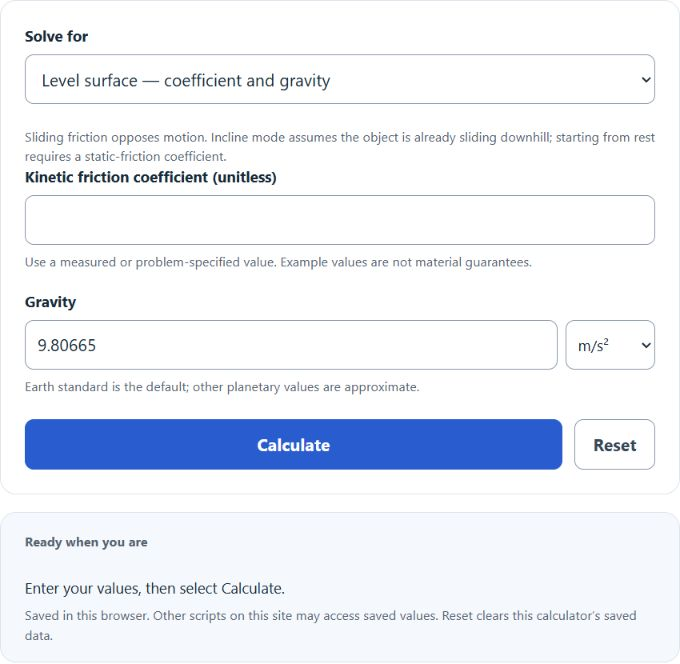
Calculate friction acceleration on a flat surface, from force and mass, or on an incline using coefficient of friction, angle, and gravity.
- All Physics Calculators
- All Acceleration Calculators
- Wheel Force Calculator
- Coefficient of Friction Calculator
- Coefficient of Friction to Acceleration Calculator
- Energy Loss From Friction Calculator
Friction Acceleration Formula
The calculator uses one of three formulas depending on the calculation you select.
Coefficient mode (level surface):
Force ÷ mass mode:
Incline mode:
- a = friction acceleration in m/s²
- μ = coefficient of friction, unitless
- g = gravitational acceleration in m/s² (9.80665 on Earth)
- F = friction force in newtons
- m = mass of the object in kilograms
- θ = incline angle in degrees
Assumptions: the surface is rigid, the normal force equals the component of weight perpendicular to the surface, and μ is the kinetic coefficient when the object is sliding. On a flat surface, mass cancels out, so a = μg gives the deceleration regardless of how heavy the object is. The incline formula returns the net downhill acceleration. If μcos(θ) is greater than sin(θ), a downhill-moving object has negative downhill acceleration and slows. The kinetic model no longer applies after it stops; it does not determine whether motion starts from rest.
The level-surface mode applies a = μg. Enter a measured or problem-specified kinetic coefficient; example values are approximate. Force ÷ mass converts inputs to newtons and kilograms before dividing. Incline mode assumes an object already sliding downhill and reports the signed acceleration and kinetic balance angle, atan(μk). Starting from rest instead requires tan(θ) > μs with a separately known static coefficient.
Reference Tables
Approximate kinetic friction examples; actual values depend on surface conditions. These are not material guarantees:
| Surface pair | μ (kinetic) | a on Earth (m/s²) |
|---|---|---|
| Ice on ice, clean | 0.03 | 0.29 |
| Shoe sole with banana skin on linoleum (study-specific) | 0.07 | 0.69 |
| Waxed wood on wet snow | 0.10 | 0.98 |
| Wood on wood | 0.30 | 2.94 |
| Rubber on wet concrete (illustrative midpoint) | 0.40 | 3.92 |
| Dry mild steel on mild steel (condition-specific) | 0.57 | 5.59 |
| Rubber on dry concrete | 0.70 | 6.86 |
Illustrative acceleration bands, not braking-safety thresholds:
| Range (g) | Range (m/s²) | What it feels like |
|---|---|---|
| < 0.10 g | < 0.98 | Slick contact, slow drift to a stop |
| 0.10 to 0.50 g | 0.98 to 4.90 | Illustrative middle band; not a braking safety threshold |
| > 0.50 g | > 4.90 | Illustrative high band; no stopping-distance guarantee |
Worked Examples
Example 1. Car skidding on wet pavement. μ = 0.40, g = 9.81 m/s². The deceleration from friction is a = 0.40 × 9.81 = 3.92 m/s². A car sliding at 25 m/s would need about 6.4 seconds and 80 meters to stop, ignoring other forces.
Example 2. Friction force given. A 10 kg crate has 32.5 N of friction acting on it. a = 32.5 / 10 = 3.25 m/s². The implied μ on a level Earth surface is 3.25 / 9.81 = 0.331.
Example 3. Block on a 25° ramp. μ = 0.30, g = 9.81. Slope component: 9.81 × sin(25°) = 4.146 m/s². Friction component: 0.30 × 9.81 × cos(25°) = 2.667 m/s². Net downhill acceleration: 4.146 − 2.667 = 1.48 m/s². The kinetic balance angle is atan(0.30) = 16.7°. An already sliding block gains downhill speed at 25°; whether a stationary block starts requires its static coefficient.
FAQ
Does mass change friction acceleration on a flat surface? No. The friction force grows with mass, but a = F/m cancels mass out. You get a = μg regardless of how heavy the object is.
Static or kinetic coefficient? Use the kinetic coefficient when the object is already sliding. Use the static coefficient only to check whether motion will start. The example coefficients are approximate kinetic values; use a value appropriate to the actual surfaces.
Why can the incline result be negative? Downhill is positive. Negative acceleration slows an object that is already moving downhill; it is not clamped to zero. The model ends at rest, where static friction determines subsequent motion.
Can I use this on the Moon or Mars? Yes. Use a planetary suggestion under Gravity, or enter a custom g value. Friction acceleration scales directly with gravity.