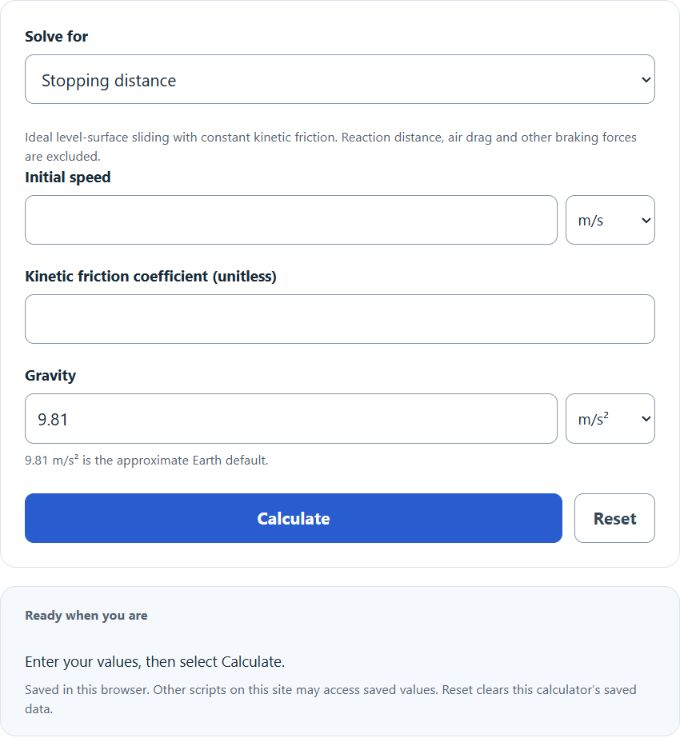
Calculate friction distance, initial velocity, friction coefficient, or gravitational acceleration from the other three values with unit conversions.
Friction Distance Formula
The following formula gives an ideal stopping distance for level-surface sliding with constant kinetic friction and positive gravity. It excludes reaction distance, air drag and other braking forces; it is not a road-safety guarantee.
Variables:
- d is the friction distance
- v₀ is the initial velocity
- μ is the friction coefficient
- g is the gravitational acceleration
To calculate the friction distance, divide the square of the initial velocity by the product of twice the friction coefficient and gravitational acceleration.
What is Friction Distance?
Friction distance refers to the distance a moving object travels before coming to a stop due to the force of friction acting against its motion. This distance is influenced by the initial velocity of the object, the coefficient of friction between the surfaces in contact, and the gravitational acceleration. Understanding friction distance is crucial in various fields, including automotive safety, where it helps in designing braking systems and understanding stopping distances.
How to Calculate Friction Distance?
The following steps outline how to calculate the Friction Distance.
- First, determine the initial velocity (v₀).
- Next, determine the friction coefficient (μ).
- Next, determine the gravitational acceleration (g).
- Finally, calculate the friction distance using the formula d = (v₀²) / (2 * μ * g).
- After inserting the values and calculating the result, check your answer with the calculator above.
Example Problem :
Use the following variables as an example problem to test your knowledge.
Initial Velocity (v₀) = 20 m/s
Friction Coefficient (μ) = 0.5
Gravitational Acceleration (g) = 9.81 m/s²