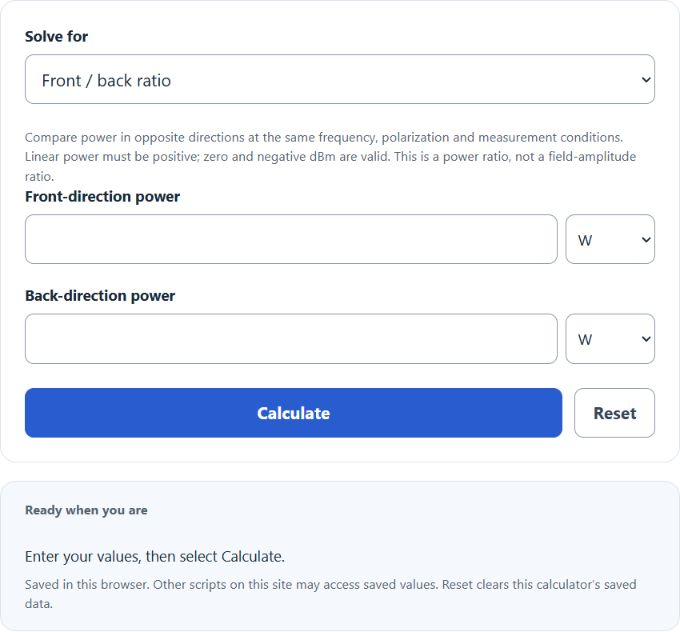
Select front-to-back ratio, front power or back power, then enter the other two values using W, mW, kW or dBm. Compare opposite directions at the same frequency, polarization and measurement conditions.
Front-to-Back Ratio Formula
The following formula is used to calculate the front-to-back ratio for a given antenna.
Variables:
- F/B is the front-to-back ratio in decibels (dB)
- Pf is the power in the front direction
- Pb is the power in the back direction
To calculate the front-to-back ratio, divide the power in the front direction by the power in the back direction. Then take the base-10 logarithm of the result and multiply by 10 to convert to decibels.
What is a Front-to-Back Ratio?
The front-to-back ratio of an antenna is a measure of the antenna’s ability to direct radio frequency energy in a specific direction while minimizing radiation in the opposite direction. It is expressed in decibels (dB) and is calculated by comparing the power radiated in the forward direction to the power radiated in the backward direction. A higher front-to-back ratio indicates better directional performance, which is particularly important in applications such as directional antennas for communication systems, where minimizing interference from unwanted directions is crucial.
How to Calculate Front-to-Back Ratio?
The following steps outline how to calculate the Front-to-Back Ratio.
- First, measure the power in the front direction (Pf).
- Next, measure the power in the back direction (Pb).
- Next, calculate the front-to-back ratio using the formula F/B = 10 log10(Pf / Pb).
- Finally, interpret the result to understand the directional performance of the antenna.
- After inserting the values and calculating the result, check your answer with the calculator above.
Example Problem :
Use the following variables as an example problem to test your knowledge.
Power in Front Direction (Pf) = 100 W
Power in Back Direction (Pb) = 1 W