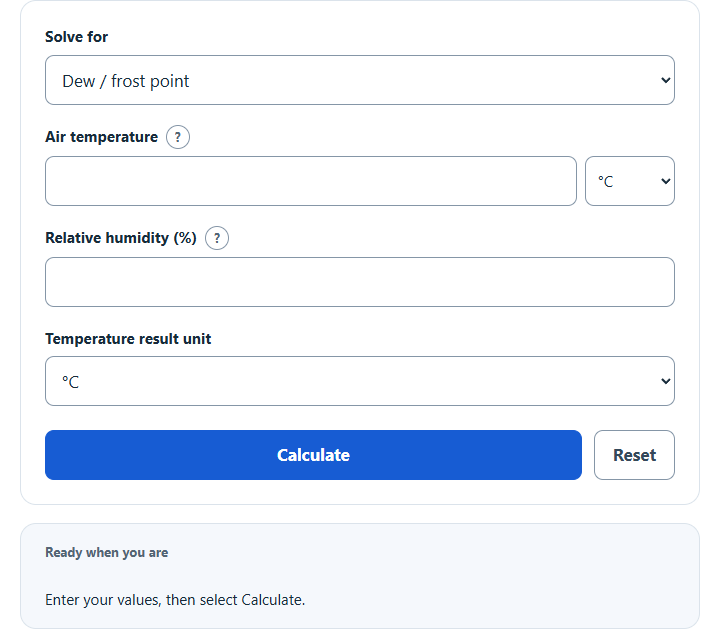
Calculate the frost point (or dew point above 0 °C) from air temperature and relative humidity in °C, °F or K, or solve for air temperature or humidity.
Calculator Functions
| Function | What it does | What it requires |
|---|---|---|
| Dew / frost point | Finds the temperature at which the air becomes saturated, given as a frost point below 0 °C and a dew point at or above it | Requires the air temperature and the relative humidity |
| Air temperature | Finds the air temperature that goes with a known dew or frost point and relative humidity | Requires the dew or frost point and the relative humidity |
| Relative humidity | Finds the relative humidity from the air temperature and the dew or frost point | Requires the air temperature and the dew or frost point |
Temperatures go in as °C, °F or K, and the result unit is chosen separately. Relative humidity is taken relative to liquid water, as hygrometers and weather reports give it. Every result also shows the vapor pressure in hPa.
Frost Point Formulas
(22.46 − L) [1]
| tf | Frost point (°C) |
| L | ln(e ÷ 6.112) |
| e | Vapor pressure of the air (hPa) |
The vapor pressure comes from the air temperature and the relative humidity:
exp(17.62t ÷ (243.12 + t)) [1]
t is the air temperature in °C and RH is the relative humidity in percent. These are the World Meteorological Organization formulas for saturation over water and over ice [1]. The frost point is the temperature at which air is saturated over a flat ice surface, and the dew point is the same thing over a water surface [2].
Dew / frost point
A vapor pressure below 6.112 hPa puts the result below 0 °C, and the calculator applies the frost point formula above. Otherwise it reports a dew point from the water form:
(17.62 − L) [1]
Air at −5 °C and 80% relative humidity has a vapor pressure of 3.38 hPa and a frost point of −7 °C. Air at 20 °C and 50% has a dew point of 9.3 °C.
Air temperature
A = L − ln(RH ÷ 100), where L comes from the entered point: the ice form for a point below 0 °C and the water form otherwise. A frost point of −7 °C at 80% relative humidity means an air temperature of −5 °C.
Relative humidity
e is the vapor pressure at the entered dew or frost point and ew is the saturation vapor pressure over water at the air temperature. Air at −5 °C with a frost point of −7 °C is at 80.1% relative humidity. A result above 100% would mean supersaturated air, which usually points to a wrong input.
Limits of This Estimate
- The water formulas hold from −45 to 60 °C and the ice formulas from −65 to 0 °C [1]. Inputs and results outside those ranges are rejected.
- No correction for air pressure is applied. The source multiplies saturation vapor pressure by a factor that depends on pressure, about 1.005 at 1,013 hPa, and the calculator leaves it out [1].
- Just below 0 °C moisture can settle as frost or as supercooled dew, and the two temperatures differ [2]. The calculator reports the frost point there.
Sources
- World Meteorological Organization and IOC, JCOMM Technical Report No. 63, Recommended Algorithms for the Computation of Marine Meteorological Variables: saturation vapor pressure over water and ice, dew point and frost point formulas, valid ranges and the pressure factor
- World Meteorological Organization, Expert Team on Metrology training units, Humidity Part 1: Introduction: definitions of dew point and frost point