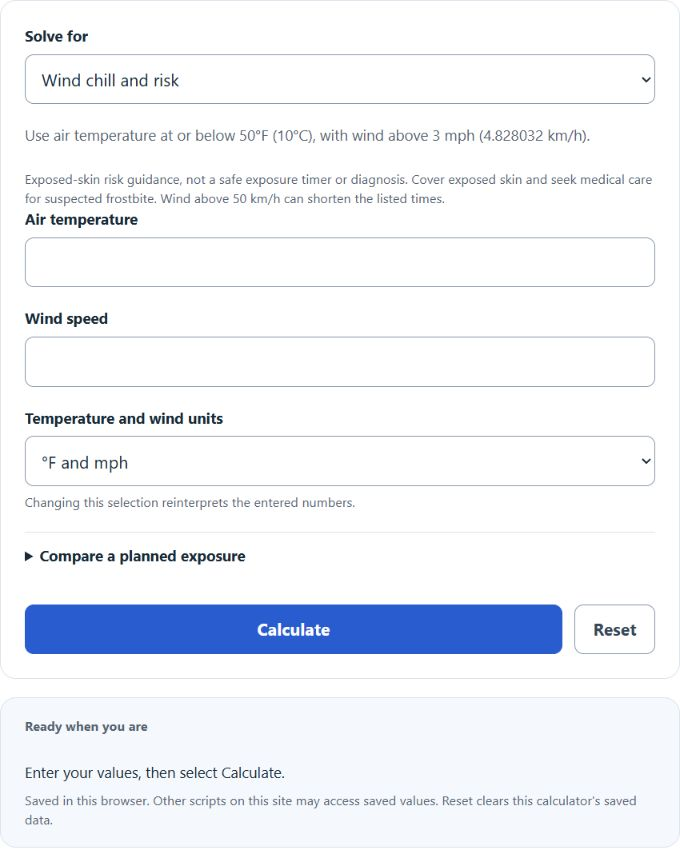
Calculate standard wind chill from air temperature and wind speed, or assess a known wind chill using published exposed-skin frostbite-risk bands in °F/°C and mph/km/h.
Wind Chill Formula (Used to Estimate Frostbite Risk)
This calculator converts inputs to °F and mph and uses the NWS wind chill equation; the metric form below has separately rounded coefficients. It uses the standard wind chill temperature equation to estimate how cold it feels on exposed skin when wind is present. Frostbite risk guidance is commonly expressed in terms of wind chill and exposure time.
Variables:
- WCT is the wind chill temperature (in degrees Celsius)
- T is the air temperature in degrees Celsius
- V is the wind speed in km/h
Important: The wind chill equation is intended for air temperatures at or below 10°C (50°F) and wind speeds above 4.828032 km/h (3 mph). This calculator rejects conditions outside that domain rather than reporting a frostbite time.
Risk-band source and limit: The calculator uses Environment and Climate Change Canada’s published bands: -28 to -39 (10 to 30 minutes), -40 to -47 (5 to 10 minutes), -48 to -54 (2 to 5 minutes), and -55 or colder (less than 2 minutes). These are exposed-skin risk estimates, not a diagnosis, safe exposure allowance or frostbite-severity grade. Whole-degree published bands leave fractional gaps; this calculator conservatively assigns those gaps to the colder band without rounding first. That continuous classification is a calculator convention, not an official ECCC cutoff rule. Sustained winds over 50 km/h can shorten the listed times. Actual air must be below freezing for frostbite; known-index mode cannot verify that condition.
What is Frostbite?
Frostbite is a type of injury caused by freezing of the skin and underlying tissues, primarily affecting the fingers, toes, nose, ears, cheeks, and chin due to exposure to cold temperatures. It may begin with a cold and prickly feeling, followed by numbness and changes in skin color (often pale/white, then possibly bluish or blotchy). Severe cases can lead to permanent damage or amputation. Seek medical attention if frostbite is suspected.
How to Estimate Frostbite Risk
The steps below outline how this calculator estimates wind chill temperature and a frostbite risk category:
- Determine the air temperature (T) and convert it to °C if needed.
- Determine the wind speed (V) and convert it to km/h if needed.
- For this calculator, T must be at or below 10°C and V must exceed 4.828032 km/h (exactly 3 mph). Outside this domain, use the actual conditions and official weather guidance; this tool reports a validation error.
- Otherwise, compute V0.16.
- Apply the wind chill formula to compute WCT.
- Use WCT to place conditions into an approximate frostbite risk/time-to-frostbite category (for exposed skin).
Example Problem:
Air Temperature (T) = -10°C
Wind Speed (V) = 20 km/h
Compute wind chill temperature:
V0.16 = 200.16 ≈ 1.615
Rounded-coefficient metric form: WCT = 13.12 + 0.6215(-10) – 11.37(1.615) + 0.3965(-10)(1.615) ≈ -17.86°C. The calculator’s canonical NWS form gives approximately -17.83°C (-17.8°C displayed), a small coefficient-rounding difference.
WCT ≈ -17.9°C is in the moderate-risk band. Prolonged exposure can cause frostbite; a missing short freezing window does not establish safety.