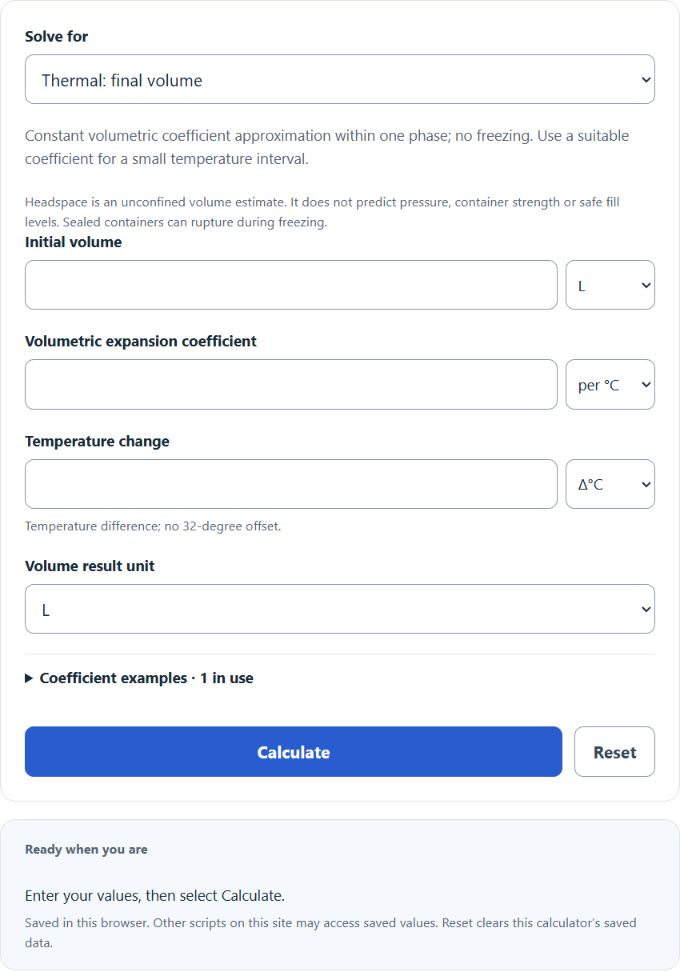
Calculate single-phase thermal expansion, water-to-ice volume, or unconfined freezer headspace from volume, temperature change, density assumptions and freeze percentage. Headspace estimates do not predict pressure, container strength or safe fill levels.
Related Calculators
- Vessel Volume Calculator
- Relative Heat Gain Calculator
- Accelerated Temperature Testing Calculator
- Vacuum Force Calculator
- All Physics Calculators
Water-to-Ice Volume Expansion Formula
The following formula is used to calculate the volume after liquid water freezes into ice (phase-change expansion), using the densities of water and ice (mass is conserved).
Variables:
- Vice is the ice volume after freezing
- Vwater is the initial liquid-water volume
- ρwater is the density of liquid water (at the relevant temperature/pressure)
- ρice is the density of ice (at the relevant temperature/pressure)
Near 0°C at 1 atm, a common approximation is ρwater ≈ 999.84 kg/m³ and ρice ≈ 916.7 kg/m³, giving Vice/Vwater ≈ 1.0907 (about a 9.1% increase). For temperature-driven expansion/contraction without freezing, use the Thermal solve modes (α·ΔT).
What is Frozen Water Expansion?
Frozen water expansion refers to the increase in volume that occurs when water freezes and turns into ice. Unlike most substances, water expands when it freezes due to the formation of a crystalline structure that occupies more space than liquid water. At standard atmospheric pressure, this phase change causes roughly a 9% volume increase near 0°C. This expansion can exert significant pressure on surrounding materials, which is why water pipes can burst in freezing temperatures. Understanding the expansion of water when it freezes is important in various fields, including engineering, meteorology, and environmental science.
How to Calculate Frozen Water Expansion?
The following steps outline how to calculate the expansion of frozen water.
- First, determine the initial liquid-water volume (Vwater).
- Next, select or measure appropriate densities for liquid water (ρwater) and ice (ρice) at the temperature/pressure of interest (or use the presets in the calculator).
- Calculate the ice volume using Vice = Vwater · (ρwater/ρice).
- Compute the percent increase as (Vice/Vwater − 1) × 100% (typically about 9% near 0°C at 1 atm).
- If freezing occurs in a container, compare the expanded volume to container capacity to estimate required headspace or overflow.
Example Problem :
Use the following variables as an example problem to test your knowledge.
Initial Water Volume (Vwater) = 1 m³
Water Density (ρwater) = 1000 kg/m³
Ice Density (ρice) = 917 kg/m³ → Ice Volume (Vice) ≈ 1 × (1000/917) = 1.0905 m³ (about a 9.05% increase)