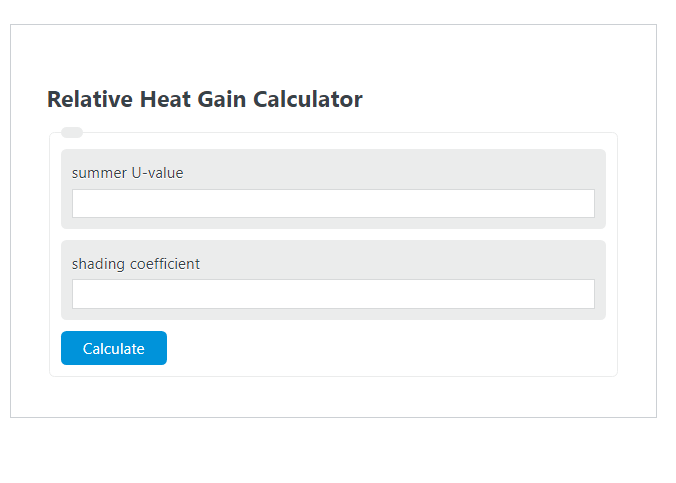
Calculate relative heat gain from summer U-value and shading coefficient, or solve for a missing value with Btu/h·ft² and W/m² units.
- All Physics Calculators
- All Heat Calculators
- Heat of Formation Calculator
- Heat Loss R-Value Calculator
Understanding Relative Heat Gain
Relative heat gain (RHG) is a quick comparison metric used to estimate how much summer heat enters through a glazing system per unit area. It combines two important effects: conductive heat transfer through the assembly and solar heat admitted through the glass. In general, a lower RHG indicates better summer performance because less heat is entering the building.
This calculator is especially useful when comparing windows, skylights, and other glazed products where both insulation performance and solar control matter. Rather than looking at the summer U-value and shading coefficient separately, RHG combines them into a single number that is easier to compare.
Relative Heat Gain Formula
If you are working with solar heat gain coefficient (SHGC) instead of shading coefficient (SC), a commonly used equivalent form is:
In this relationship, the first term represents conductive heat flow and the second term represents solar heat gain. Lowering either the summer U-value or the shading coefficient will reduce the RHG.
Inputs and Output
| Term | Meaning | Common Units | Effect on RHG |
|---|---|---|---|
| Summer U-value | The heat transfer rate through the glazing system used in the summer comparison method | Btu/(h·ft²·°F) or W/m²·K | Lower values reduce conductive heat gain |
| Shading Coefficient (SC) | A dimensionless measure of how much solar radiation passes through the glazing relative to a reference glass | Decimal | Lower values reduce solar heat gain |
| Relative Heat Gain (RHG) | The combined summer heat gain per unit area | Btu/(h·ft²) or W/m² | Lower values generally indicate better summer performance |
How to Use the Calculator
- Enter the summer U-value for the glazing system.
- Enter the shading coefficient.
- Let the calculator compute the RHG automatically, or use the formula to calculate it manually.
- Compare the RHG values of multiple products or design options. The option with the lower RHG will usually admit less summer heat.
If you are calculating by hand, keep your unit system consistent. Do not mix imperial and metric values in the same calculation unless the conversion has already been handled.
Example
For a glazing system with a summer U-value of 1.25 and a shading coefficient of 0.75:
Using imperial units, the result is 168.75 Btu/(h·ft²). This gives you a single comparison value for the summer heat gain behavior of the glazing.
How to Interpret the Result
- Lower RHG: Better at limiting unwanted summer heat gain and often preferred in cooling-dominated conditions.
- Higher RHG: Indicates more heat is entering through the glazing, which can increase cooling demand.
- Best use: RHG is most helpful for comparing similar glazing options rather than predicting the total cooling load of an entire building.
For example, if two windows have similar U-values, the one with the lower shading coefficient will usually have the lower RHG. If two windows have similar shading coefficients, the one with the lower U-value will generally perform better against conductive heat transfer.
Why RHG Matters
Window performance affects comfort, HVAC sizing, and energy use. RHG is useful because it blends insulation and solar control into one screening metric. That makes it easier to compare products for spaces that are sensitive to afternoon sun, large glass areas, or warm outdoor conditions.
- Use RHG when comparing windows for offices, homes, storefronts, and other spaces with significant glazing.
- Use lower RHG values when the priority is reducing cooling load and summer overheating.
- Review RHG alongside other metrics such as visible light transmission, SHGC, and overall U-value when making a final product choice.
Practical Notes
- RHG is a per-area value, so larger glazed areas still result in greater total heat gain even if the RHG is moderate.
- This metric is a comparison tool and does not replace a full building load calculation.
- Orientation, exterior shading, climate, and frame design can all influence real-world performance.
- If manufacturer data is listed as SHGC instead of SC, use the SHGC version of the equation when appropriate.
Common Questions
What does a low shading coefficient mean?
A low SC means the glazing blocks more solar heat, which usually lowers RHG and improves summer performance.
Does RHG measure total room heat gain?
No. RHG focuses on glazing-related heat gain per unit area. Internal loads, ventilation, infiltration, occupancy, and equipment loads are not included.
Can RHG be used to compare products quickly?
Yes. That is one of its main advantages. It provides a fast screening value for comparing options before doing more detailed energy analysis.