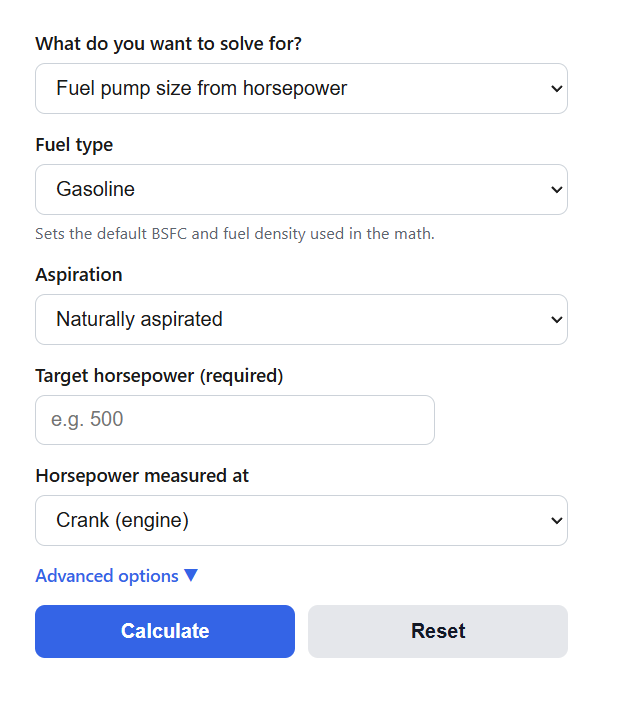
Calculate the fuel pump size your engine needs in LPH, GPH, and lb/hr from horsepower, fuel type, and boost, or the horsepower a given pump can support.
Fuel Pump Sizing Formula
W = HP * BSFC * (1 + SM/100)
GPH = W / D
LPH = GPH * 3.78541
- W is the required fuel flow in pounds per hour (lb/hr)
- HP is the target crank horsepower
- BSFC is the brake specific fuel consumption in lb/hp/hr
- SM is the safety margin in percent (20% is standard)
- D is the fuel density in pounds per gallon
- GPH is the required flow in gallons per hour
- LPH is the required flow in liters per hour
The calculator's main mode works through these formulas in order. It multiplies your target horsepower by BSFC to get the fuel mass the engine burns per hour, adds the safety margin so the pump never runs at 100% duty, then divides by the density of your chosen fuel to convert mass flow into volume flow in GPH and LPH, the units pumps are sold by. If you enter wheel horsepower, the calculator first converts it to crank horsepower using HP = WHP / (1 - loss/100), since fuel demand is set by the power the engine makes, not what reaches the tires.
The reverse mode runs the same math backward: it converts a pump's flow rating into lb/hr, removes the safety margin, and divides by BSFC to estimate the maximum crank horsepower that pump can support on your fuel. The calculator also reports the rail pressure to size at, which is base fuel pressure plus peak boost, because a pump must deliver its flow at that pressure, not at zero pressure.
BSFC, Fuel Density, and Real-World Pump Output
BSFC depends mostly on fuel type and whether the engine is under boost. Alcohol fuels carry less energy per pound, so the engine must burn more of them per horsepower.
| Fuel | BSFC naturally aspirated | BSFC boosted / nitrous | Density (lb/gal) |
|---|---|---|---|
| Gasoline | 0.45 to 0.50 | 0.55 to 0.65 | 6.0 |
| E85 | 0.60 to 0.70 | 0.75 to 0.85 | 6.59 |
| Methanol | 0.90 to 1.10 | 1.10 to 1.30 | 6.63 |
| Diesel | 0.35 to 0.40 | 0.35 to 0.40 | 7.05 |
The number printed on a pump's box is usually free flow or flow at a low test pressure. Electric pumps lose flow as rail pressure climbs, and rail pressure climbs one psi for every psi of boost on a manifold-referenced regulator. Voltage matters just as much: pump output scales with motor speed, so the same pump flows noticeably more at 13.5 volts than at 12. The table below shows typical behavior for a common in-tank pump so you can sanity check a spec sheet before buying.
| Operating condition | Approximate output vs. advertised rating |
|---|---|
| 40 psi, 13.5 V (typical rating point) | 95 to 100% |
| 58 psi, 13.5 V (returnless base pressure) | 85 to 90% |
| 73 psi, 13.5 V (43.5 psi base + 30 psi boost) | 70 to 80% |
| Any pressure, 12 V instead of 13.5 V | Subtract another 10 to 15% |
| Any pressure, 16 to 18 V (voltage booster) | Add roughly 15 to 30% |
This is why a "340 LPH" pump that comfortably feeds 600 gasoline horsepower at stock pressure can fall short on the same engine at 25 psi of boost. Always check the manufacturer's flow vs. pressure chart at your actual rail pressure and charging voltage.
Fuel Pump Sizing Example
Example 1: You want to support 500 crank horsepower from a turbocharged gasoline engine running 15 psi of boost on a 43.5 psi base pressure system. Using a BSFC of 0.60 and a 20% margin: W = 500 * 0.60 * 1.20 = 360 lb/hr. Dividing by gasoline's 6.0 lb/gal gives 60 GPH, and 60 * 3.78541 = 227 LPH. You need a pump that flows at least 227 LPH at 58.5 psi (43.5 base + 15 boost), so a pump advertised at 255 LPH free flow is marginal here, while a 340 LPH class pump has comfortable headroom.
Example 2: You already own a 340 LPH pump and want to know what it supports on boosted E85. Converting to mass flow: 340 / 3.78541 = 89.8 GPH, and 89.8 * 6.59 = 592 lb/hr. Removing the 20% margin leaves 493 lb/hr of usable flow, and dividing by a BSFC of 0.80 gives about 617 crank horsepower, assuming the pump actually delivers 340 LPH at your rail pressure and voltage.
Fuel Pump Sizing FAQ
Should I size the pump from crank or wheel horsepower?
Size from crank horsepower, because the engine burns fuel for every horsepower it produces, including the power lost in the drivetrain. If all you have is a wheel dyno number, convert it first by dividing by 1 minus the drivetrain loss, which is the conversion the calculator applies automatically. A 400 WHP RWD car with 15% loss is roughly a 471 crank horsepower engine, and skipping that step undersizes the pump by the same 15%.
Why does my pump support less power than its LPH rating suggests?
Almost always because the rating was taken at low pressure and ideal voltage. At real rail pressure, base plus boost, the pump flows less, and any voltage drop through aged wiring, connectors, or a shared ground reduces it further. Fuel also heats up in a return system at high duty cycle, which lowers its density. Size with a 20% margin, check the flow chart at your rail pressure, and if you run serious boost, consider rewiring the pump with a relay and heavier gauge wire before buying a bigger pump.
Can a fuel pump be too big?
For a return-style system, oversizing is mostly harmless: the regulator bleeds excess fuel back to the tank, though a grossly oversized pump recirculates a lot of fuel and can raise tank temperature on long drives. On returnless systems the stock controller may not manage a much larger pump cleanly at idle, causing pressure hunting. In both cases the practical answer is to buy one comfortable size class up from your calculated requirement rather than the largest pump available, or use a staged twin-pump setup where the second pump only activates under boost.