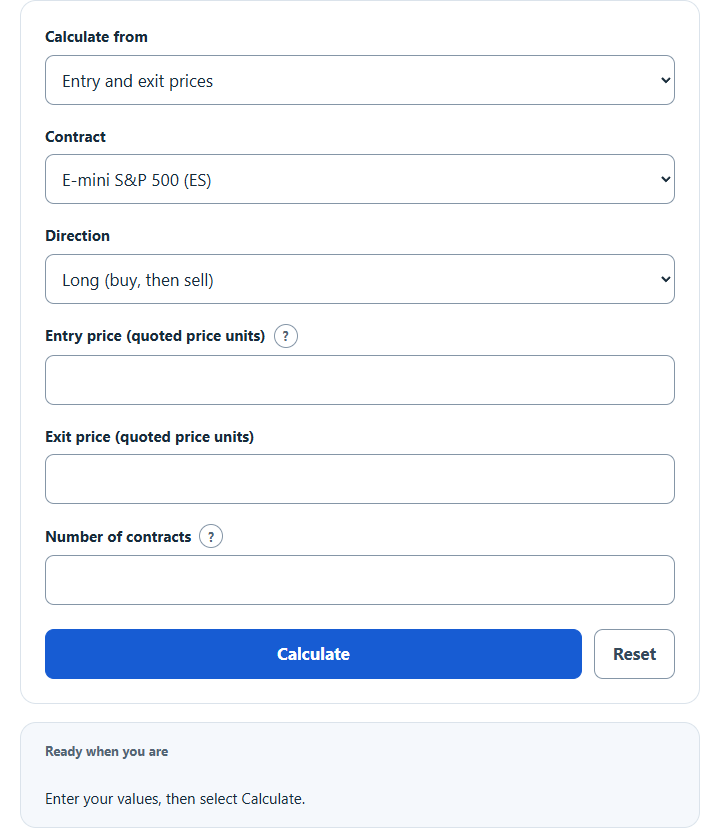
Calculate futures profit or loss from entry and exit prices or from points or ticks moved, with tick values preset for ES, NQ, MNQ, YM, CL and GC.
Futures Profit Formula
Futures P&L is measured in ticks – the minimum price increment – each worth a fixed dollar amount:
P = ((Exit - Entry) / TickSize) * TickValue * N
Variables:
- P is the total profit or loss ($); for short trades the price difference is reversed
- Exit and Entry are the trade prices in contract points
- TickSize is the minimum price increment of the contract
- TickValue is the dollar value of one tick per contract ($)
- N is the number of contracts
Pick an outright-futures preset for ES, MES, NQ, MNQ, YM, CL, or GC, or choose Custom and enter the applicable tick size and USD tick value. Set direction, entry, exit and a positive whole contract count; a blank count means 1. Average execution prices may produce fractional ticks. Negative prices are accepted for CL and Custom. The calculator returns gross dollar P&L, signed ticks and price units, the per-contract result and the dollar value of one full price unit. Spread and other special tick rules may differ from the presets.
Common Contract Specifications
| Contract | Tick size | Tick value | $ per point |
|---|---|---|---|
| E-mini S&P 500 (ES) | 0.25 | $12.50 | $50 |
| Micro E-mini S&P (MES) | 0.25 | $1.25 | $5 |
| E-mini Nasdaq-100 (NQ) | 0.25 | $5.00 | $20 |
| Micro E-mini Nasdaq (MNQ) | 0.25 | $0.50 | $2 |
| E-mini Dow (YM) | 1.00 | $5.00 | $5 |
| Crude Oil (CL) | 0.01 | $10.00 | $1,000 |
| Gold (GC) | 0.10 | $10.00 | $100 |
MES and MNQ have one-tenth the contract multiplier of their corresponding E-mini contracts. This reduces the dollar effect of a given index move, but futures losses can still exceed the margin deposit.
Example Problems
Example 1: Long ES scalp.
You buy 2 ES contracts at 5000.00 and sell at 5012.50.
Move = 12.50 points = 12.50 / 0.25 = 50 ticks. P = 50 * $12.50 * 2 = $1,250.
Example 2: Short crude oil.
You short 1 CL contract at 78.50 and cover at 79.10 – the trade goes against you.
Move = (78.50 – 79.10) = -0.60 points = -60 ticks. P = -60 * $10 = -$600 loss.
Frequently Asked Questions
What is the difference between a tick and a point?
A point is one whole unit of the quoted price; a tick is the smallest increment the contract actually trades in. ES moves in 0.25-point ticks, so one point is four ticks worth $50. CL moves in 0.01-point ticks, so one point is 100 ticks worth $1,000.
Why can futures losses exceed my margin deposit?
Futures margin is a performance bond, not a maximum loss. Positions are marked to market daily, and a gap through your stop can produce a loss larger than the margin posted – you owe the difference. Position sizing matters more in futures than anywhere else.
Do these results include fees?
No. Commissions and exchange fees typically run a few dollars per contract per round turn. On micro contracts and high-frequency strategies, fees can consume a large share of gross profit, so subtract them when judging a system.