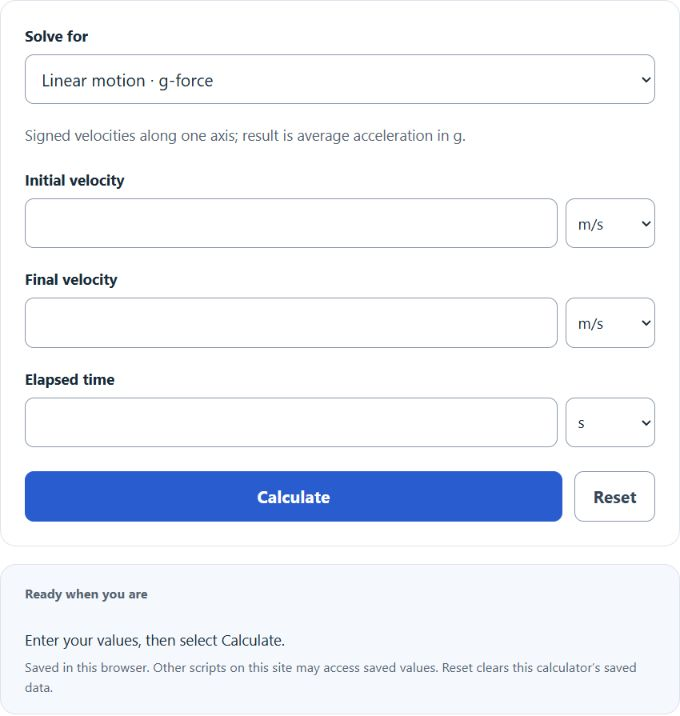
Calculate g-force from acceleration or from a speed change over time, gravity from mass and distance, or centrifuge RCF from rotor radius and RPM.
- All Physics Calculators
- All Force Calculators
- G Force To Acceleration Calculator
- Lateral G-Force From Speed and Turn Radius
- Convert G-Force to Newtons Using Mass
Calculator Functions
| Function | What it does | What it requires |
|---|---|---|
| Linear motion · g-force | Finds the average g-force of a change in speed along a straight line | Requires the initial velocity, final velocity and elapsed time |
| Acceleration · g-force | Converts an acceleration to g-force | Requires the acceleration in m/s², ft/s² or g |
| Linear motion · final velocity | Finds the velocity reached after holding a steady g-force for a time | Requires the initial velocity, signed acceleration in g and elapsed time |
| Linear motion · initial velocity | Finds the starting velocity before a steady g-force acted for a time | Requires the final velocity, signed acceleration in g and elapsed time |
| Linear motion · elapsed time | Finds how long a steady g-force takes to change one velocity into another | Requires the initial velocity, final velocity and signed acceleration in g |
| Gravity · acceleration | Finds the gravitational acceleration at a distance from the center of a planet, star or other body | Requires the body mass and the distance from its center |
| Gravity · body mass | Finds the mass of a body from the gravity it produces at a known distance | Requires the gravitational acceleration and the distance from the center |
| Gravity · center distance | Finds the distance from a body’s center where its gravity has a given strength | Requires the body mass and the gravitational acceleration |
| Centrifuge · RCF | Finds the relative centrifugal force (× g) of a spinning rotor | Requires the rotor radius and the rotational speed in RPM |
| Centrifuge · RPM | Converts a target RCF (× g) to the rotor speed in RPM | Requires the rotor radius and the RCF |
| Centrifuge · rotor radius | Finds the rotor radius that gives a target RCF at a given speed | Requires the rotational speed in RPM and the RCF |
Velocities are accepted in m/s, km/h, mph, ft/s or knots, and time in seconds, minutes or hours. Body mass can be entered in kg, Earth masses or solar masses, and distance in m, km, mi, ft or Earth radii. Rotor radius is in cm, mm, m or inches. Every result also shows the matching acceleration in m/s².
G Force Formulas
| a | Acceleration (m/s²) |
| g₀ | Standard acceleration of gravity, exactly 9.80665 m/s² |
G-force is an acceleration written as a multiple of standard gravity. The eleven functions differ only in where the acceleration comes from: a change in speed, the pull of a massive body, or rotation.
How to Calculate G Force
Find the acceleration in m/s² and divide it by 9.80665. For a change in speed, the acceleration is the change in velocity divided by the time it took, so a car that goes from 0 to 60 mph (26.8224 m/s) in 3 seconds averages 26.8224 ÷ 3 = 8.9408 m/s², which is 8.9408 ÷ 9.80665 = 0.91 g. For something moving in a circle, the acceleration comes from the radius and the rotation speed, as in the centrifuge functions below.
G Force from Acceleration and Speed
Acceleration · g-force
This is the main formula used directly. An acceleration of 30 m/s² is 30 ÷ 9.80665 = 3.059 g. A value in ft/s² is multiplied by 0.3048 first to give m/s².
Linear motion · g-force
v₀ is the initial velocity and v₁ the final velocity in m/s, and t is the elapsed time in seconds. The result is the average over that time, and it carries a sign: braking from 30 m/s to a stop in 2 seconds gives (0 − 30) ÷ (2 × 9.80665) = −1.53 g, where the minus sign means the acceleration points against the direction of travel.
Linear motion · final velocity
Here g is the signed acceleration in g, held constant. Starting from rest, 2 g for 5 seconds gives 0 + 2 × 9.80665 × 5 = 98.07 m/s.
Linear motion · initial velocity
An object that stops (v₁ = 0) after 3 seconds at −1 g was moving at 0 − (−1 × 9.80665 × 3) = 29.42 m/s.
Linear motion · elapsed time
Going from rest to 100 m/s at a steady 1.5 g takes 100 ÷ (1.5 × 9.80665) = 6.80 seconds. The acceleration cannot be zero, and its sign has to match the direction of the velocity change so that the time comes out positive.
G Force from Gravity
Gravity · acceleration
G is the gravitational constant, 6.67430 × 10⁻¹¹ m³/(kg·s²) [4], M is the mass of the body in kg and r is the distance from its center in meters. One Earth mass (5.9722 × 10²⁴ kg) at one Earth radius (6,371,000 m) [5] gives 9.8203 m/s², or 1.0014 g. The solar mass unit is 1.98847 × 10³⁰ kg.
Gravity · body mass
A body that produces exactly 9.80665 m/s² at 6,371 km from its center has a mass of 9.80665 × 6,371,000² ÷ G = 5.9639 × 10²⁴ kg.
Gravity · center distance
One Earth mass produces exactly 1 g (9.80665 m/s²) at √(G × 5.9722 × 10²⁴ ÷ 9.80665) = 6,375.4 km from the center. Mass and acceleration must both be above zero.
Centrifuge G Force and RPM
Centrifuge · RCF
r ÷ g₀ [6]
r is the rotor radius in meters, measured from the center of rotation to the sample. With the constants multiplied out this is RCF = 1.118 × 10⁻⁵ × r × RPM² for a radius in centimeters, or 0.001118 × r × RPM² for a radius in meters. A 10 cm rotor at 3,000 RPM gives 1.118 × 10⁻⁵ × 10 × 3,000² = 1,006 × g. Doubling the speed quadruples the g-force.
Centrifuge · RPM
(1.118 × 10⁻⁵ × r))
With r in centimeters, reaching 1,000 × g on a 10 cm rotor takes √(1,000 ÷ (1.118 × 10⁻⁵ × 10)) = about 2,990 RPM. The radius must be above zero.
Centrifuge · rotor radius
(1.118 × 10⁻⁵ × RPM²)
With r in centimeters, 1,000 × g at 3,000 RPM needs a radius of 1,000 ÷ (1.118 × 10⁻⁵ × 3,000²) = 9.94 cm. The speed must be above zero.
Limits of This Estimate
- The linear motion functions work along one axis with constant acceleration. The g-force from a speed change is an average, so peaks during the event can be higher. It is not an accelerometer reading or an assessment of load on a person.
- The gravity functions treat the body as a point mass or a sphere measured from outside. They leave out rotation and shape, which is why one Earth mass at the mean radius gives 9.82 m/s² instead of the standard 9.80665 m/s², and they do not apply below the surface. Local gravity on Earth varies from about 9.78 m/s² at the equator to 9.83 m/s² at the poles [5].
- RCF depends on where in the tube the radius is measured, so the radius for the sample position matters. The conversion does not show whether a speed is safe for a rotor: the manufacturer’s rotor limits do.
Sources
- NIST, CODATA value: standard acceleration of gravity: the exact value 9.80665 m/s²
- NASA Glenn Research Center, Ballistic Flight Equations: velocity under constant acceleration
- NASA Glenn Research Center, Weight Equation: gravitational acceleration from the gravitational constant, mass and distance squared
- NIST, CODATA value: Newtonian constant of gravitation: the value of G
- NASA Goddard Space Flight Center, Earth Fact Sheet: Earth’s mass, mean radius and surface gravity at the equator and poles
- Food and Agriculture Organization of the United Nations, Notes on centrifugation (Appendix 8): the relationship between RCF, RPM and radius in centimeters