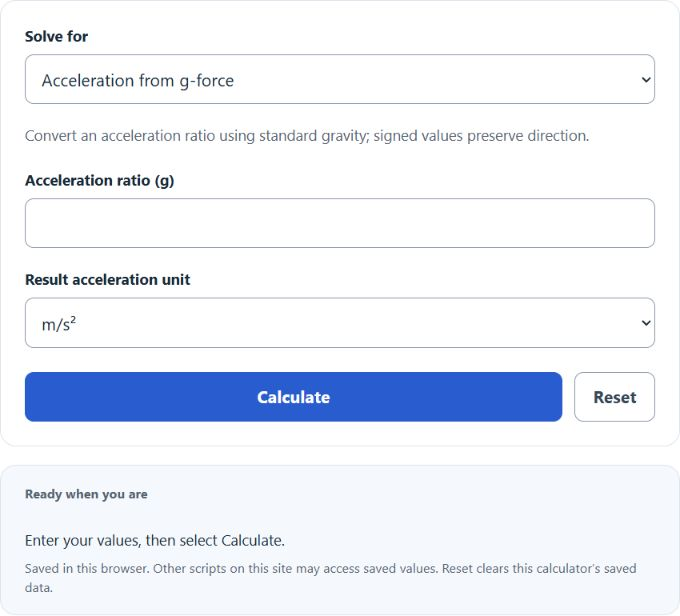
Calculate acceleration from g-force, or g-force from acceleration in m/s² or ft/s², using standard gravity of 9.80665 m/s².
- All Physics Calculators
- All Acceleration Calculators
- G-Force To Velocity Calculator
- Joules to G Force Calculator
- Newtons to G Force Calculator
- Power to Acceleration Calculator
- Moving Force Calculator
G-Force to Acceleration Formula
G-force expresses acceleration as a multiple of standard gravity. This calculator converts a value in g into linear acceleration, or converts acceleration back into g when the acceleration is known. In practical terms, 2 g means the acceleration magnitude is two times standard gravity.
Where:
- a = acceleration in meters per second squared (m/s²)
- G = load factor in g
- 9.80665 = exact standard gravity in m/s² per g
If you want the result in feet per second squared, use:
To convert acceleration back into g-force, rearrange the equation:
How to Use the Calculator
- Select the value to calculate, then enter the known g-force or acceleration.
- Choose the unit you want for the result, such as m/s² or ft/s².
- Read the converted acceleration; a negative value preserves the chosen direction.
Enter a nonnegative value for a magnitude, or a signed value for a component along a chosen axis.
What G-Force Means
- 1 g corresponds to standard gravity.
- Less than 1 g means the acceleration is below standard gravity.
- Greater than 1 g means the acceleration exceeds standard gravity.
- 0 g converts to zero acceleration; apparent loading depends on the physical context.
Although people commonly say “g-force,” the entered value in g is really a ratio that compares acceleration to standard gravity.
Common G-Force Conversions (rounded)
| G-Force | Acceleration (m/s²) | Acceleration (ft/s²) | Interpretation |
|---|---|---|---|
| 0.5 g | 4.903 | 16.087 | Light acceleration |
| 1 g | 9.807 | 32.174 | Standard gravity |
| 2 g | 19.613 | 64.348 | Strong acceleration or braking |
| 5 g | 49.033 | 160.87 | Very high loading |
| 6 g | 58.840 | 193.044 | Severe high-g event |
Example Conversion
If a system or rider experiences 6 g, the equivalent acceleration in SI units is:
That same acceleration is 193.044 ft/s² in imperial units.
Where This Conversion Is Used
- Automotive testing: braking, launch, and crash analysis
- Aerospace: maneuver loads, launch profiles, and pilot tolerance
- Amusement rides: rider comfort and restraint design
- Sports science: impact tracking and motion analysis
- Industrial systems: shock, vibration, and equipment qualification
Important Notes
- This calculator uses standard gravity, so small rounding differences may appear between displayed answers and other references.
- Use m/s² for SI-based calculations and ft/s² for imperial-unit applications.
- If acceleration is already known, use the inverse formula to determine the equivalent g loading.