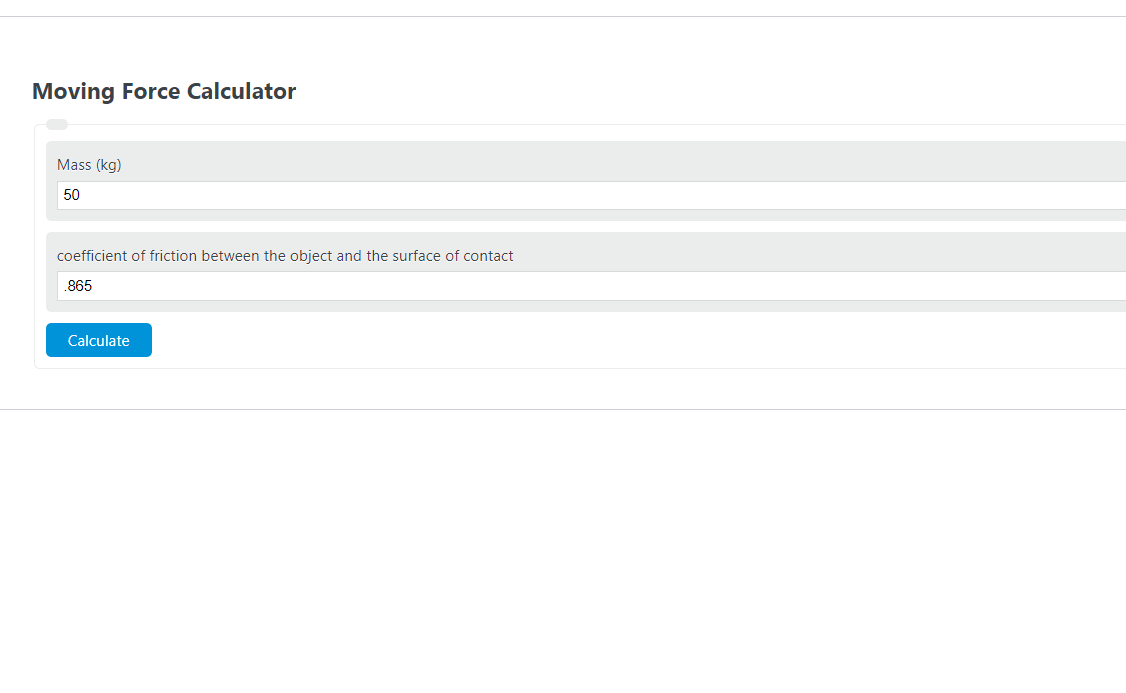
Calculate the force required to move a load on a level surface, up a ramp, or with acceleration, or solve for load mass or coefficient of friction.
- All Physics Calculators
- All Force Calculators
- Tractive Force Calculator
- Coefficient of Friction Calculator
- Extension Force Calculator
Moving Force Formula
The calculator uses one of three formulas depending on the scenario you select.
Level surface, steady speed:
Up a ramp, steady speed:
Level surface with acceleration:
- F = force needed to move the load (N or lbf)
- W = weight of the load (N or lbf), where W = m * g
- m = mass of the load (kg or lb)
- μ = coefficient of friction between the load and the surface
- θ = ramp angle from horizontal
- a = desired acceleration (m/s² or ft/s²)
- g = 9.80665 m/s²
Assumptions: the surface is rigid, the load slides rather than rolls, and the pushing force is applied parallel to the surface. The calculator uses a single coefficient of friction. Use the static value if you need to start the load from rest, and the kinetic value if it is already moving. Air drag and tipping are ignored.
Reference Values
Typical coefficients of friction for common material pairs:
| Material pair | Static μ | Kinetic μ |
|---|---|---|
| Wood on wood | 0.40 | 0.30 |
| Steel on steel (dry) | 0.74 | 0.57 |
| Steel on steel (lubricated) | 0.16 | 0.06 |
| Rubber on dry concrete | 1.00 | 0.70 |
| Rubber on wet concrete | 0.70 | 0.50 |
| Cardboard on carpet | 0.50 | 0.35 |
| PTFE on PTFE | 0.04 | 0.04 |
How to read the result, expressed as required force divided by the load’s weight:
| Force / weight ratio | What it feels like |
|---|---|
| Below 0.10 | Easy push, one person |
| 0.10 to 0.35 | Moderate push, sustained effort |
| 0.35 to 0.70 | Hard push, two people or short bursts |
| Above 0.70 | Use rollers, a dolly, or mechanical aid |
Worked Example
You want to push a 100 kg crate across a wood floor (μ = 0.30) and accelerate it at 1 m/s².
- Weight: W = 100 × 9.80665 = 980.7 N
- Friction: μW = 0.30 × 980.7 = 294.2 N
- Acceleration force: ma = 100 × 1 = 100 N
- Total: F = 100 + 294.2 = 394.2 N (about 89 lbf)
FAQ
Static or kinetic friction? Use static μ to find the force needed to start the load moving. Use kinetic μ once it is sliding. Static is always higher.
Why is the ramp force higher even at the same μ? On a ramp you fight gravity directly through the sin θ term in addition to friction. At 10° with μ = 0.30, the force is roughly 47% of the load weight versus 30% on a level floor.
Does this work for wheeled loads? Replace μ with the rolling resistance coefficient, typically 0.01 to 0.05 for pneumatic tires on hard ground. The formulas are the same.