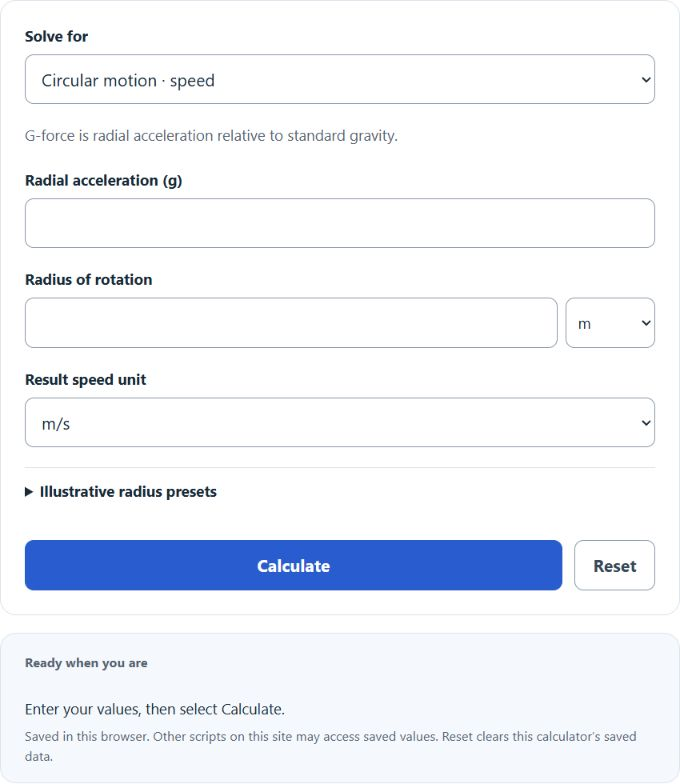
Calculate g-force, radius, or velocity from two known values, and convert centrifuge RPM and RCF or angular speed, period, and turn rate.
- All Velocity Calculators
- MPH to G Force Calculator
- All Physics Calculators
- G Force To Acceleration Calculator
G-Force To Velocity Formula
The following equation calculates tangential speed in circular motion from radial acceleration expressed in g and the turn radius.
- Where V is the velocity (m/s)
- GF is radial acceleration expressed as a multiple of standard gravity
- g is standard gravity, 9.80665 m/s²
- r is the radius of rotation (m)
To calculate the velocity from g-forces, multiply the g-forces, acceleration due to gravity, and radius together, then take the square root of the result.
| G-Forces (G) | Velocity (m/s) |
|---|---|
| 0.25 | 4.951 |
| 0.5 | 7.002 |
| 0.75 | 8.576 |
| 1 | 9.903 |
| 1.5 | 12.128 |
| 2 | 14.005 |
| 2.5 | 15.658 |
| 3 | 17.152 |
| 4 | 19.806 |
| 5 | 22.143 |
| 6 | 24.257 |
| 7 | 26.200 |
| 8 | 28.009 |
| 9 | 29.709 |
| 10 | 31.316 |
| 12 | 34.304 |
| 15 | 38.354 |
| 18 | 42.014 |
| 20 | 44.287 |
| 25 | 49.514 |
| Computed with v = √(G × g × r), using g = 9.80665 m/s² and r = 10 m. For other radii, velocity scales with √r. | |
How to Calculate Velocity from G-Force?
Example Problem:
The following example outlines the steps and information needed to calculate velocity from g-force.
First, determine the number of g-forces. In this example, the number of g-forces is found to be 6.
Next, determine the radius of rotation. For this problem, the radius of rotation is found to be 10 m.
Finally, calculate the velocity using the formula above:
V = SQRT( GF*g*r)
V = SQRT( 6*9.80665*10)
V = 24.26 m/s