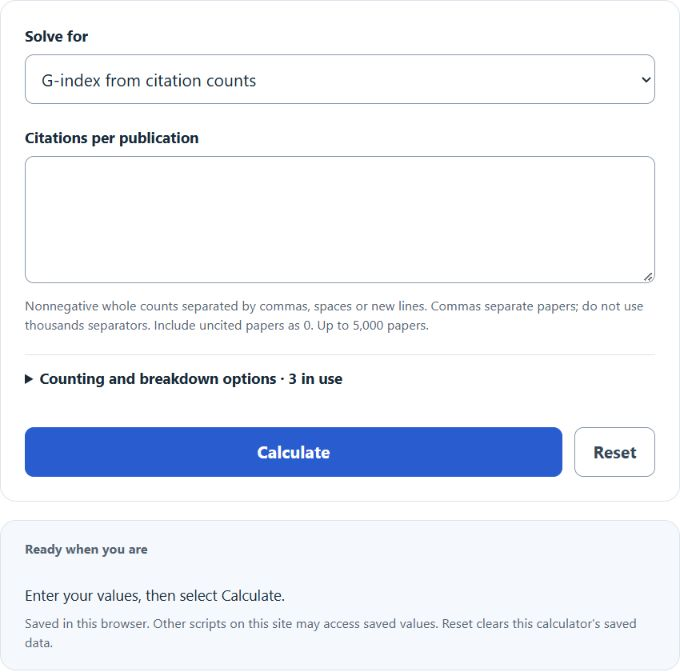
How do I use this calculator?
Paste the citation counts for each publication (one number per paper) into the citations field, then click Calculate to compute the g-index. The calculator will also report the number of papers and the h-index from the same citation list.
Calculator Operations:
- Enter the citation counts for each publication (comma/space/newline separated). You can paste them in any order; the calculator will sort them from highest to lowest automatically.
- Click Calculate to compute the g-index (and the h-index) from the citation list.
- Open Calculation details to see the metrics and selected paper-by-paper breakdown against k2. Counting and breakdown options lets you choose the convention, citation threshold, and table length.
- Click Reset to clear the calculator.
Use the calculate button when all known values have been entered and use the reset button when you want to clear the values from the calculator.
Calculate your g-index from a list of citation counts per paper, plus your h-index, i10-index and the extra citations needed to hit a target g.
Related Calculators
- M-Index Calculator
- Impact Factor Calculator
- Academic Index Calculator
- Content Validity Index Calculator
- All Statistics Calculators
G Index Formula
The g-index checks whether an author’s top-cited papers accumulate enough citations to support a larger score. After sorting from highest to lowest citation count, it is the largest rank whose cumulative citations are at least that rank squared. By default this calculator caps g at the real paper count. Its optional zero-padding convention adds conceptual uncited papers, so g can exceed the real paper count; those padded ranks do not require publishing additional real papers.
Variables
- g = g-index
- ci = citations received by the i-th most-cited paper
- k = candidate index value being tested
In practical terms, a result of 8 means the top 8 papers have at least 64 total citations. A result of 15 means the top 15 papers have at least 225 total citations.
What the G-Index Measures
The g-index is designed to reward both productivity and concentration of influence. Unlike metrics that only check whether each paper clears the same citation threshold, the g-index gives more credit to very highly cited papers. That makes it useful when an author has a few standout publications that substantially raise total impact.
- Higher g-index: stronger cumulative citation performance among the top papers
- Lower g-index: fewer papers, fewer citations, or both
- More sensitive than the h-index to exceptionally cited articles
How to Calculate the G-Index
- List the citation count for every publication.
- Sort the list from largest to smallest.
- Compute the running total of citations for the top 1, top 2, top 3 papers, and so on.
- For each position k, compare the cumulative citations to the square threshold for that position.
- The largest position that still meets the threshold is the g-index.
Once the cumulative citations fail to reach the next square threshold, the previous valid rank is the answer. The capped convention also stops at the real paper count. With zero padding, additional ranks contribute zero citations and may extend g up to the square root of the total citation count, rounded down.
Example
Suppose the citation counts are: 10, 8, 5, 4, 3, 1. They are already sorted from highest to lowest.
| Rank k | Citations for Paper k | Cumulative Citations | Square Threshold | Meets Threshold? |
|---|---|---|---|---|
| 1 | 10 | 10 | 1 | Yes |
| 2 | 8 | 18 | 4 | Yes |
| 3 | 5 | 23 | 9 | Yes |
| 4 | 4 | 27 | 16 | Yes |
| 5 | 3 | 30 | 25 | Yes |
| 6 | 1 | 31 | 36 | No |
The largest valid rank is 5, so the g-index is:
G-Index vs. H-Index
| Aspect | G-Index | H-Index |
|---|---|---|
| Core idea | Checks whether the top papers collectively accumulate enough citations. | Checks whether at least a certain number of papers each reach the same citation count. |
| Effect of highly cited papers | Stronger effect; standout papers can raise the score. | More limited effect after a paper has already cleared the threshold. |
| Best interpretation | Total impact among the most influential papers. | Balanced consistency across multiple papers. |
| Typical relationship | Usually equal to or higher than the h-index for the same citation set. | Usually equal to or lower than the g-index for the same citation set. |
Tips for Using the Calculator
- Enter one citation count per publication.
- Commas, spaces, and line breaks can all be used as separators.
- You do not need to sort the numbers first; the calculator handles sorting automatically.
- Include zero-citation papers if you want the full publication list represented.
- Use only raw citation counts, not cumulative totals.
- Remove negative values or non-numeric text before calculating.
How to Interpret the Result
A higher g-index means the author’s top publications generate a larger pool of citations. This can indicate that a small set of influential papers meaningfully boosts overall impact. Because the metric emphasizes citation concentration, it is especially informative when comparing researchers whose citation profiles are uneven or top-heavy.
Limitations to Keep in Mind
- The metric does not account for differences in citation practices across fields.
- Results depend on the completeness of the publication and citation data entered.
- Different databases may report different citation counts for the same paper.
- The g-index measures citation impact, not research quality by itself.
- Early-career researchers may have lower values simply because their work has had less time to accumulate citations.