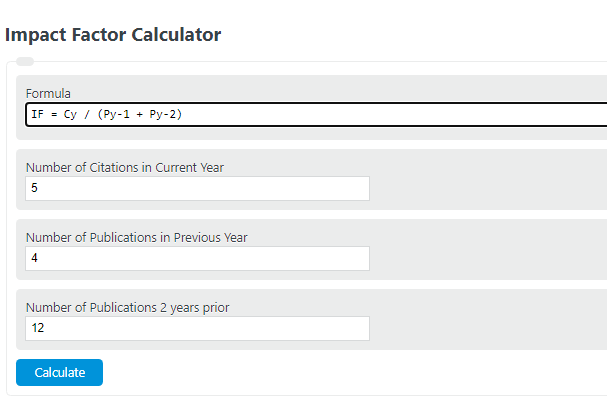
Calculate a journal impact factor from citations and citable items, or solve citation targets and publication totals for two-year and five-year JIF windows.
Related Calculators
- Event Rate Calculator
- Frequency Percentage Calculator
- Survey Percentage Calculator
- Average Rating Calculator (Star Rating)
- All Statistics Calculators
Impact Factor Formulas
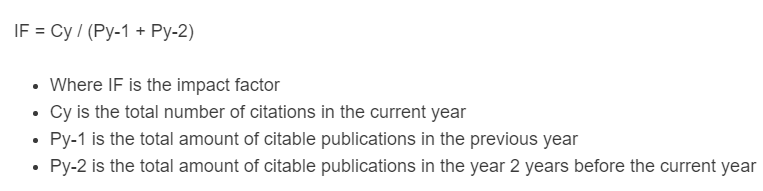
The standard 2-year Journal Impact Factor (JIF), as reported annually in the Journal Citation Reports (JCR), is calculated as follows:
- Where IF is the 2-year Journal Impact Factor
- Cy is the number of citations received in the current JCR year to citable items published in the previous two years (Y-1 and Y-2)
- Py-1 is the number of citable items (articles, reviews, and proceedings papers) published in the previous year (Y-1)
- Py-2 is the number of citable items published two years prior (Y-2)
The 5-year impact factor extends this window: it divides citations in the current year to all citable items from Y-1 through Y-5 by the total citable items published across those five years. CiteScore, published by Scopus, uses a 4-year window and includes all document types (not just articles and reviews) in both numerator and denominator.
What Is a Journal Impact Factor?
A journal impact factor is a citation-based metric reflecting the average number of citations received per citable item published by a journal during a defined window. It was conceived by Eugene Garfield and Irving Sher in the early 1960s as a tool for librarians to evaluate journal subscriptions, not as a measure of individual article or researcher quality. Clarivate Analytics (formerly Thomson Reuters) publishes impact factors annually through the Journal Citation Reports, which as of 2024 covers over 21,900 journals across 254 subject categories.
Only certain document types count as "citable items" in the denominator: original research articles, review articles, and proceedings papers. However, the numerator (citations) can come from any document type published in JCR-indexed journals, including editorials, letters, and corrections. This asymmetry between numerator and denominator is one of the most widely discussed structural features of the metric.
Impact Factor Benchmarks by Field
Impact factors are not comparable across disciplines. A journal with an IF of 3.0 may rank in the top 10% of its category in mathematics but fall below the median in cell biology. This is because citation density, co-authorship norms, publication volume, and reference list lengths vary enormously by field.
General benchmarks: in most scientific fields, an IF above 10 is considered excellent, 3 to 10 is strong, 1 to 3 is respectable, and below 1 is common for niche or newer journals. Fewer than 144 journals (under 1% of those tracked in JCR) have an IF above 20. Only about 2.3% exceed an IF of 10. The highest impact factors belong to broad-scope clinical and review journals. CA: A Cancer Journal for Clinicians has historically held the highest IF of any journal, exceeding 200 in some years. The New England Journal of Medicine, Nature, Science, The Lancet, and Cell consistently rank among the top 10 worldwide.
In fields like pure mathematics and many humanities disciplines, impact factors rarely exceed 3, and an IF of 1.5 can represent a top-tier journal. Engineering and computer science journals typically fall between 1 and 8. Biomedical and life sciences show the broadest range, with specialty clinical journals sometimes exceeding 50.
Journal Impact Factor vs. Other Citation Metrics
The impact factor is one of several journal-level metrics, each with distinct methodologies and data sources. Understanding their differences is essential for proper journal evaluation.
CiteScore is published by Elsevier using data from the Scopus database. It divides citations in the CiteScore year to documents from the preceding four years by all documents published in those four years. Unlike JIF, CiteScore includes all document types (conference papers, book chapters, data papers, editorials) in both the numerator and denominator, making its calculation more transparent. CiteScore values tend to run slightly lower than JIF for the same journal because the denominator includes more items.
SJR (SCImago Journal Rank) operates similarly to Google's PageRank algorithm. It assigns different weights to citations based on the prestige of the citing journal. A citation from Nature carries more weight than one from a low-ranked journal. SJR also normalizes for field differences, making it more suitable for cross-discipline comparison than raw JIF. It uses a 3-year citation window and is freely available through the SCImago portal.
SNIP (Source Normalized Impact per Paper) explicitly corrects for citation potential. In fields where articles tend to include long reference lists (like biomedicine), each individual citation is worth less in the SNIP calculation. In fields with shorter reference lists (like mathematics), each citation counts for more. This makes SNIP the most directly cross-field-comparable metric among the four.
Journal Citation Indicator (JCI) was introduced by Clarivate in 2021 as a field-normalized metric. It normalizes each article's citation count against the average for its subject category and publication year, then averages across the journal. A JCI of 1.0 means the journal performs at the field average; above 1.0 means above average.
Limitations and Criticisms
The impact factor has faced sustained criticism from researchers, funders, and institutions since at least the early 2000s. The core objections center on statistical validity, field bias, and susceptibility to manipulation.
Citation distributions within journals are highly skewed. In a typical journal, roughly 15% to 20% of articles account for about 50% of all citations. The mean (impact factor) therefore misrepresents the citation count of any individual paper. A journal with an IF of 5 may contain articles cited 200 times alongside articles cited zero times.
The 2-year window is too short for fields where citations accumulate slowly. In mathematics, many foundational papers receive the bulk of their citations 5 to 10 years after publication, making the 2-year JIF a poor reflection of their influence. The 5-year IF partially addresses this but remains uncommon in evaluations.
Self-citation manipulation has been documented extensively. Some journals have had their impact factors suppressed by Clarivate after investigations revealed that over 90% of the citations contributing to their IF came from their own publications. Common gaming tactics include coercive citation (requiring authors to add references to the journal during peer review), strategic publication of review articles (which receive more citations than original research), and editorial timing to shift publications between JCR years.
DORA and the Reform Movement
The San Francisco Declaration on Research Assessment (DORA), established in 2012 at the annual meeting of the American Society for Cell Biology, directly recommends against using journal impact factors as proxy measures for individual article quality or for making hiring, promotion, or funding decisions. As of 2024, more than 22,300 individuals and organizations across 159 countries have signed DORA, including major funders like the Wellcome Trust, the European Research Council, and the Canadian Institutes of Health Research.
Several universities have formally restructured their tenure criteria in response. Ghent University (Belgium) adopted new evaluation standards in 2020 prioritizing open science practices over journal-level metrics. The University of Glasgow and the University of Zurich followed in 2021. Despite these institutional shifts, research indicates that journal rank still correlates strongly with perceived quality in practice, and no single alternative metric has replaced the impact factor in day-to-day academic decision-making.
Where to Find Official Impact Factors
The Journal Citation Reports (JCR) from Clarivate Analytics is the only official source for Journal Impact Factors. Access requires a subscription, typically provided through university libraries. JCR releases updated impact factors once per year, usually in late June. For CiteScore, SJR, and SNIP, the Scopus Sources tool (free to query) provides current and historical values. The SCImago Journal and Country Rank portal offers free SJR lookups. Google Scholar Metrics provides h5-index values for journals but does not calculate impact factors.
FAQ
What is a good impact factor for a journal? There is no universal threshold. Impact factors vary dramatically by discipline, so they are only meaningful when compared within the same JCR subject category and year. In biomedicine, an IF of 5 may be average for a specialty journal, while in pure mathematics, an IF of 2 can represent a top-tier publication. Fewer than 1% of all journals tracked in JCR exceed an IF of 20.
What are the highest impact factor journals? Journals that consistently hold the highest impact factors include CA: A Cancer Journal for Clinicians (IF historically above 200), The New England Journal of Medicine (IF around 90), Nature Reviews Molecular Cell Biology (IF around 94), Nature Reviews Drug Discovery, The Lancet, Chemical Reviews, Science, Cell, and Nature. These rankings shift annually with each JCR release.
Why does the impact factor matter? The impact factor serves as one indicator of how frequently a journal's recent articles are cited on average. It is used by librarians for subscription decisions, by publishers for marketing, and by researchers for choosing where to submit. However, DORA and many research institutions now recommend using it alongside article-level metrics, peer review assessments, and broader impact indicators rather than as a standalone quality measure.
What is the difference between impact factor and CiteScore? The Journal Impact Factor uses a 2-year citation window and is calculated from Web of Science data by Clarivate. It counts only articles, reviews, and proceedings papers as citable items. CiteScore uses a 4-year window from Scopus data and includes all document types in both numerator and denominator. CiteScore values are typically slightly lower than JIF for the same journal due to the larger denominator.
How long before a new journal gets an impact factor? A journal must be indexed in the Web of Science Core Collection for at least two full calendar years before it can receive its first 2-year JIF. In practice, this means a new journal typically waits 3 years from its launch date (one year to get indexed, plus the two-year citation accumulation window) before appearing in JCR.
Can impact factors be manipulated? Yes. Documented manipulation tactics include coercive citation (journals requiring authors to cite their own recent papers), excessive self-citation orchestrated through editorial policy, strategic timing of article publication to shift items between JCR calculation years, and disproportionate publication of review articles that attract more citations. Clarivate monitors for anomalous self-citation patterns and has suppressed impact factors for journals caught engaging in these practices.