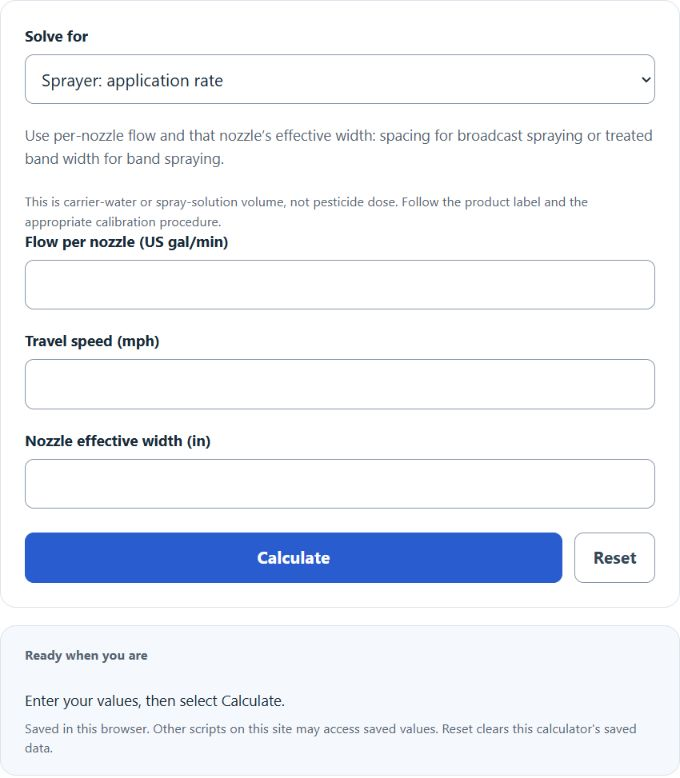
Calculate carrier-water or spray-solution volume from rate and treated area, find rate from volume and area, or solve sprayer rate, per-nozzle flow, travel speed or effective width. All gallons are US liquid gallons. This volume rate is not pesticide dose; follow the product label.
Gallons Per Acre Formula
For a known total volume and treated area, use GPA = V / A. Sprayer calibration instead uses GPA = 5,940 × GPM / (mph × W), where GPM is US gallons per minute per nozzle and W is that nozzle’s effective width in inches. For uniform broadcast spraying, W is nozzle spacing; for a single band, use its treated width. Do not combine total boom flow with one nozzle’s spacing. UGA Extension calibration equation.
Variables:
- GPA is US liquid gallons per treated acre
- V is the total carrier-water or spray-solution volume (US liquid gallons)
- A is the treated area (international acres)
To calculate gallons per acre, divide the total volume of liquid by the area in acres.
What is Gallons Per Acre?
Gallons per acre (GPA) describes liquid volume applied per acre. It supports water and spray-solution planning, but it does not by itself specify pesticide concentration, product dose, required coverage or an approved application rate. Follow the product label and calibrate the actual equipment for the liquid and operating conditions.
How to Calculate Gallons Per Acre?
The following steps outline how to calculate the Gallons Per Acre.
- First, determine the total applied volume (V) in US liquid gallons.
- Next, determine the area (A) in acres.
- Next, gather the formula from above = GPA = V / A.
- Finally, calculate the Gallons Per Acre (GPA).
- After inserting the variables and calculating the result, check your answer with the calculator above.
Example Problem :
Use the following variables as an example problem to test your knowledge.
total applied volume (V) = 500 US liquid gallons
treated area (A) = 2 acres. Therefore, GPA = 500 / 2 = 250 US gal/ac. This arithmetic example does not recommend an application rate.