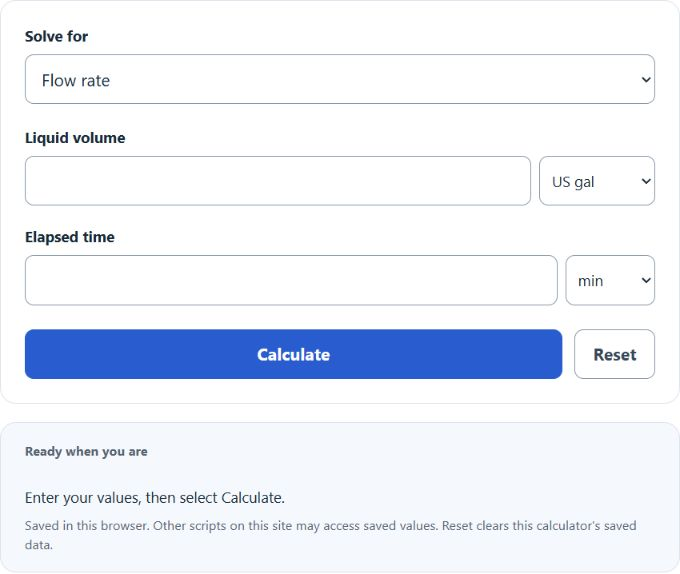
Calculate gallons per hour, liquid volume, or elapsed time and convert flow rates between GPH, GPM, GPD, liters per hour, and cubic meters per hour.
- All Unit Converters
- Gallons Per Minute Calculator
- Volumetric Flow Rate Calculator
- Water Flow Rate Calculator
- CFS to GPM Calculator
- Gallons Per Minute to Cubic Feet Per Second Calculator
- Hose Flow Rate Calculator
Gallons Per Hour Formula
Variables:
- GPH is the Gallons Per Hour (gallons per hour)
- GPM is the gallons per minute
To calculate Gallons Per Hour, multiply the gallons per minute by 60.
How to Calculate Gallons Per Hour?
The following steps outline how to calculate the Gallons Per Hour.
- First, select Convert a flow rate and enter the gallons per minute, choosing US gal/min as the unit.
- Next, gather the formula from above = GPH = GPM * 60.
- Finally, calculate the Gallons Per Hour.
- After inserting the variables and calculating the result, check your answer with the calculator above.
Example Problem :
Use the following variables as an example problem to test your knowledge.
gallons per minute = 304; gallons per hour = 304 × 60 = 18,240.
FAQs
What is the significance of converting Gallons per Minute (GPM) to Gallons per Hour (GPH)?
Converting GPM to GPH is crucial in various applications such as irrigation, plumbing, and water supply management, where it’s important to understand the volume of water flow over longer periods than just a minute. This helps in planning, resource allocation, and efficiency optimization.
Can the formula for converting GPM to GPH be used for any liquid, not just water?
Yes, the formula GPH = GPM * 60 is universal for converting the flow rate of any liquid from gallons per minute to gallons per hour, as it simply scales the time frame from minutes to hours and does not depend on the fluid’s properties.
How accurate is the GPM to GPH conversion?
The accuracy of the conversion from GPM to GPH depends on the precision of the initial GPM measurement. The formula itself is mathematically accurate, but measurement errors or fluctuations in flow rate can affect the final calculation.
Are there any tools or devices required to measure GPM accurately before conversion?
Yes, measuring GPM accurately requires the use of flow meters or similar devices that can measure the volume of liquid passing through a point in a minute. These devices vary in complexity from simple mechanical meters to advanced digital sensors.