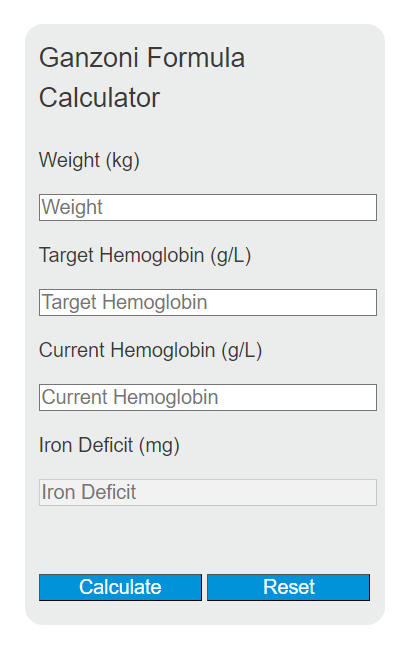
Calculate total iron deficit with the Ganzoni formula from body weight, current and target hemoglobin, and depot iron stores, plus IV iron dose split and infusion volume.
Related Calculators
- mg/kg/day Calculator
- Drip Rate Calculator
- Gfr To Creatinine Clearance Calculator
- MAP Calculator (Mean Arterial Blood Pressure)
- All Health and Medical Calculators
Ganzoni Formula
The Ganzoni formula estimates a patient’s total elemental iron deficit. It is commonly used when planning iron replacement for iron deficiency anemia because it combines the hemoglobin gap, body weight, and an additional amount for iron stores. This calculator is most useful when you want a fast estimate of how much elemental iron may be needed to raise hemoglobin toward a chosen target.
If hemoglobin is entered in g/dL, use:
If hemoglobin is entered in g/L, use:
The result is an estimate of elemental iron, not necessarily the total mass of the iron product being administered.
Variable Guide
| Variable | Meaning | Practical Notes |
|---|---|---|
| Hbtarget | The hemoglobin level you want to reach | Use the goal appropriate for the patient and protocol. |
| Hbcurrent | The patient’s present hemoglobin level | Make sure the unit matches the formula: g/dL or g/L. |
| Weight | Body weight in kilograms | If weight is entered in pounds, convert to kilograms before applying the formula. |
| Stores | Additional iron added to replenish body stores | This calculator supports an adult default, a weight-based option, or a custom value. |
| 2.4 or 0.24 | Conversion factor used by the Ganzoni method | Use 2.4 with g/dL and 0.24 with g/L. |
How to Use the Calculator
- Enter the patient’s weight.
- Select the correct weight unit if the calculator offers kg or lb.
- Enter the target hemoglobin.
- Enter the current hemoglobin.
- Choose the hemoglobin unit carefully: g/dL or g/L.
- Select the iron stores addition method:
- adult default value,
- weight-based value, or
- custom stores amount.
- Calculate the result to obtain the estimated iron deficit in mg.
Example
Suppose a patient weighs 70 kg, has a target hemoglobin of 130 g/L, a current hemoglobin of 100 g/L, and a stores addition of 500 mg.
In this case, the estimated total elemental iron deficit is 1004 mg.
How to Interpret the Result
- A higher deficit usually means a larger hemoglobin gap, greater body weight, larger stores addition, or a combination of all three.
- A result near zero means the current hemoglobin is already close to the target, although a stores component may still contribute to the total.
- The calculation is an estimate; actual treatment plans may differ based on product limits, dosing schedules, tolerance, ongoing blood loss, and clinical judgment.
- The output refers to elemental iron, which is important when comparing different oral or intravenous iron products.
Common Input Mistakes
- Mixing hemoglobin units by entering g/L values while thinking in g/dL, or the reverse.
- Using pounds as kilograms, which can significantly overestimate the deficit.
- Choosing an unrealistic target hemoglobin for the clinical scenario.
- Forgetting the stores addition, which can make the estimate look artificially low.
- Assuming the result equals a single dose; the total deficit may need to be split depending on the iron formulation used.
Why Results Can Vary
Two users can enter similar patient data and still get different results if they choose different units, different stores additions, or different hemoglobin targets. Small rounding differences can also occur. For that reason, the most important part of using the calculator correctly is keeping units consistent and confirming that the stores value matches the intended protocol.
Quick Reference
- Use 2.4 when hemoglobin is in g/dL.
- Use 0.24 when hemoglobin is in g/L.
- Weight should be in kg for the formula itself.
- The output is mg of elemental iron.
- The stores amount is added after calculating the hemoglobin correction component.
Frequently Asked Questions
Is this calculator for elemental iron or total product weight?
The result represents elemental iron. Different iron products contain different amounts of elemental iron per dose.
Can I use pounds directly in the formula?
No. The formula is based on kilograms. If the calculator accepts pounds, it should convert them before calculating.
Why is there a stores addition?
Correcting hemoglobin alone may not fully replenish iron reserves, so an added stores value is often included in the estimate.
Does this replace medical judgment?
No. It is a planning tool that helps estimate iron deficit, but final dosing decisions should reflect the full clinical picture.