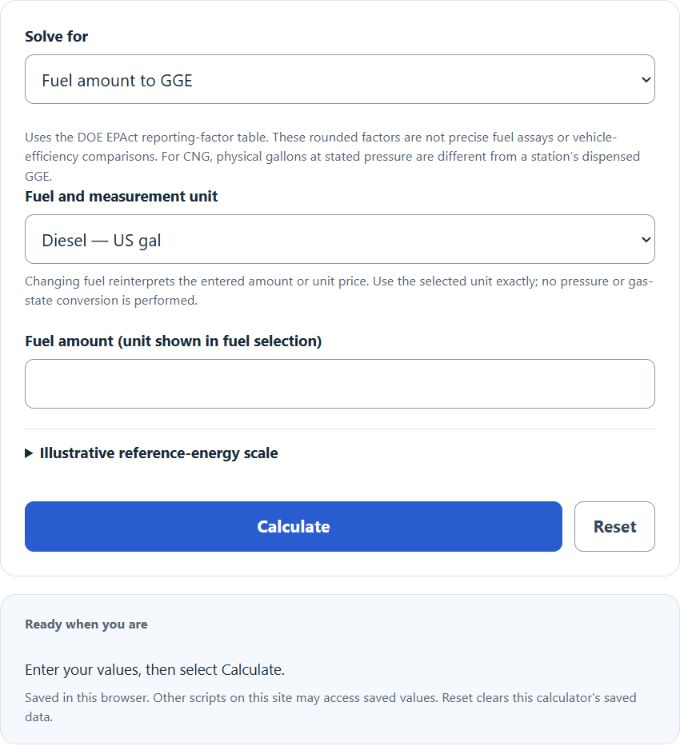
Calculate the gasoline gallon equivalent (GGE) of CNG, propane, diesel, hydrogen, and electricity, convert GGE back to fuel units, and compare cost per GGE.
Gasoline Gallon Equivalent Formula
To convert an amount of an alternative fuel into its gasoline gallon equivalent, multiply the fuel amount by that fuel’s conversion factor:
GGE = A * CF
To find how much of a fuel you need to match a number of gasoline gallons, divide instead:
A = G / CF
To compare price on the selected reporting basis, divide the fuel’s price per unit by the same conversion factor to get cost per GGE. This does not compare vehicle efficiency or cost per mile:
Cost per GGE = P / CF
Variables:
- GGE is the gasoline gallon equivalent, the number of gallons of gasoline that hold the same energy
- A is the amount of the alternative fuel, measured in its own unit (gallons, ccf, kWh, or kg)
- CF is the conversion factor for that fuel, in GGE per-unit, taken from the table below
- G is the number of gasoline gallons you want to match
- P is the price of the alternative fuel per-unit
The calculator converts fuel amounts to reporting GGE, reverses that conversion, or compares prices in USD per reporting GGE. Its optional BTU output multiplies GGE by an illustrative reference scale, defaulting to 114,000 BTU/GGE; it is not a measurement of the selected fuel’s actual heating value. The rounded electricity factor of 0.03 implies 33.3333 kWh per reporting GGE. Do not combine this reporting factor with a different gasoline heating-value convention as if they were exact identities.
Fuel Conversion Factors and Cost per GGE
These rounded factors match the DOE State and Alternative Fuel Provider Fleet EPAct reporting table. The last column is the rounded reciprocal. All gallons are US gallons. The CNG gallon entries are physical volumes at the stated pressure, not an amount already dispensed in GGE; LNG is specified at 14.7 psi and −234 °F. Use the factor and measurement basis required for your reporting purpose. Actual fuel properties and other equivalence conventions can differ.
| Fuel | Unit | GGE per-unit (CF) | Units per GGE |
|---|---|---|---|
| Diesel | gallon | 1.14 | 0.88 |
| Biodiesel (B100) | gallon | 1.05 | 0.95 |
| E85 | gallon | 0.78 | 1.28 |
| Propane (LPG) | gallon | 0.74 | 1.35 |
| LNG at 14.7 psi, −234 °F | US gallon | 0.66 | 1.52 |
| CNG at 2,400 psi | gallon | 0.18 | 5.56 |
| CNG at 3,000 psi | gallon | 0.22 | 4.55 |
| CNG at 3,600 psi | gallon | 0.26 | 3.85 |
| CNG | hundred cubic feet (ccf) | 0.81 | 1.23 |
| Electricity | kWh | 0.03 | 33.33 |
| Hydrogen (gas) | kg | 1.00 | 1.00 |
| Hydrogen (liquid) | gallon | 0.27 | 3.70 |
The factor only tells you about energy, not price. This next table shows how the same factors turn a per-unit price into a cost per gallon of gasoline energy, using one set of sample prices. Plug your local prices into the cost mode to update these numbers.
| Fuel | Sample price | Cost per GGE |
|---|---|---|
| Gasoline | $3.39 / gallon | $3.39 |
| Diesel | $3.79 / gallon | $3.32 |
| E85 | $2.69 / gallon | $3.45 |
| Propane (LPG) | $2.79 / gallon | $3.77 |
| CNG | $1.10 / ccf | $1.36 |
| Electricity | $0.15 / kWh | $5.00 |
| Hydrogen (gas) | $14.00 / kg | $14.00 |
At these sample prices, propane costs more per reporting GGE than gasoline despite its lower price per gallon. Electricity at $0.15/kWh gives $5.00 per reporting GGE under the 0.03 factor, and CNG is cheapest in this sample. These are illustrative energy-price comparisons, not current market prices or rankings of driving cost; vehicle efficiency and other charges are separate.
Example Problems
Example 1: Convert a fuel amount to GGE.
You fill up with 8 gallons of propane and want the gasoline equivalent. Multiply the amount by the propane factor of 0.74:
GGE = 8 * 0.74 = 5.92 GGE, so that propane holds about the same energy as 5.92 gallons of gasoline.
Example 2: Compare cost per GGE.
Propane costs $2.79 per gallon and gasoline costs $3.39 per gallon. Divide the propane price by its factor:
Cost per GGE = 2.79 / 0.74 = $3.77. That is higher than the $3.39 gasoline price, so at these prices gasoline is the cheaper source of energy even though propane’s price per gallon looks lower.
Frequently Asked Questions
What is a gasoline gallon equivalent?
A gasoline gallon equivalent expresses another fuel on a gasoline energy-equivalence scale. A numerical equivalence depends on its stated fuel properties and reporting convention. This calculator uses the rounded EPAct table above. Its separate BTU reference scale does not replace that table or determine the fuel’s actual heating value; see DOE’s fuel-property notes for composition and heating-value qualifications.
Is GGE the same as a diesel gallon equivalent?
No. A diesel gallon equivalent (DGE) uses diesel rather than gasoline as its reference. Under this EPAct table, one gallon of diesel is 1.14 GGE. Dividing a USD/DGE price by 1.14 is appropriate only if that price uses the same equivalence basis; check a station’s stated reporting convention before converting.
Does a lower cost per GGE always mean lower fuel bills?
Not by itself. Cost per GGE compares the energy you buy, but not how efficiently your vehicle turns that energy into miles. An electric motor converts stored energy to motion far more efficiently than a gasoline engine, so a fuel can cost more per GGE and still cost less per mile. Use cost per GGE to compare the fuels, then adjust for your vehicle’s efficiency to compare the actual driving cost.